
What Is Adiponectin? The Fat-Derived Hormone Explained
Articles · Hormones & metabolism
Adiponectin is a protein hormone released by fat tissue that acts on AdipoR1 and AdipoR2 receptors to influence how cells use glucose and fat. This article explains its structure, signalling and evidence, including why higher levels are not always better, for research and educational purposes only.
What is adiponectin?
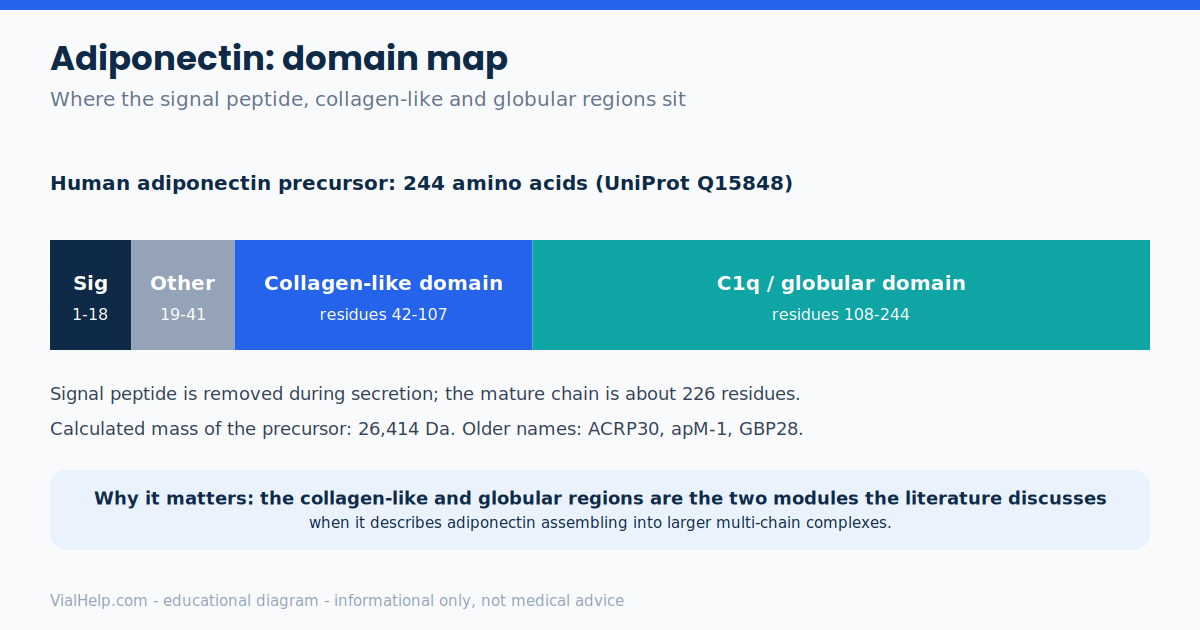
Adiponectin is a protein hormone made mainly by fat (adipose) tissue and released into the bloodstream. It belongs to the group of fat-derived signals called adipokines, alongside leptin. In the UniProt reference entry for the human protein (Q15848), the precursor is 244 amino acids long, with a signal peptide at residues 1–18 that is removed during secretion, a collagen-like domain at residues 42–107, and a C1q-type globular domain at residues 108–244. Its calculated mass is about 26.4 kDa.
The protein has collected several names over the years. UniProt lists ACRP30 (the “30 kDa adipocyte complement-related protein”), apM-1 and GBP28 as synonyms, and the gene is written ADIPOQ. The literature also describes adiponectin assembling into larger multi-chain complexes built from its collagen-like region, which is one reason measured levels depend on the assay used.
How adiponectin is studied to work
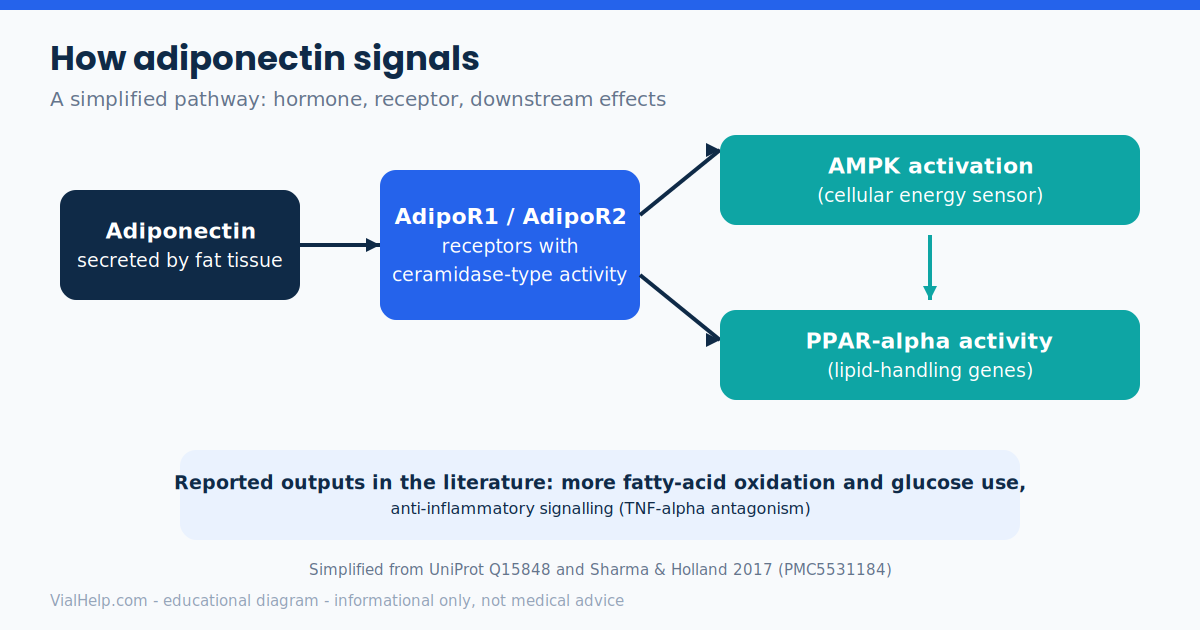
Adiponectin acts through two membrane receptors, AdipoR1 and AdipoR2. Reviews describe these as unusual receptors: they are not classic G-protein-coupled receptors and they carry intrinsic hydrolase (ceramidase-type) activity. In a 2017 review, Sharma and Holland note that AdipoR2 can bind and break down C18:0 ceramide into a free fatty acid and sphingosine, a zinc-dependent step inside the receptor’s transmembrane region. (For how ordinary receptors differ, see what is a GPCR.)
Downstream, adiponectin signalling is reported to raise the activity of AMPK, a cellular energy sensor, and of PPAR-alpha, a regulator of lipid-handling genes. UniProt summarises the outcome in liver and muscle as enhanced glucose use and fatty-acid oxidation, plus anti-inflammatory effects such as antagonism of TNF-alpha and reduced endothelial NF-kappa-B signalling.
Reported effects in the research literature
Most of the evidence links adiponectin to insulin sensitivity. A 2006 Journal of Clinical Investigation review by Kadowaki and colleagues describes adiponectin as specifically and abundantly expressed in adipose tissue, notes that reduced adiponectin (driven by genetic and obesity-related factors) contributes to insulin resistance and type 2 diabetes, and reports that AdipoR1 and AdipoR2 are downregulated in obesity-related insulin resistance. The same review argues that upregulation of adiponectin is a partial cause of the insulin-sensitising action of thiazolidinedione drugs, an established class in diabetes care.
What the human evidence shows
Human studies mostly measure circulating adiponectin and relate it to outcomes. Results are more complicated than the mechanistic story suggests. Reviews of the so-called adiponectin paradox discuss cohorts in which higher circulating adiponectin tracks with higher mortality or cardiovascular risk, especially in older people and in some chronic diseases, even though low levels are associated with insulin resistance. Proposed explanations include comorbidity burden and differences between measured forms of the protein, and the question is still debated. The practical lesson is that a single blood number does not tell you which direction a person is heading.
As of the sources reviewed for this article, no adiponectin-based drug is established in clinical use. The best-known experimental tool is AdipoRon, an orally active small-molecule AdipoR agonist described by Okada-Iwabu and colleagues in Nature (2013). In mice on a high-fat diet and in db/db mice it improved insulin resistance and glucose intolerance, and its effects disappeared in mice lacking both receptors. That is preclinical, animal-only work.
Handling and measurement considerations (research context)
Adiponectin is normally measured by immunoassay, and different kits can report different values because the protein circulates in more than one form. Laboratories working with recombinant protein or peptide fragments should follow the supplier’s handling and storage sheet. For general lab arithmetic on concentrations, see the concentration converter and the reconstitution calculator, and for aseptic basics see sterile technique.
Cautions and considerations
Adiponectin is a research topic, not a supplement or treatment target for individuals. Nothing here is a recommendation to measure, raise or lower any hormone. Anyone with concerns about weight, glucose or cardiovascular risk should talk to a qualified clinician.
Frequently asked questions
What does adiponectin do?
In the research literature it is linked to insulin sensitivity, fatty-acid oxidation and anti-inflammatory signalling through AdipoR1 and AdipoR2, AMPK and PPAR-alpha activity.
Why is it called ACRP30 or GBP28?
These are older names recorded in UniProt: ACRP30 for the 30 kDa adipocyte complement-related protein and GBP28 for gelatin-binding protein.
What is the adiponectin paradox?
It is the finding in some cohorts that higher circulating adiponectin accompanies worse outcomes, despite low levels being tied to insulin resistance. Explanations are still debated.
Is there an approved adiponectin drug?
Not in the sources reviewed here. AdipoRon is an experimental agonist studied in mice.
References
- Okada-Iwabu M, Yamauchi T, Iwabu M, et al. A small-molecule AdipoR agonist for type 2 diabetes and short life in obesity. Nature, 2013
- Sharma AX, Holland WL. Adiponectin and its Hydrolase-Activated Receptors. J Nat Sci, 2017
- Kadowaki T, et al. Adiponectin and adiponectin receptors in insulin resistance, diabetes, and the metabolic syndrome. J Clin Invest 116(7):1784-92, 2006
- UniProt Q15848 (ADIPOQ_HUMAN), adiponectin
- Adiponectin, Cardiovascular Disease, and Mortality: Parsing the Dual Prognostic Implications of a Complex Adipokine
- The Adiponectin Paradox for All-Cause and Cardiovascular Mortality
Informational only. This guide is for educational and laboratory/measurement purposes and is not medical advice. It does not recommend or instruct personal human use. Consult a qualified healthcare professional for any health decision. Content is intended for adults 21+. Verify scientific details against the primary sources cited.