What Is Insulin? The Body’s Blueprint Peptide Hormone
Hormone biology
Insulin is the 51-amino-acid peptide hormone that lowers blood sugar after you eat — and the molecule that rewrote what a medicine could be. It was the first protein ever fully sequenced and the first drug ever made by recombinant DNA. This guide explains what insulin is, how the body builds it, what it does, and why the same hormone has been re-engineered into a whole family of modern drugs.
What insulin is
Insulin is a small peptide hormone built from 51 amino acids arranged in two chains: an A-chain of 21 residues and a B-chain of 30 residues. The two chains are stitched together by three disulfide bonds — two bridging the chains and one looping within the A-chain — which lock the hormone into its active shape. The finished molecule weighs about 5,808 daltons. Inside the pancreas it is stored not as loose molecules but as orderly zinc-coordinated hexamers, six insulin units clustered around zinc ions, ready for release.

How the body makes it: proinsulin and C-peptide
Insulin starts life as a single long chain called preproinsulin, made in the beta cells of the pancreatic islets of Langerhans. A signal sequence is trimmed to give proinsulin — one continuous chain folded and locked by its disulfide bonds. Enzymes (the prohormone convertases PC1/3 and PC2, plus carboxypeptidase E) then snip out a connecting segment, the C-peptide, leaving mature insulin behind. Because insulin and C-peptide are released in equal amounts, measuring C-peptide is a useful way to gauge how much insulin a person’s own body is producing.
What insulin does in the body
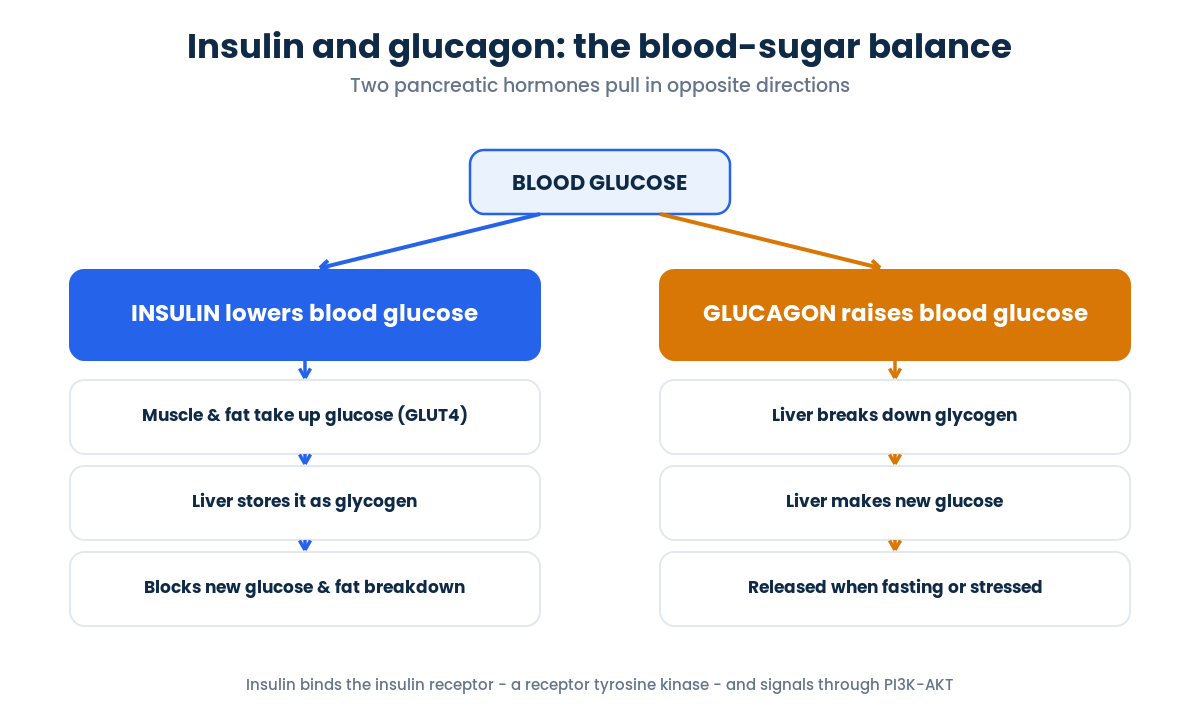
Insulin is the body’s main “storage” signal. When blood glucose rises after a meal, beta cells release insulin, which tells tissues to take sugar out of the blood and put it away:
- Muscle and fat cells pull glucose in through the GLUT4 transporter.
- The liver stores glucose as glycogen and stops manufacturing new glucose.
- Fat breakdown is switched off, and the body shifts into an anabolic, building mode.
Its mirror image is glucagon, released during fasting to push glucose back up. The two hormones work as a push-pull system that keeps blood sugar within a narrow range.
The insulin receptor: a receptor tyrosine kinase
Insulin works by binding the insulin receptor (INSR), which belongs to the receptor tyrosine kinase family. Unlike most receptors in that family, the insulin receptor is already assembled as a disulfide-linked four-part complex (two alpha and two beta subunits) even before insulin arrives. Insulin binding switches on the receptor’s built-in kinase, which fires off two branches of signaling — the PI3K–AKT branch that drives glucose uptake, and the RAS–MAPK branch tied to growth. Its closest relative is the IGF-1 receptor, which is why insulin and IGF-1 signaling overlap and why the two sit together in the wider GH and IGF-1 axis.
A landmark in medicine: from 1922 to recombinant insulin
Insulin was isolated at the University of Toronto in 1921–22 by Frederick Banting and Charles Best in J.J.R. Macleod’s lab, with James Collip purifying the extract; the discovery earned the 1923 Nobel Prize in Physiology or Medicine. Insulin then made history twice more: Frederick Sanger determined its full amino-acid sequence — the first protein ever sequenced — winning the 1958 Nobel Prize in Chemistry, and in 1982 recombinant human insulin (Humulin) became the first genetically engineered drug approved for people. Few molecules sit at so many turning points in modern biology.
Engineered insulins: same hormone, tuned timing
Once the sequence was known, chemists began editing it to change how fast the drug is absorbed rather than what it does. Rapid-acting analogs (such as lispro, aspart and glulisine) carry small substitutions that weaken insulin’s tendency to clump into hexamers, so it breaks apart and absorbs quickly for mealtime coverage. Long-acting analogs stretch the effect a different way: glargine shifts its charge so it micro-precipitates under the skin and dissolves slowly, while detemir and degludec add a fatty-acid tail that grips onto albumin in the blood, forming a slow-release depot.
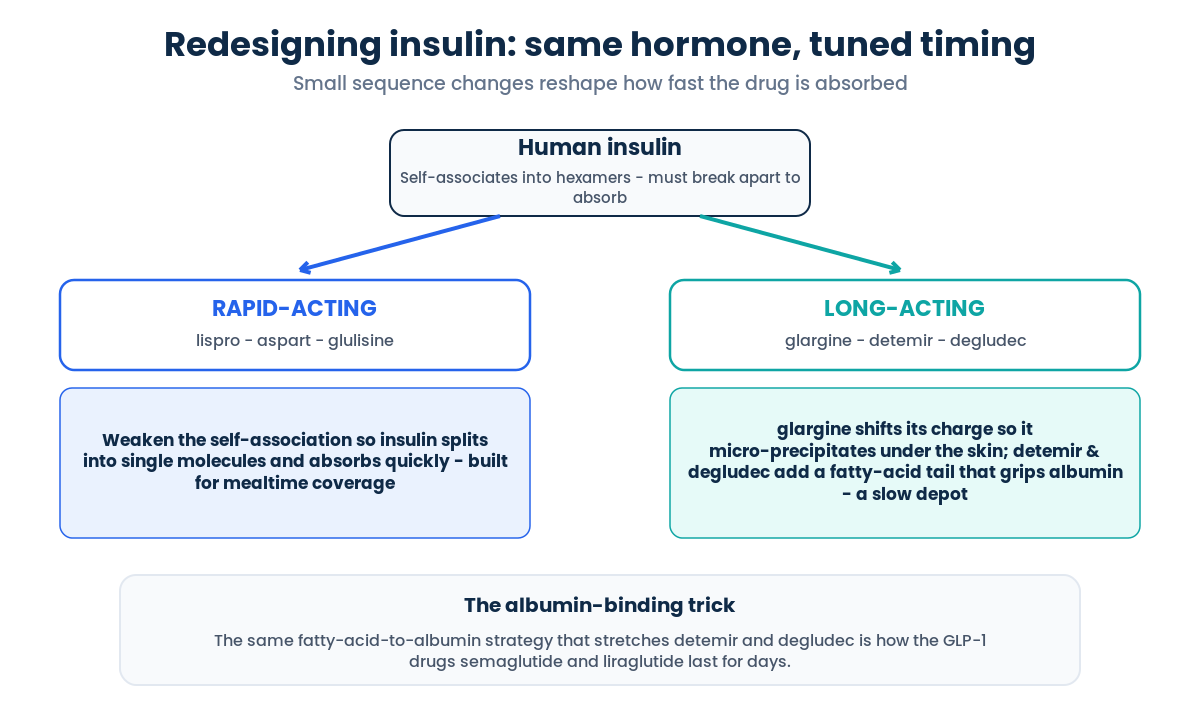
That last trick — hanging a fatty acid on the molecule so it binds albumin and lasts longer — is exactly the strategy used by the modern GLP-1 drugs such as semaglutide and liraglutide. Insulin engineering wrote the playbook that today’s peptide medicines still follow.
Frequently asked questions
Is insulin a peptide or a protein?
It sits right on the border. At 51 amino acids insulin is often called a small protein, but it is also frequently described as a peptide hormone. The line between “peptide” and “protein” is a convention of size, not a hard rule — see our explainer on peptides versus small-molecule drugs.
What is C-peptide and why does it matter?
C-peptide is the connecting piece cut out when proinsulin becomes insulin. Because it is released one-for-one with insulin, it serves as a marker of how much insulin the body itself is making.
How is insulin related to IGF-1?
They are structural cousins. Insulin and IGF-1 are related hormones, and their receptors are closely related receptor tyrosine kinases — which is why their signaling pathways overlap.
Why can’t insulin be taken as a pill?
Because it is a peptide, insulin would be digested in the stomach and gut before it could work, which is why it is injected. This is the same barrier covered in the incretin-hormone story and is a general rule for peptide drugs.
References
- UniProt. INS / Insulin (Homo sapiens), P01308. uniprot.org/uniprotkb/P01308
- PubChem. Insulin Human, CID 118984375. pubchem.ncbi.nlm.nih.gov
- StatPearls. Biochemistry, Insulin Metabolic Effects (NBK525983). ncbi.nlm.nih.gov/books/NBK525983
- Endotext. Insulin: Pharmacology and Therapeutic Regimens (NBK278938). ncbi.nlm.nih.gov/books/NBK278938
- Nobel Prize in Physiology or Medicine 1923 (Banting & Macleod). nobelprize.org/prizes/medicine/1923
- Nobel Prize in Chemistry 1958 (Sanger, structure of insulin). nobelprize.org/prizes/chemistry/1958
- Cold Spring Harbor Perspectives. The Insulin Receptor as a Receptor Tyrosine Kinase. cshperspectives.cshlp.org
Informational only — not medical advice. Consult a qualified healthcare professional. Intended for adults 21+.