
The HPT Axis: How Your Body Controls Thyroid Hormone
Hormone biology
The HPT axis — hypothalamus, pituitary, thyroid — is the three-tier chain of command that sets your metabolic pace. It is also a neat lesson in peptide science: the signals that run down the axis are peptides, but the hormone at the bottom is not. This guide walks the HPT axis from a three-amino-acid trigger to the blood test that reads the whole loop.
What the HPT axis is
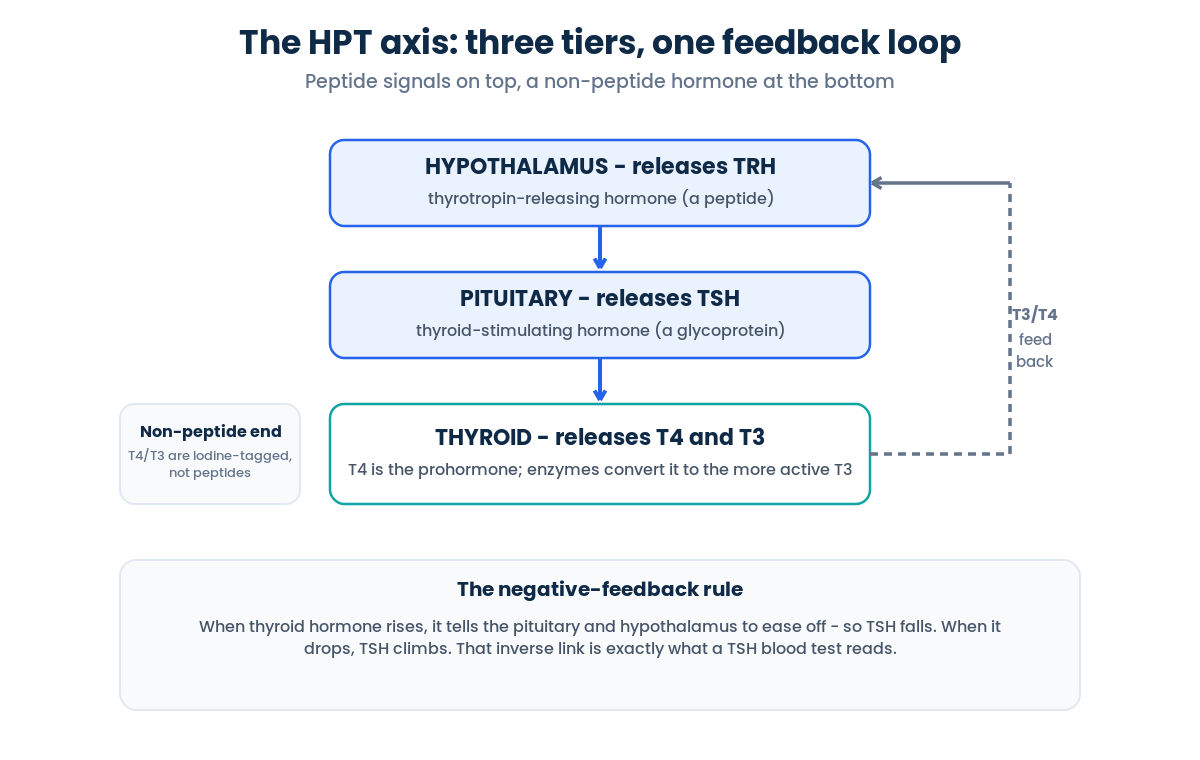
The HPT axis (hypothalamic–pituitary–thyroid axis) is a relay in three steps. The hypothalamus releases TRH (thyrotropin-releasing hormone), which tells the pituitary to release TSH (thyroid-stimulating hormone), which tells the thyroid gland to release its hormones, T4 and T3. Each tier speaks to the next, and the output feeds back to keep the whole system balanced.
TRH: a hormone just three amino acids long
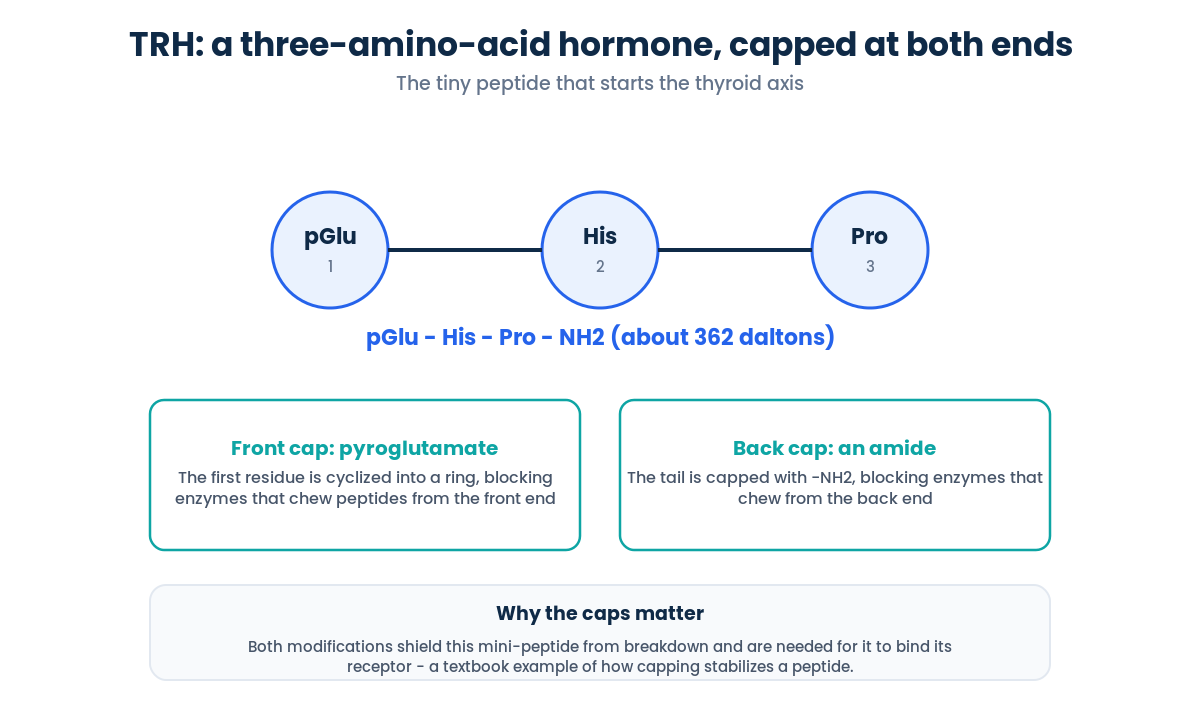
The trigger at the top is remarkably small. TRH is a tripeptide — three amino acids, written pGlu-His-Pro-NH2 (about 362 daltons). What makes it interesting is its two “caps”: the front residue is cyclized into a pyroglutamate ring, and the tail is sealed with an amide. Both modifications shield the little peptide from enzymes that would otherwise chew it up, and both are needed for it to bind its receptor — a textbook example of how peptide modifications like pyroglutamate capping and C-terminal amidation confer stability and activity.
TRH acts through the TRH receptor, a class A G-protein-coupled receptor that signals through the Gq–phospholipase C pathway on pituitary cells.
TSH: the pituitary’s messenger
In response to TRH, the pituitary’s thyrotroph cells release TSH, a glycoprotein hormone. TSH is built from two subunits — a common alpha subunit it shares with the reproductive hormones LH and FSH (and with hCG), plus a unique beta subunit that gives TSH its specific identity. TSH acts on the TSH receptor, another class A GPCR, on thyroid follicular cells, switching on the machinery that makes and releases thyroid hormone.
T4 and T3: the end hormones — and they are not peptides
Here is the twist worth remembering. The thyroid mostly secretes T4 (thyroxine), which acts as a prohormone; enzymes called deiodinases convert it in the tissues to the more active T3. But T4 and T3 are iodinated tyrosine derivatives — small iodine-tagged molecules, not peptides. So the HPT axis carries its instructions with peptide and glycoprotein signals (TRH, TSH) yet ends in a non-peptide hormone. It is a clean illustration that “hormone” and “peptide” are not synonyms.
Negative feedback and why a TSH test works so well
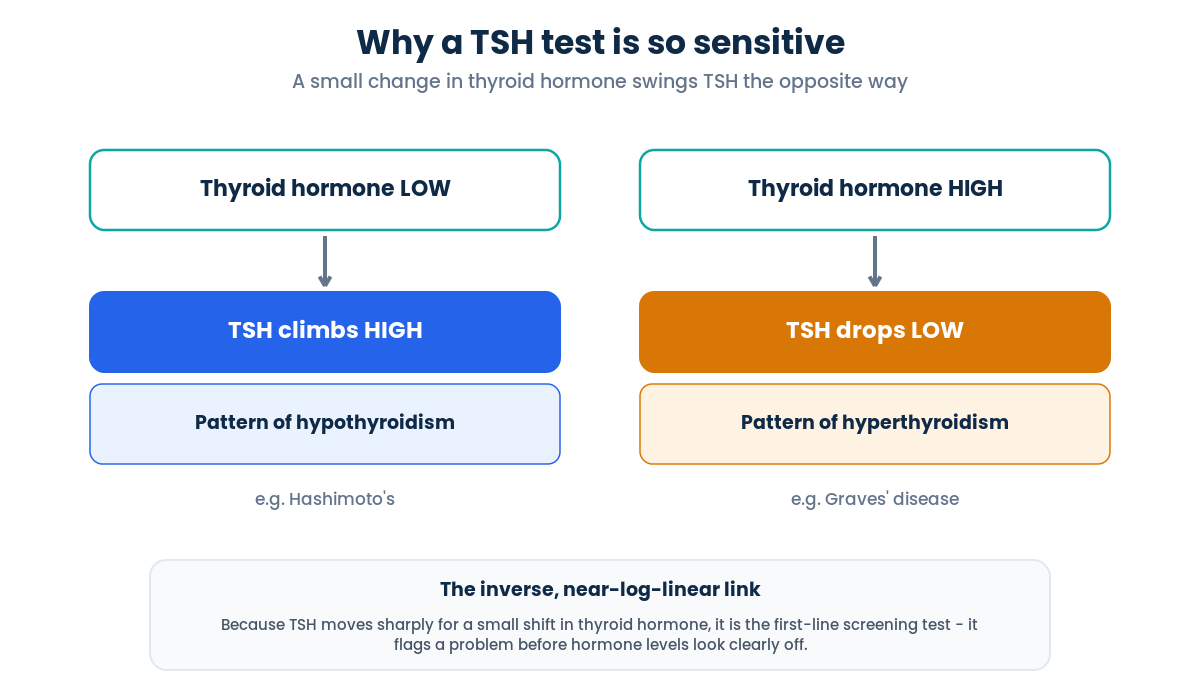
Thyroid hormone doesn’t just flow downhill — it reports back. Rising T3 and T4 suppress both TSH and TRH; falling levels release the brake and TSH climbs. Because TSH moves sharply and in the opposite direction to even small shifts in thyroid hormone, a TSH blood test is the sensitive, first-line way to screen thyroid function: it flags a problem before hormone levels look clearly off.
When the axis tips out of balance
Reading the axis makes the two big patterns easy to tell apart:
- Hypothyroidism — the thyroid underperforms, so TSH is high while thyroid hormone is low. The most common cause is Hashimoto’s, an autoimmune thyroiditis.
- Hyperthyroidism — the thyroid overproduces, so TSH is suppressed while thyroid hormone is high. The classic cause is Graves’ disease, where antibodies mimic TSH and over-stimulate the gland.
Drugs that act on the HPT axis
Several approved medicines map directly onto the tiers of the axis: levothyroxine is synthetic T4 and liothyronine is synthetic T3 (both used for hypothyroidism); protirelin is synthetic TRH used as a diagnostic; and thyrotropin alfa (Thyrogen) is recombinant human TSH used in thyroid-cancer follow-up. Each is a real-world version of a natural axis signal.
Frequently asked questions
Is TRH really only three amino acids?
Yes. TRH is a tripeptide (pGlu-His-Pro-NH2). Its small size is offset by its two protective end-caps, which keep it stable and active.
Why is TSH the main thyroid blood test?
Because TSH changes sharply and inversely with thyroid hormone. A small drop in thyroid hormone produces a large rise in TSH, so TSH catches problems early — which is why it is the first-line screen.
Are thyroid hormones peptides?
No. TRH and TSH are peptide and glycoprotein signals, but the thyroid’s own hormones, T4 and T3, are iodinated tyrosine derivatives — not peptides.
How does the HPT axis relate to the body’s other axes?
It is one of a family of hypothalamic–pituitary axes that share the same design. See the HPA (cortisol) axis, the GH and IGF-1 axis, and the pituitary gland that sits at the center of all of them.
Related reading
Reconstitution calculator · Peptide library · Guides & how-tos
References
- Endotext. Physiology of the Hypothalamic-Pituitary-Thyroid Axis (NBK278958). ncbi.nlm.nih.gov/books/NBK278958
- StatPearls. Physiology, Thyroid Stimulating Hormone (NBK499850). ncbi.nlm.nih.gov/books/NBK499850
- UniProt. Pro-thyrotropin-releasing hormone (human), P20396. uniprot.org/uniprotkb/P20396
- IUPHAR/BPS Guide to Pharmacology. TRH receptor (TRHR). guidetopharmacology.org
- IUPHAR/BPS Guide to Pharmacology. Glycoprotein hormone receptors (incl. TSHR). guidetopharmacology.org
- FDA. Thyrogen (thyrotropin alfa) prescribing information. accessdata.fda.gov
Informational only — not medical advice. Consult a qualified healthcare professional. Intended for adults 21+.