
What Is Somatostatin? The Body’s Universal Off-Switch
Peptide Biology
Somatostatin is the body’s universal “off switch” — a small peptide hormone whose main job is to tell other hormones and secretions to slow down. It is the natural brake on growth hormone, the counterweight to the peptides that push growth hormone up, and the parent molecule behind several widely used medicines.
What is somatostatin?
Somatostatin was discovered in 1973 by Roger Guillemin, Paul Brazeau and colleagues, who isolated it from the hypothalamus and found it blocked the release of growth hormone. That discovery was part of the work for which Guillemin shared the 1977 Nobel Prize. Its original name, growth-hormone-inhibiting hormone (also called SRIF), captures the theme that runs through all of its biology: while most hormones tell the body to do something, somatostatin mostly tells it to stop.
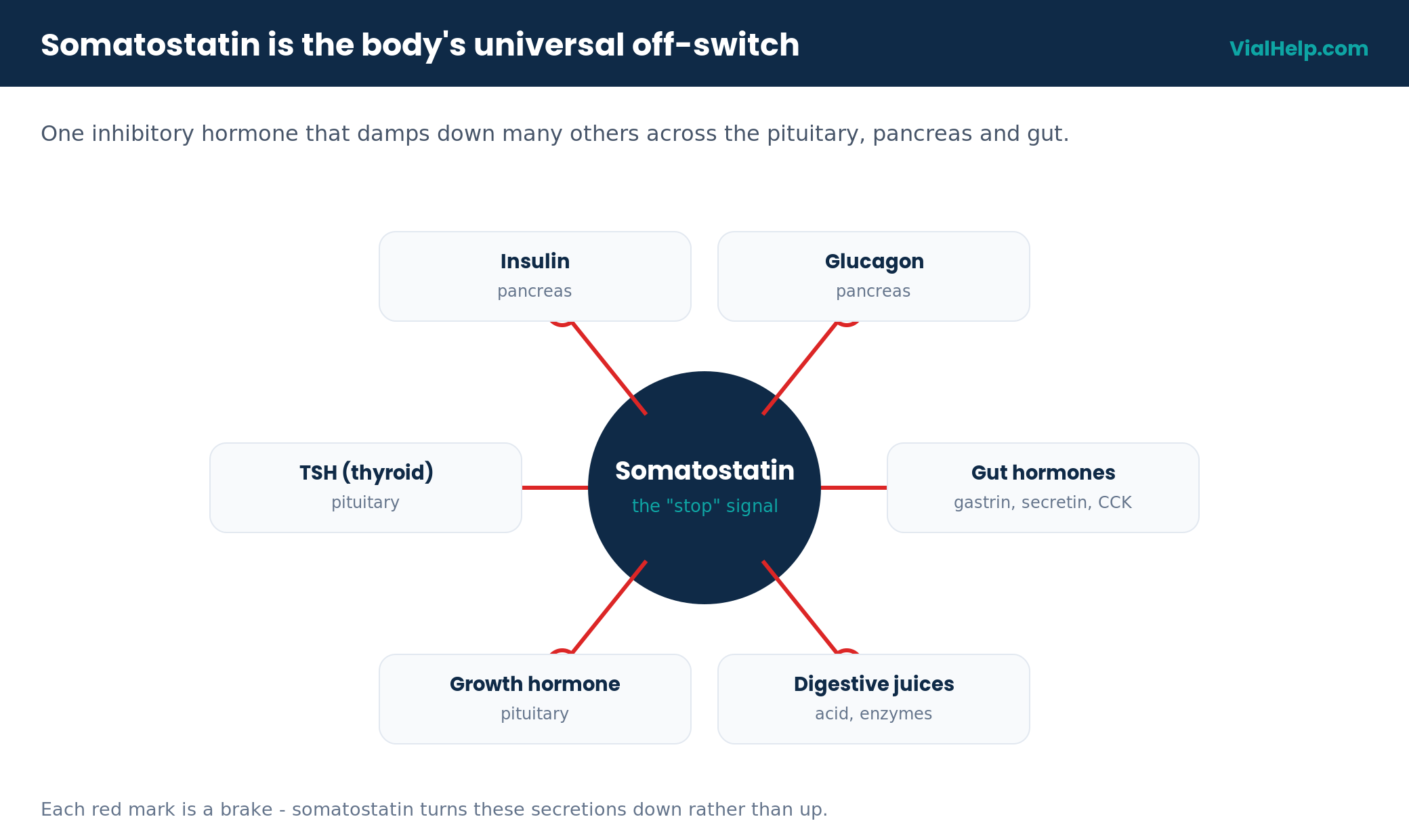
It is made in several places: the delta (δ) cells of the pancreatic islets, the D cells scattered through the stomach and intestine, and neurons in the hypothalamus and throughout the brain. From these sites it acts locally on neighbouring cells and, from the hypothalamus, on the pituitary gland — putting it in a position to quiet a remarkably wide range of signals.
One precursor, two active forms
Somatostatin is built from a single larger precursor protein (preprosomatostatin) that the body trims down into two active peptides: somatostatin-14 (SS-14), fourteen amino acids long, and somatostatin-28 (SS-28), an extended twenty-eight-amino-acid version. The shorter SS-14 (sequence AGCKNFFWKTFTSC, molecular weight about 1,638 daltons) carries an internal disulfide bond between its two cysteines, which locks the peptide into a small ring. SS-14 predominates in the brain and pancreas, while SS-28 is more prominent in the gut; the two forms differ in where they act and how strongly.
The universal brake: what somatostatin shuts down
Somatostatin’s defining feature is the breadth of what it inhibits. Documented targets include:
- Pituitary hormones — growth hormone (its signature action) and thyroid-stimulating hormone (TSH).
- Pancreatic hormones — both insulin and glucagon, through paracrine action of the islet delta cells.
- Gut hormones — a wide set including gastrin, secretin, cholecystokinin (CCK), GIP, VIP and motilin.
- Digestive secretions and motility — stomach acid and pancreatic enzymes, plus slowed gastric emptying and reduced blood flow to the gut.
The growth-hormone axis: accelerator vs brake
Somatostatin is best understood as one half of a balance. Growth-hormone release from the pituitary is set by two opposing signals: the hypothalamic hormone GHRH pushes it up, and somatostatin holds it down. The two work on the same downstream machinery inside pituitary cells — GHRH raises the second messenger cAMP to trigger a growth-hormone pulse, and somatostatin lowers it to cap that pulse.
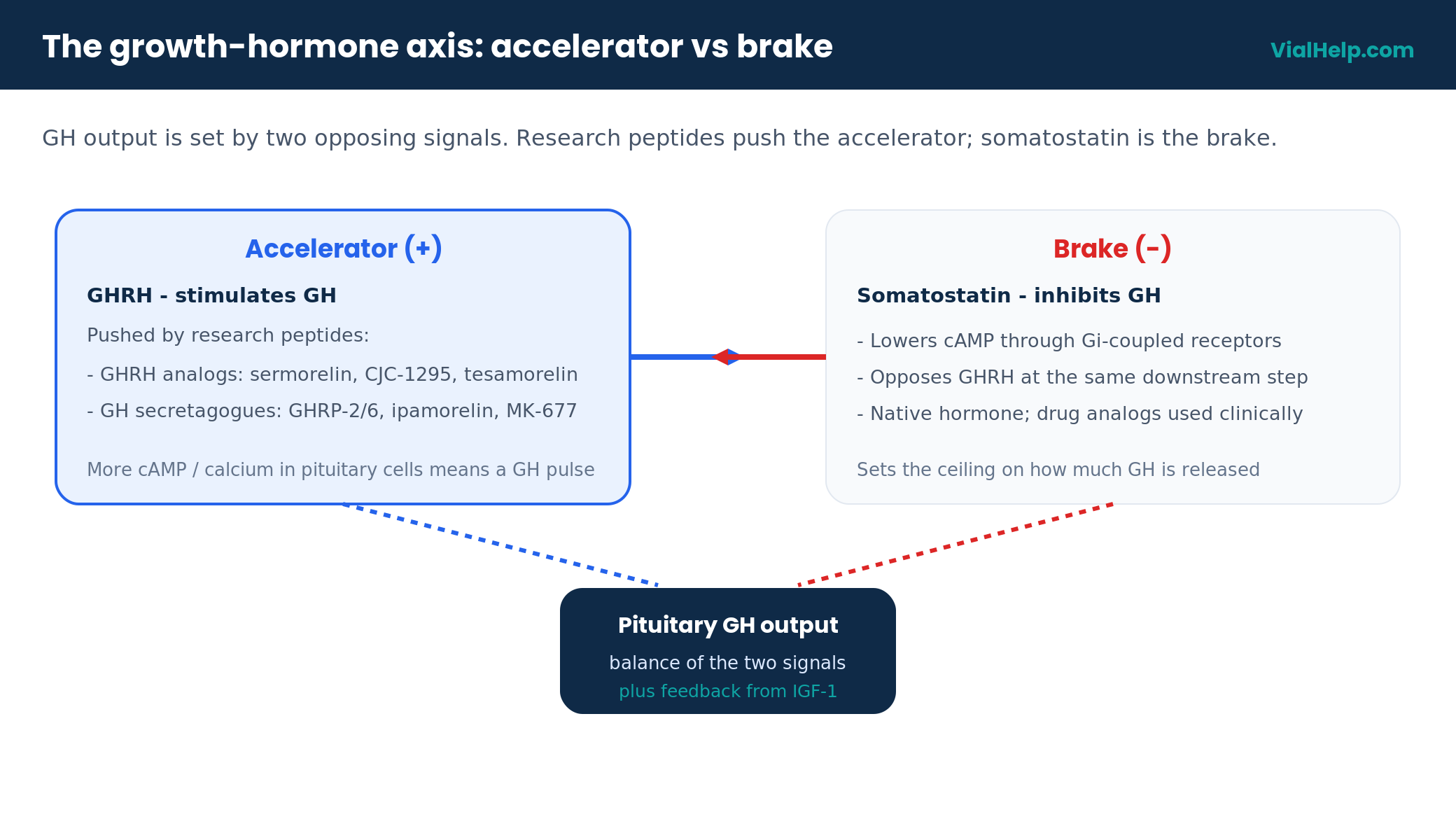
This is exactly the axis that many research peptides act on. GHRH-analog peptides such as sermorelin, CJC-1295 and tesamorelin, and the ghrelin-mimicking growth-hormone secretagogues, all push on the accelerator side of this balance — while somatostatin is the brake they are pushing against. Our explainers on GHRH analogs vs GH secretagogues and growth-hormone peptide side effects cover the accelerator side in detail.
From an unstable hormone to real medicines
Native somatostatin has one big practical problem as a drug: it is destroyed in the blood within roughly one to three minutes. That is far too short to be useful, so researchers engineered longer-lasting, more stable analogs that keep the “stop” signal working for hours — or, in depot form, weeks.
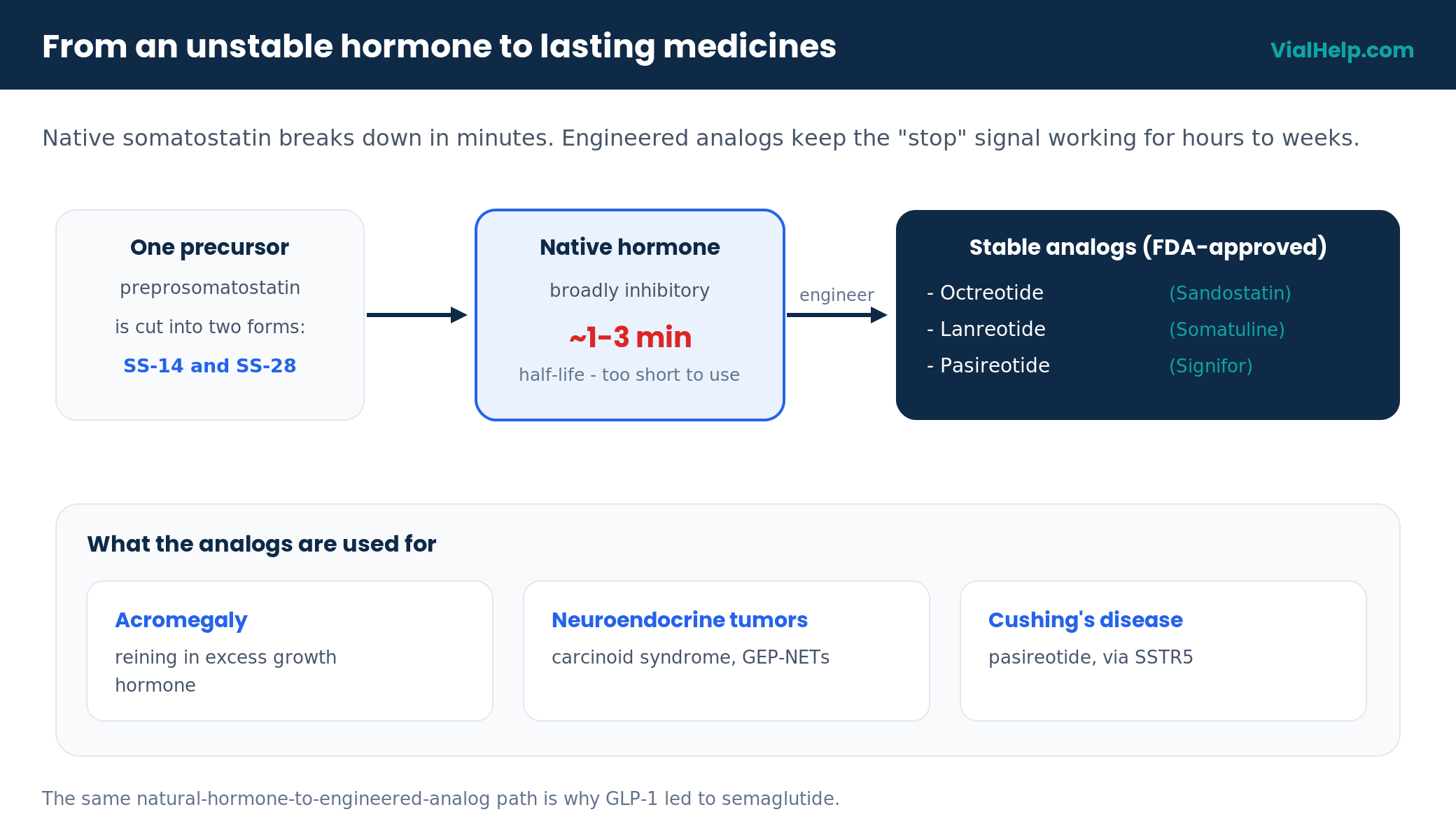
Three of these somatostatin analogs are FDA-approved and in routine clinical use: octreotide (Sandostatin), lanreotide (Somatuline) and pasireotide (Signifor). They are used to rein in the excess growth hormone of acromegaly, to control hormone-secreting neuroendocrine tumors and carcinoid syndrome, and (in pasireotide’s case) for Cushing’s disease. This is the same “natural hormone becomes an engineered analog” story that turned the gut hormone GLP-1 into semaglutide — a pattern explained in what is GLP-1? and, for the general idea of extending a peptide’s life, peptide half-life explained.
How somatostatin acts: the SSTR receptors
Somatostatin works through five receptor subtypes, SSTR1 through SSTR5. All are G-protein-coupled receptors — the same broad family described in what is a GPCR? — of the inhibitory (Gi/o) type, meaning they lower cAMP inside the cell to switch activity down. Different tissues carry different mixes of these subtypes, which is part of why drug developers try to match an analog to the receptors on a given tumour. A closely related peptide called cortistatin shares most of somatostatin’s sequence and binds the same receptors, but has some distinct effects of its own.
Frequently asked questions
Is somatostatin the opposite of growth hormone?
Not exactly — somatostatin inhibits the release of growth hormone. It is the brake in a system where GHRH is the accelerator; growth hormone itself is the output the two of them control.
What is the difference between SS-14 and SS-28?
They are two active forms cut from the same precursor. SS-14 is the shorter fourteen-amino-acid peptide and dominates in the brain and pancreas; SS-28 is a longer form more common in the gut. They differ in distribution and potency.
Why can’t somatostatin itself be used as a medicine?
Its natural half-life in the blood is only about one to three minutes — too short to be practical. Engineered analogs such as octreotide and lanreotide last far longer and are what clinicians actually use.
How does somatostatin relate to research growth-hormone peptides?
It is the physiological brake on growth-hormone release. GHRH-analog and secretagogue peptides act on the opposite, accelerator side of the same growth-hormone axis.
References
- Brazeau P, Vale W, Burgus R, et al. Hypothalamic polypeptide that inhibits the secretion of immunoreactive pituitary growth hormone. Science. 1973;179(4068):77–79. PubMed 4682131
- Patel YC. Somatostatin and its receptor family. Frontiers in Neuroendocrinology. 1999;20(3):157–198. PubMed 10433861
- Günther T, et al. IUPHAR CV. Somatostatin receptors: structure, function, ligands and new nomenclature. Pharmacological Reviews. 2018;70(4):763–835. PubMed 30232095
- Rorsman P, Huising MO. The somatostatin-secreting pancreatic δ-cell in health and disease. Nature Reviews Endocrinology. 2018;14(7):404–414. PubMed 29773871
- UniProtKB P61278 — Somatostatin (SST), Homo sapiens. uniprot.org/uniprotkb/P61278
- Sandostatin (octreotide acetate) FDA prescribing information. accessdata.fda.gov