
The GH/IGF-1 Axis Explained: How Growth Hormone Really Works
Hormone biology & pharmacology
The GH/IGF-1 axis is the chain of signals that runs from the brain to the liver and decides how much growth hormone your body releases and what it does. Understanding this one loop explains why so many research peptides — from sermorelin to ipamorelin to the IGF-1 analogs — get grouped together: each one pushes on a different point of the same circuit.
What the GH/IGF-1 axis is
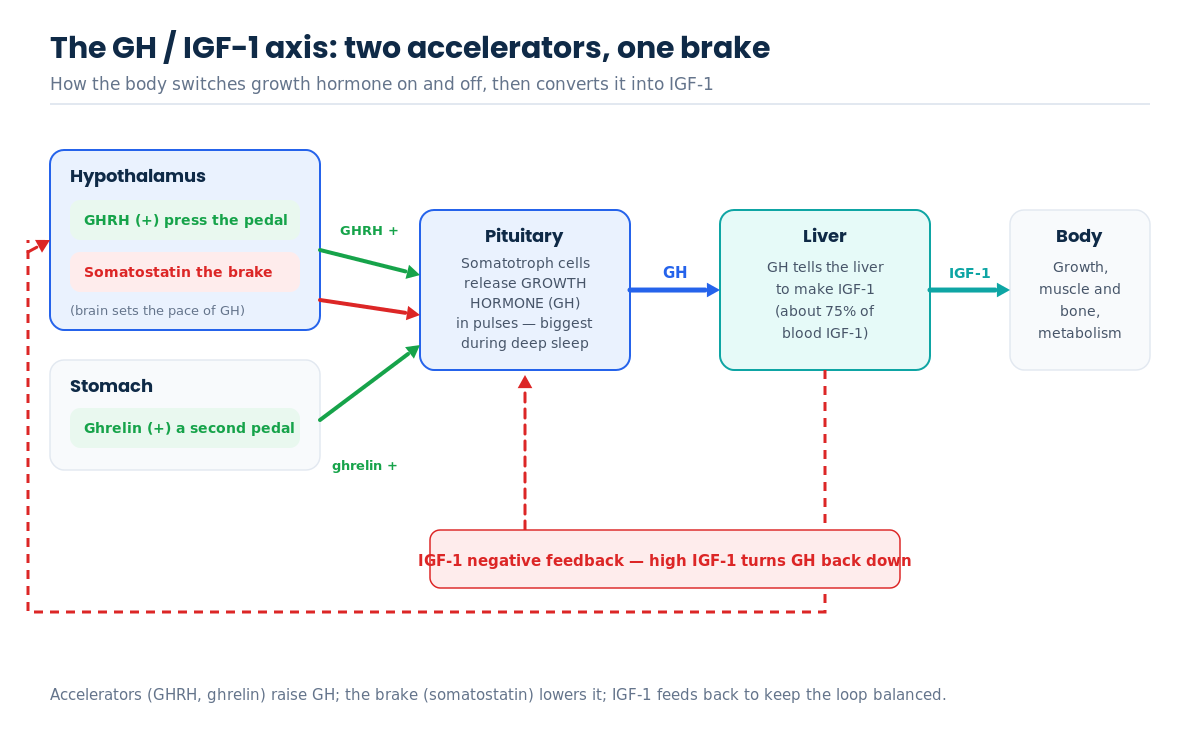
The axis has four main stops. The hypothalamus sets the pace with two opposing peptides: growth-hormone-releasing hormone (GHRH), a 44-amino-acid peptide that switches GH production on, and somatostatin, a small cyclic peptide that switches it off. A third input, the stomach hormone ghrelin (a 28-amino-acid peptide), adds an extra push. These signals reach the anterior pituitary, where somatotroph cells release growth hormone (GH) in pulses. GH then travels to the liver and other tissues, which respond by making insulin-like growth factor 1 (IGF-1) — the messenger that carries out much of GH’s growth-promoting work.
The feedback loop: two accelerators and a brake
Think of GHRH and ghrelin as two accelerator pedals and somatostatin as the brake. When the accelerators win, GH pulses rise; when somatostatin dominates, they fall. The largest natural GH pulses occur within minutes of the onset of slow-wave (deep) sleep. To keep the system from running away, IGF-1 feeds back negatively at both the hypothalamus and the pituitary, and GH itself raises somatostatin tone. About three-quarters of the IGF-1 in your blood is made by the liver, with other tissues producing IGF-1 locally.
Two hormones, two very different receptors
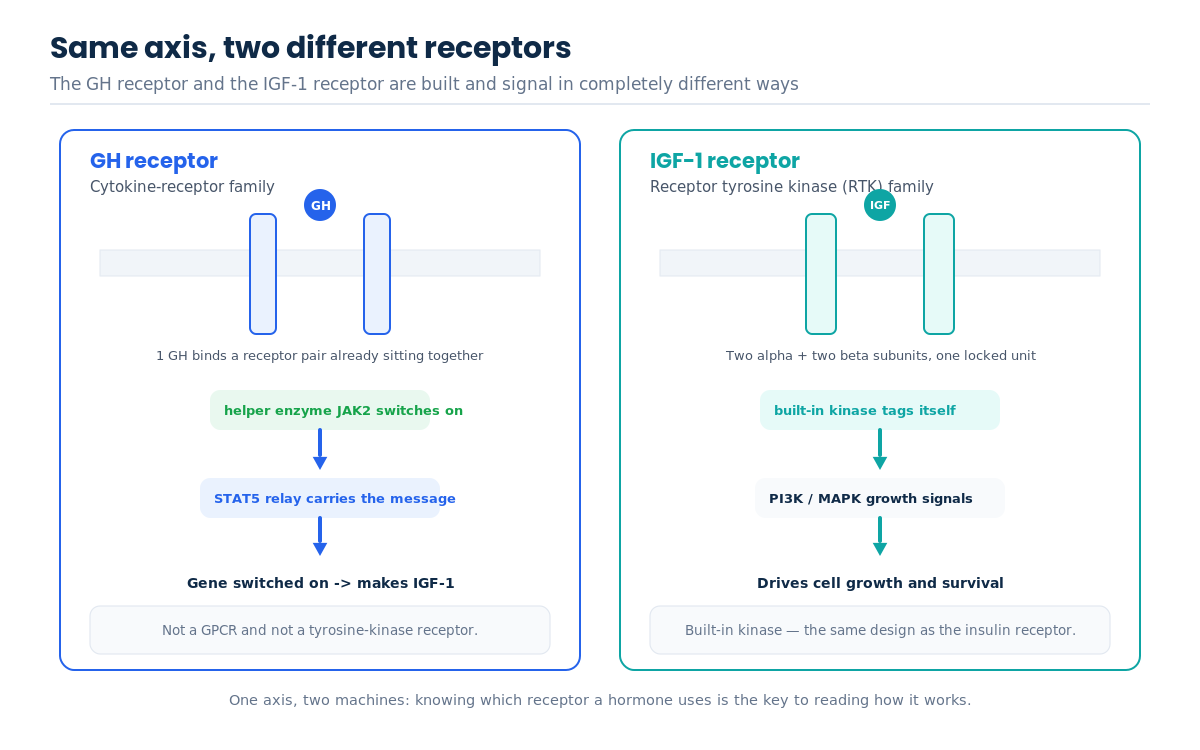
A common misconception is that growth hormone and IGF-1 use the same kind of receptor. They do not. The GH receptor belongs to the cytokine-receptor family: a single GH molecule binds a receptor pair that already sits together, and the receptor borrows a separate helper enzyme (JAK2) to relay the signal through STAT proteins — chiefly STAT5b, which switches on the IGF-1 gene. It is neither a GPCR nor a tyrosine-kinase receptor. The IGF-1 receptor, by contrast, is a genuine receptor tyrosine kinase, built like the insulin receptor from two alpha and two beta subunits with a built-in kinase. Same axis, two entirely different machines.
Why IGF-1 lasts hours when GH lasts minutes
Growth hormone is cleared quickly — its circulating half-life is on the order of about 10 to 20 minutes, which is why GH appears in sharp, short pulses. IGF-1 behaves the opposite way. Almost all of it circulates bound to IGF-binding proteins, and its main carrier, IGFBP-3, joins with a protein called the acid-labile subunit (ALS) to form a three-part complex. That complex protects IGF-1 and stretches its half-life to roughly 16 hours. The practical result is that blood IGF-1 stays fairly steady across the day while GH swings up and down — a point that matters for how the axis is measured. For a broader look at why molecules clear at different rates, see our guide on peptide half-life.
What goes wrong, and how the axis is measured
Too much GH causes acromegaly in adults and gigantism if it occurs before the growth plates close; too little causes short stature in children and shifts in body composition (more fat, less lean mass) in adults. Because a single GH measurement is almost meaningless — you might catch a peak or a trough — clinicians lean on IGF-1 as a stable, integrated marker of GH status. Suspected deficiency is probed with GH stimulation tests (for example, arginine or clonidine), and suspected excess with suppression testing. None of this is something to attempt outside a clinical setting; it is included here to explain what the axis looks like when it is out of balance.
The drugs that act on the axis
Several FDA-approved medicines target this loop directly. Somatropin is recombinant human GH used for replacement. Mecasermin (Increlex) is recombinant IGF-1, approved for children with severe primary IGF-1 deficiency. Pegvisomant (Somavert), approved in 2003, is a GH-receptor blocker used in acromegaly. The somatostatin analogs octreotide, lanreotide and pasireotide mimic the brake and are used for acromegaly. Tesamorelin (Egrifta), approved in 2010, is a stabilized GHRH analog approved to reduce excess abdominal fat in HIV-associated lipodystrophy. Sermorelin — GHRH(1-29), once marketed as Geref — is no longer sold as an approved product in the United States and now appears only through compounding.
Where research peptides fit on the axis
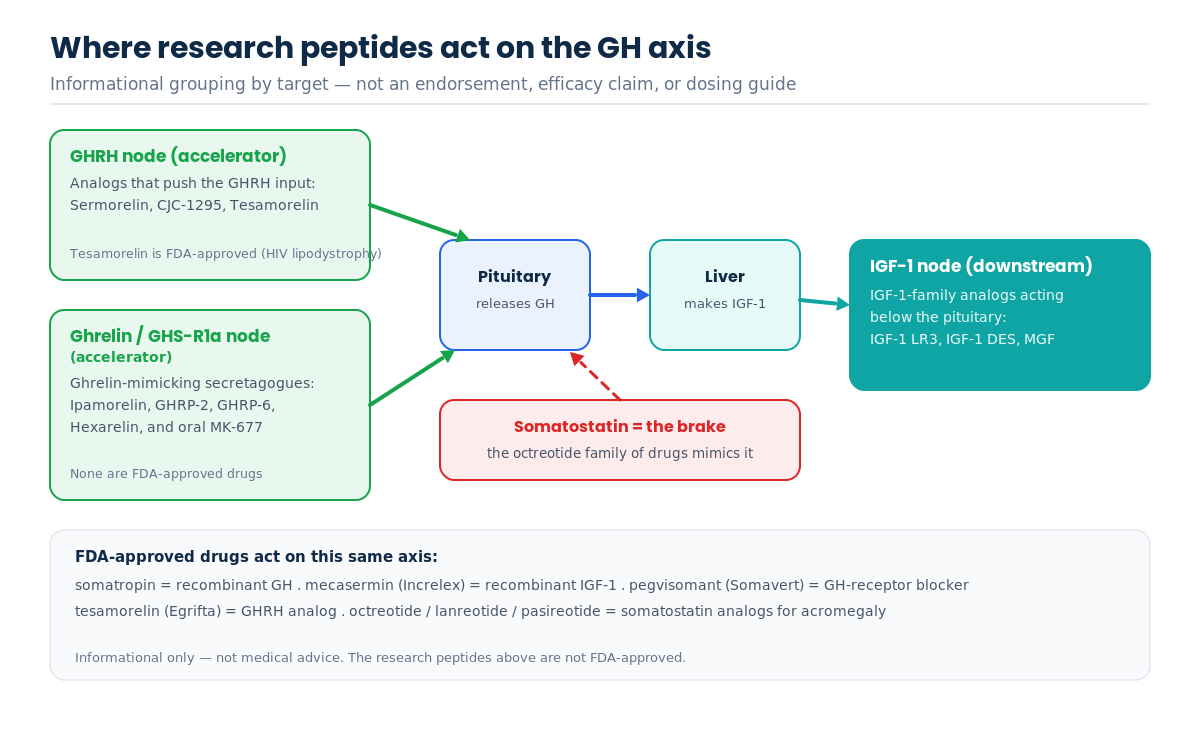
Grouping the research-peptide landscape by node makes it far easier to read. This is descriptive only — it says which part of the axis a molecule imitates, not that any of them work, are safe, or should be used, and it is not a dosing guide.
- The GHRH node (an accelerator): GHRH-style analogs such as sermorelin, CJC-1295 and tesamorelin push at the GHRH input. Of these, only tesamorelin is FDA-approved.
- The ghrelin / GHS-R1a node (an accelerator): ghrelin-mimicking secretagogues such as ipamorelin, GHRP-2, GHRP-6, hexarelin and the oral compound MK-677 act at the same receptor ghrelin uses. None are FDA-approved drugs. The difference between these two accelerator classes is covered in GHRH analogs vs GH secretagogues.
- The IGF-1 node (downstream): IGF-1-family analogs such as IGF-1 LR3, IGF-1 DES and MGF act below the pituitary, at the IGF-1 end of the axis.
Set against all of these is somatostatin, the brake — the target that the octreotide family of drugs imitates.
Frequently asked questions
Is IGF-1 the same thing as growth hormone?
No. GH acts partly through its own receptor and partly by telling the liver to make IGF-1, which then carries out much of GH’s growth-promoting effect. They are two different hormones with two different receptors.
Why do doctors measure IGF-1 instead of GH?
GH is released in short pulses and clears within minutes, so a single reading is unreliable. IGF-1 stays steady across the day, making it a better integrated marker of GH activity.
Do GHRH peptides and GHRP peptides do the same thing?
Both are “accelerators,” but they act at different points: GHRH analogs push the GHRH receptor, while GHRPs and other ghrelin mimetics act at the ghrelin (GHS-R1a) receptor. This is informational, not a recommendation.
Is the GH receptor a tyrosine kinase like the insulin receptor?
No. The GH receptor is a cytokine-type receptor that signals through JAK2 and STAT proteins. The IGF-1 receptor is the one that is a receptor tyrosine kinase, closely related to the insulin receptor.
References
- Normal Physiology of Growth Hormone in Normal Adults — Endotext (NCBI Bookshelf)
- UniProt P01241 — Somatotropin (GH1), Homo sapiens
- UniProt P05019 — Insulin-like growth factor 1 (IGF1), Homo sapiens
- Le Roith D, et al. The Somatomedin Hypothesis: 2001. Endocrine Reviews (PMID 11159816)
- INCRELEX (mecasermin) — FDA Prescribing Information
- SOMAVERT (pegvisomant) — FDA Prescribing Information
Informational only — not medical advice. Content is for education about the biology of the GH/IGF-1 axis and is intended for adults 21+. Consult a qualified healthcare professional for any medical decision.