
What Is Neprilysin? The Enzyme That Ends Natriuretic-Peptide Signals
Enzymes & peptide signalling
Neprilysin is a surface enzyme that chops up many small signalling peptides — including the natriuretic peptides. That “off-switch” role is exactly why blocking neprilysin became a modern heart-failure strategy.

What is neprilysin?
Neprilysin is a zinc-dependent metallopeptidase anchored on the outside of cell membranes, where it snips passing peptides. It belongs to the M13 peptidase family, carries the enzyme classification EC 3.4.24.11, and is encoded by the gene MME (human UniProt entry P08473). The same protein goes by a long list of names — neutral endopeptidase (NEP), NEP 24.11, enkephalinase, and, in pathology labs, CD10 / CALLA, where it serves as a well-known leukaemia and lymphoma marker. It is broadly distributed, with notably high activity in the kidney, plus lung, brain, endothelium and gut.
What neprilysin does
Neprilysin is a generalist. Documented substrates include the natriuretic peptides (ANP, BNP and CNP), bradykinin, substance P, the enkephalins, angiotensin peptides, endothelin and others. In each case it cleaves the peptide into shorter, inactive fragments — effectively ending that peptide’s message.
Its most talked-about job is degrading the natriuretic peptides. Those peptides oppose the renin-angiotensin-aldosterone system: they relax vessels, promote salt and water excretion, and dial down aldosterone. Because neprilysin breaks them down, it acts as their off-switch. Neprilysin is also studied in the brain as a major enzyme that clears amyloid-beta, a link that keeps it in Alzheimer’s research — an active hypothesis rather than a treatment.
Neprilysin vs DPP-4: two off-switches, different chemistry
If you have read about DPP-4, neprilysin will feel familiar: both are cell-surface peptidases whose inhibition is useful because it lets a helpful peptide signal last longer. But they are built differently and act on different peptide families.
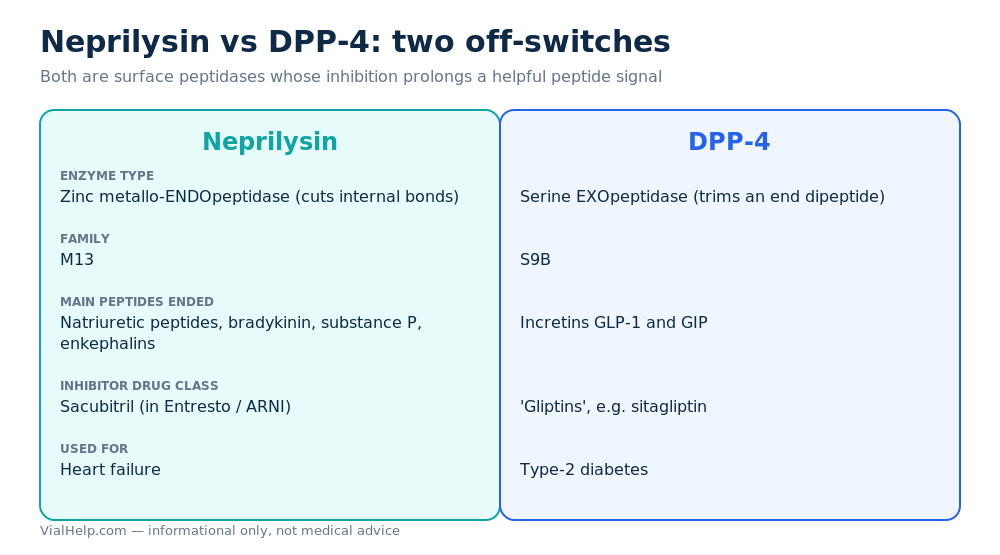
Neprilysin is a zinc metallo-endopeptidase (family M13) that ends natriuretic peptides, bradykinin and others; blocking it is a heart-failure strategy. DPP-4 is a serine exopeptidase (family S9B) that ends the incretins GLP-1 and GIP; blocking it is a type-2-diabetes strategy (the “gliptins”). Same theme, different biology.
Why blocking neprilysin needs a careful partner
Because neprilysin also degrades angiotensin II and bradykinin, simply switching it off has trade-offs. The successful design pairs a neprilysin inhibitor with an angiotensin-receptor blocker (ARB), giving the drug class its name: ARNI, angiotensin-receptor / neprilysin inhibitor.

- Sacubitril is a prodrug converted by esterases to its active form, LBQ657, which blocks neprilysin. Beneficial peptides rise — but so does angiotensin II.
- Valsartan, an ARB, blocks the angiotensin-II receptor and cancels that downside. The combination is marketed as Entresto (initial U.S. approval 2015).
- An ARNI must not be combined with an ACE inhibitor. Both raise bradykinin, and stacking them increases the risk of angioedema — which is also why switching from an ACE inhibitor requires a washout period.
That last point is a lesson learned the hard way. An earlier drug, omapatrilat, blocked ACE and neprilysin at once; the double hit on bradykinin caused unacceptable angioedema and the drug was abandoned. The ARNI design deliberately avoids that by pairing neprilysin inhibition with an ARB instead. In the large PARADIGM-HF trial, sacubitril/valsartan reduced cardiovascular death and heart-failure hospitalisation compared with the ACE inhibitor enalapril.
A biomarker footnote
Neprilysin degrades BNP but not NT-proBNP. That distinction matters when these are used as heart-failure blood markers, because a neprilysin inhibitor can raise measured BNP without raising NT-proBNP — a useful nuance rather than a sign of worsening disease.
Frequently asked questions
Is neprilysin the same as CD10?
Yes. CD10 (also called CALLA) and neprilysin are the same protein. In pathology it is used as a cell-surface marker; in cardiovascular biology the same enzyme is the target of neprilysin inhibitors.
Why would you want to block an enzyme?
Because neprilysin destroys beneficial peptides. Blocking it lets the natriuretic peptides survive longer, prolonging their vessel-relaxing and salt-shedding effects — helpful in heart failure.
How is neprilysin different from ACE?
Both are peptidases that touch the blood-pressure peptides, but ACE mainly builds angiotensin II and degrades bradykinin, while neprilysin degrades natriuretic peptides, bradykinin and many others. Because both can raise bradykinin, drugs that block them are not combined.
What does neprilysin have to do with Alzheimer’s disease?
In the brain, neprilysin is one of the main enzymes that clears amyloid-beta. Lower activity with age has been proposed as a contributor to amyloid build-up. This is a research direction, not an approved therapy.
- UniProt. Neprilysin (MME), human, P08473. uniprot.org/uniprotkb/P08473
- StatPearls. Sacubitril-Valsartan. NBK507904. ncbi.nlm.nih.gov/books/NBK507904
- BRENDA Enzyme Database. EC 3.4.24.11 (neprilysin). brenda-enzymes.org
- McMurray JJV, et al. Angiotensin-neprilysin inhibition versus enalapril in heart failure (PARADIGM-HF). N Engl J Med 2014. PMC4565085
- Campbell DJ. Neprilysin inhibitors and bradykinin. PMC6157573
- FDA. Entresto (sacubitril and valsartan) prescribing information. dailymed.nlm.nih.gov
Informational only — not medical advice · 21+