
How Mass Spectrometry Confirms a Peptide’s Identity
Guide
Peptide mass spectrometry is the line on a certificate of analysis that answers a simple question: is this actually the molecule the label claims? HPLC tells you how pure a sample is; mass spectrometry tells you what it is. This guide explains how a mass spec reads a peptide, how a lab turns a spectrum into an identity confirmation, what common mass shifts mean, and — importantly — what a good mass does not prove.
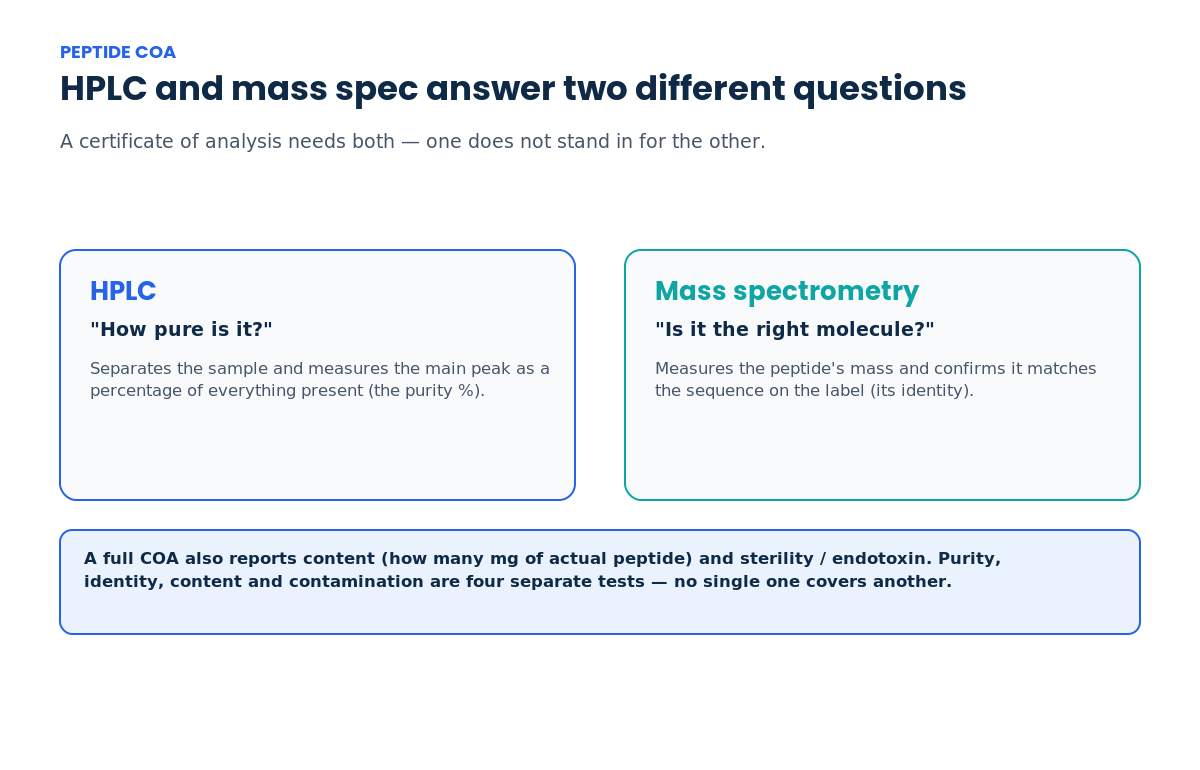
Identity, purity and content are three different questions
A COA is really answering several independent questions, and each needs its own method. Identity asks “is this the right molecule and sequence?” — the job of mass spectrometry (and, at higher confidence, tandem MS and amino-acid analysis). Purity asks “what fraction of the peptide material is the target versus related impurities?” — an HPLC area-percent measurement. Content asks “how many milligrams of actual peptide are in the vial?” — a weight-based assay corrected for bound water and counter-ion (see net peptide content). The framework in USP General Chapter <1503> treats identity, impurities and assay as distinct control elements, with identity established using several orthogonal techniques.
How mass spectrometry sees a peptide
A mass spectrometer does not weigh a molecule directly — it measures its mass-to-charge ratio (m/z). First the peptide has to be turned into a gas-phase ion, using one of two “soft” ionization methods that don’t shatter it: electrospray ionization (ESI), which sprays a charged liquid stream and pairs naturally with liquid chromatography (LC-MS), or MALDI, which fires a laser at the sample embedded in a matrix and typically produces singly-charged ions.
Two mass numbers get quoted. The monoisotopic mass sums the exact mass of the most abundant isotope of each atom; the average mass uses standard atomic weights averaged over natural isotopes. High-resolution instruments resolve the monoisotopic peak, while larger molecules or lower-resolution methods report an average mass — and the two drift apart as a peptide gets bigger.
From several peaks to one molecular weight
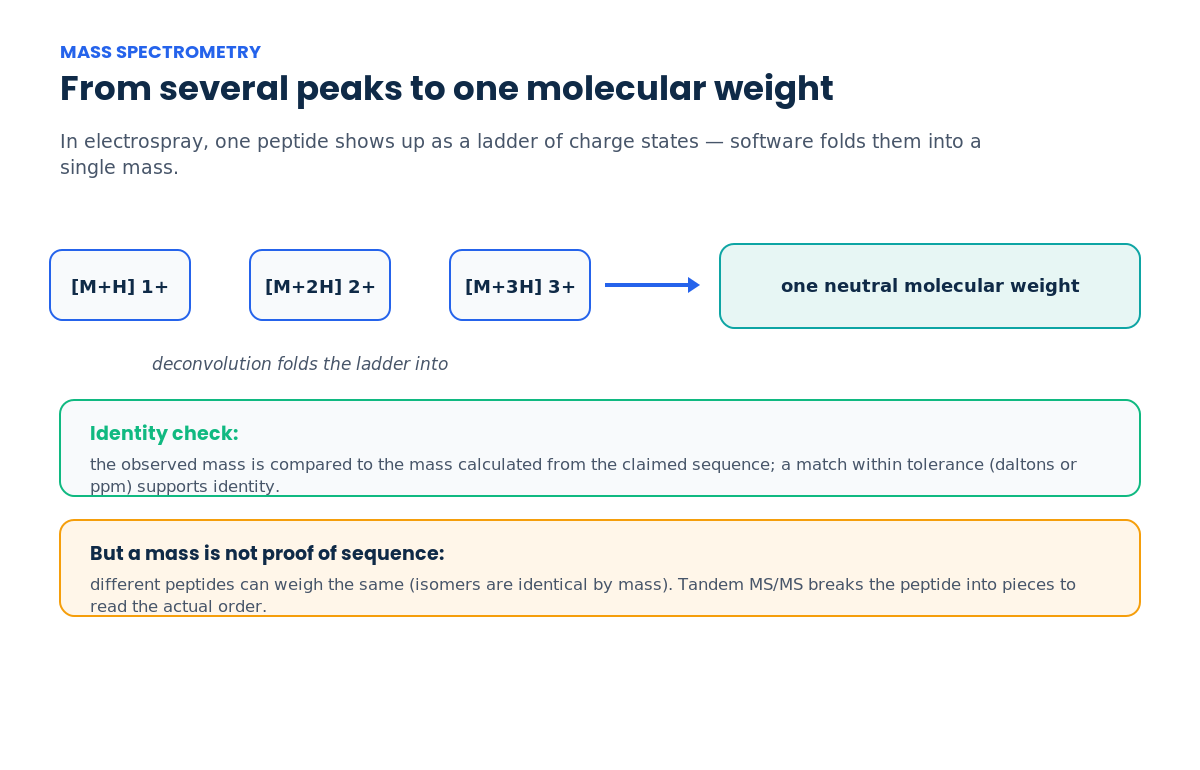
Electrospray does something that surprises newcomers: one peptide shows up as several peaks, because it picks up different numbers of protons — [M+H]+, [M+2H]2+, [M+3H]3+, and so on. Multiple charging pushes big molecules down into an easily measured m/z window. Software then deconvolutes that ladder of charge states back into a single neutral molecular weight, and because each charge state is an independent measurement, averaging across them improves precision.
Identity is confirmed by comparing that observed mass to the theoretical mass calculated from the claimed sequence. A match within tolerance — expressed in daltons or in parts-per-million (ppm) — supports the identity. There is no single universal tolerance; high-resolution work may quote a few ppm, while routine database searches use wider windows. The concept, not one magic number, is what matters.
Why a matching mass is not proof of sequence
Here is the catch a good COA reader keeps in mind: different peptides can weigh exactly the same. Rearranging the same amino acids gives an isomer with an identical mass, and some residues are effectively interchangeable by weight (leucine and isoleucine are identical). So a correct intact mass is consistent with the labelled peptide but does not, by itself, prove the sequence.
That is what tandem mass spectrometry (MS/MS) is for. The instrument isolates the peptide, breaks it apart — usually into complementary b and y ions — and the mass differences between consecutive fragments spell out the amino-acid sequence. Coupled to chromatography (LC-MS/MS), it is the highest-confidence identity method and the one USP lists for sequence confirmation. Intact mass says “it weighs what it should”; MS/MS says “and the pieces spell the sequence we expected.” For the codes behind those sequences, see reading a peptide sequence.
What common mass shifts mean
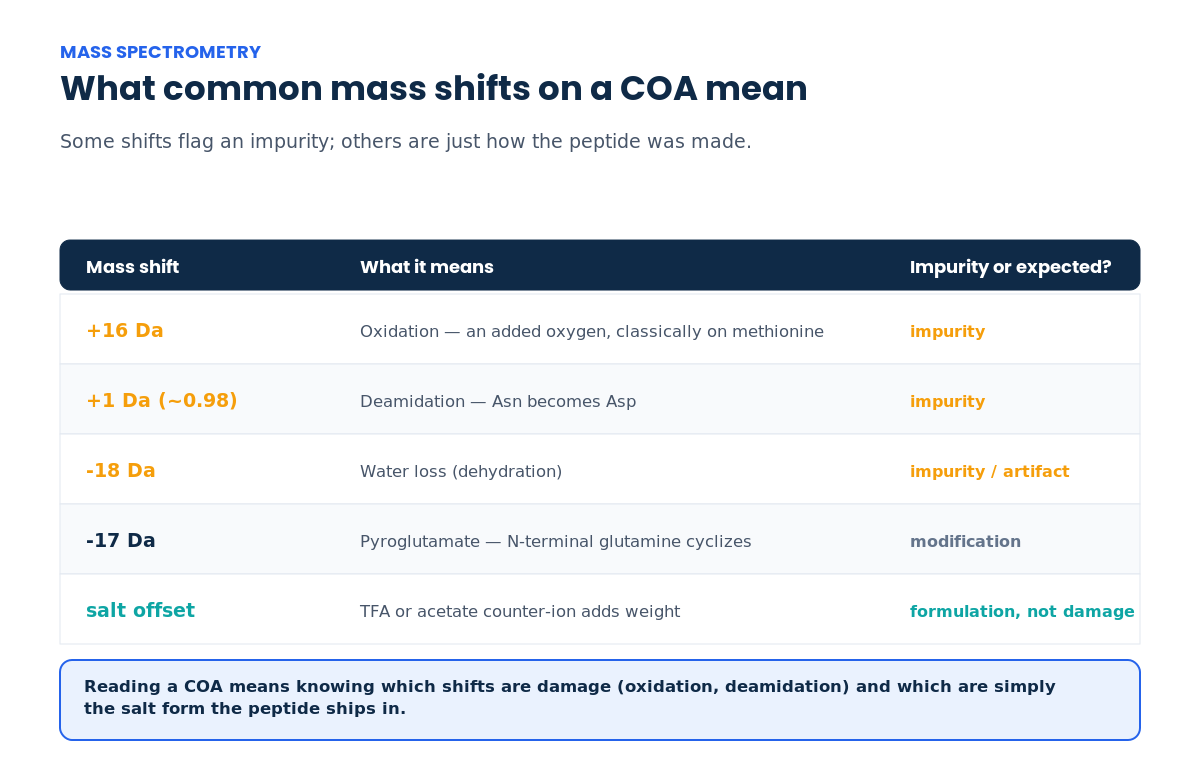
Small offsets from the expected mass are clues. Some flag degradation or impurities; others are just the chemistry of how the peptide was made:
- +16 Da — oxidation. An added oxygen atom, classically on methionine. A telltale small peak beside the main one.
- +1 Da (about +0.98) — deamidation. Asparagine converting to aspartate; on low-resolution instruments it reads as roughly +1.
- -18 Da — water loss (dehydration). Can be a real modification or a gas-phase artifact.
- -17 Da — pyroglutamate. An N-terminal glutamine cyclising; the shift alone is not unique, so it needs confirmation.
- Salt offset — counter-ion, not damage. Peptides made by solid-phase synthesis are usually isolated as trifluoroacetate (TFA) salts and may be exchanged to acetate; the counter-ion adds weight. That is why content uses a mass-balance correction, and why the identity mass is reported for the free peptide. More on this in acetate vs. TFA salt forms.
Why identity, purity, content and sterility are all separate
No single test covers another. Mass spectrometry confirms the molecule; HPLC measures purity; a mass-balance assay measures content; and endotoxin and sterility tests measure contamination — what is around the molecule, which MS and HPLC were never designed to detect. A sample can be correct by mass and 99% pure by HPLC and still carry endotoxin. That is why a complete COA lists them as separate line items, and why reading one means checking all of them — a habit worth building alongside how to read a COA.
Frequently asked questions
What does mass spectrometry confirm on a peptide COA?
Identity — that the material’s measured mass matches the mass calculated from the claimed sequence. It answers “is this the right molecule?”, which is different from purity or content.
Why does one peptide show up as several peaks?
In electrospray, a peptide picks up different numbers of protons, producing multiple charge states. Software deconvolutes them back to one neutral molecular weight.
If the mass matches, is the peptide definitely correct?
Not necessarily. Different sequences can share the same mass, so a matching intact mass supports identity but does not prove sequence — that requires tandem MS/MS or other orthogonal methods.
What does a +16 Da peak mean?
Usually oxidation — an added oxygen atom, classically on methionine. It signals a degradation-related impurity rather than a formulation feature like the salt form.
References
1. Strupat K. Molecular Weight Determination of Peptides and Proteins by ESI and MALDI. Methods Enzymol. 405. PubMed 16413308
2. Thermo Fisher Scientific. Ionization Source Technology Overview. thermofisher.com
3. Bachem. The Online Peptide Guide: An Introduction (QC by MS & HPLC). bachem.com
4. Interpretation of Tandem MS/MS Spectra for Peptide Analysis (b/y ions). Springer Nature. springernature.com
5. PolyPeptide. Control Strategies for Synthetic Therapeutic Peptide APIs (summarizing USP <1503>). PDF
6. Waters. Analysis of Deamidation and Oxidation using Peptide Mapping (+16 Da, +0.98 Da). waters.com
Informational only — not medical advice. Consult a qualified healthcare professional. For adults 21+.