
HPLC Purity Explained: How the % on a Peptide COA Is Measured
Peptide science · Quality & COAs
HPLC purity is the number most people look at first on a peptide certificate of analysis (COA) — the “98%” or “99%” that seems to sum up quality in a single figure. It does measure something real and useful, but it answers a narrower question than most readers assume, and it is easy to over-read. This is an educational walk-through of how that percentage is generated, what it does and does not certify, and why a very high number is never the whole story.
What HPLC actually measures
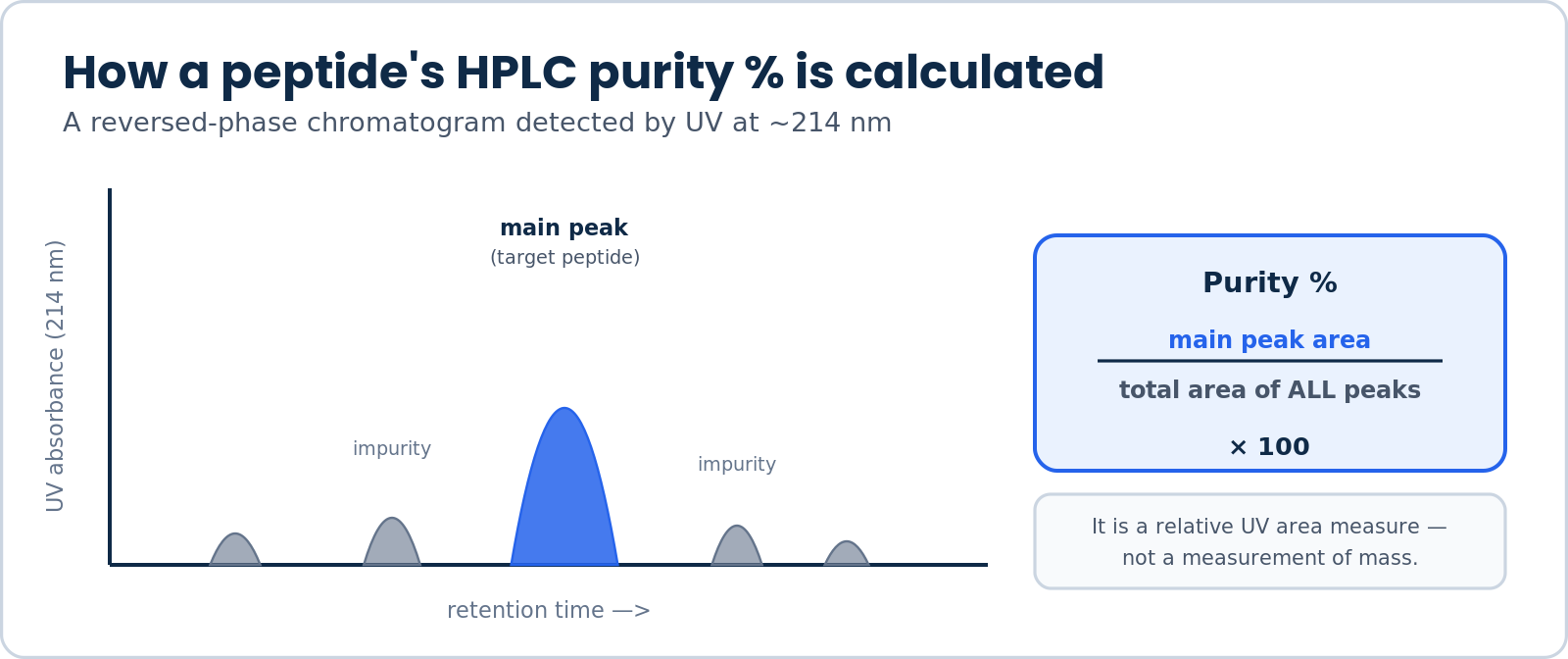
HPLC stands for high-performance liquid chromatography. For synthetic peptides the workhorse version is reversed-phase HPLC on a C18 column: the sample is pushed through the column in a water/acetonitrile gradient (usually with about 0.1% trifluoroacetic acid), and molecules separate by how hydrophobic they are. As each species leaves the column it passes a UV detector. The detector is typically set near 214 nm, because the peptide (amide) bond itself absorbs strongly there — so essentially every peptide species is seen, not just the ones with aromatic side chains. The result is a chromatogram: a trace with one tall peak for the target peptide and smaller peaks for everything else.
How the purity % is calculated
The purity number is an area-normalization calculation. The software integrates the area under every peak, then divides the target peak area by the total area of all peaks:
That last point is the crux. Area-% quietly assumes that impurities absorb UV about as strongly as the target does — which is not strictly true — so “95% area” is not the same as “95% by weight.” It is a comparison of peaks on a UV trace, and it only “sees” material that absorbs UV at the detection wavelength. Water, salts, counter-ions and endotoxin are effectively invisible to it. The number also depends on the method: change the wavelength, gradient, column or how the baseline is drawn and the figure can shift, which is why two labs can report slightly different purities for the same vial.
Purity is not content, identity, or sterility
The single most useful thing to understand about a COA is that purity is only one of four independent questions.
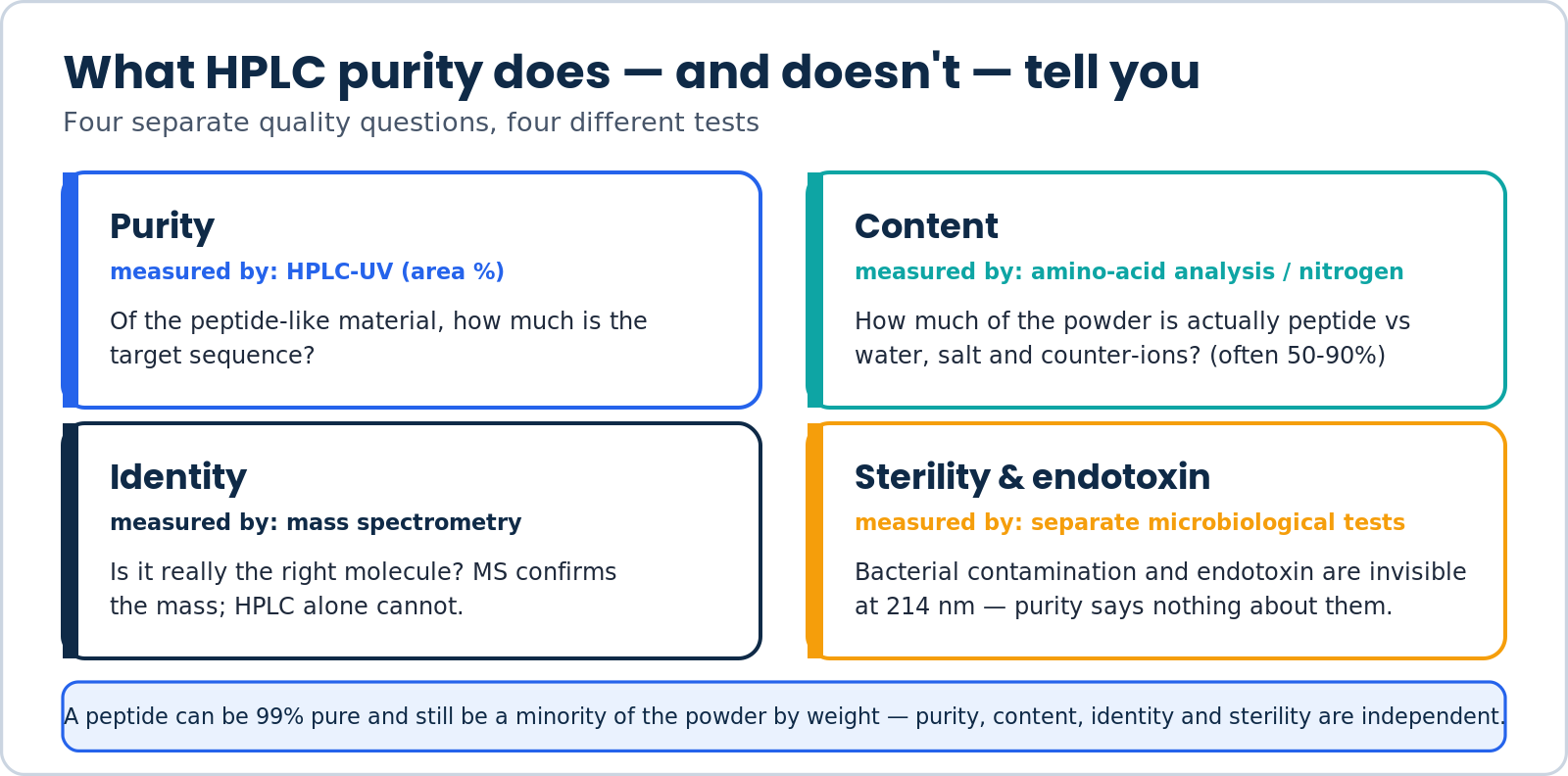
- Purity (HPLC-UV): of the peptide-like material present, how much is the target sequence?
- Net peptide content (needs amino-acid analysis or nitrogen/elemental analysis): how much of the dry powder is actually peptide, as opposed to water, salt and counter-ions? This commonly runs 50–90%, and it can be low even for an extremely pure peptide, especially for peptides rich in basic residues that carry more counter-ion salt. See our full note on net peptide content.
- Identity (needs mass spectrometry): is it really the right molecule? HPLC shows a peak has the expected retention behavior, but MS confirms the mass — and can catch a wrong sequence that co-elutes.
- Sterility and endotoxin (separate microbiological tests): these are not visible at 214 nm at all. A high purity number says nothing about bacterial contamination or endotoxin load. See endotoxins and the LAL test.
Put together: a peptide can be 99% pure and still be a minority of the powder by weight, or carry an endotoxin problem, because those are different measurements entirely.
Where the extra peaks come from
The impurity peaks that the purity % is measured against are mostly peptide-related, and they trace back to how the peptide was assembled by solid-phase synthesis and worked up afterward.
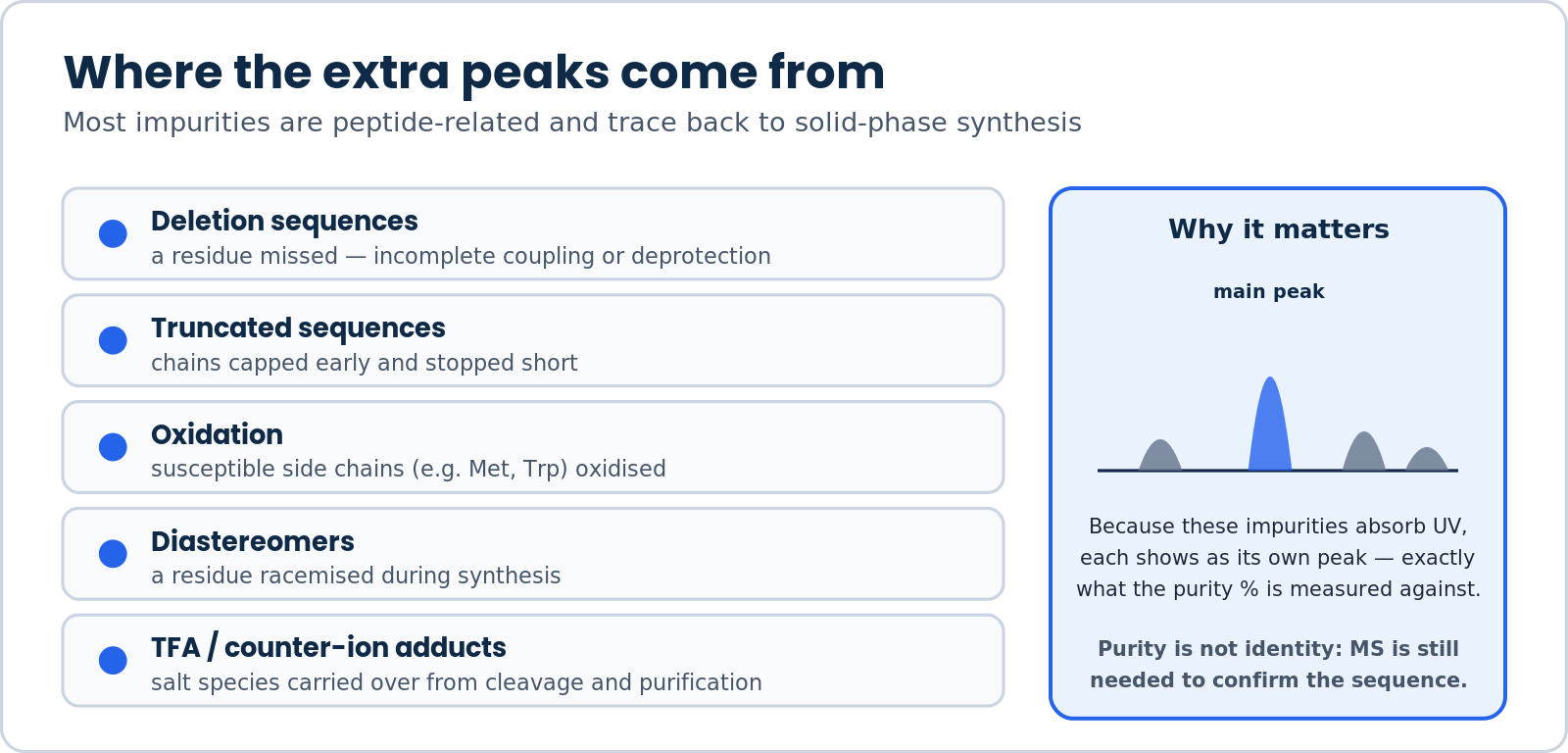
- Deletion sequences — a residue missing because a coupling or deprotection step was incomplete.
- Truncated sequences — chains that were “capped” and stopped short.
- Oxidation — susceptible side chains (for example methionine or tryptophan) picking up oxygen.
- Diastereomers — a residue that racemized during synthesis, giving a same-mass but differently-shaped impurity.
- TFA and counter-ion adducts — salt species carried over from cleavage and purification; purified peptides are usually TFA salts. More on this in acetate vs TFA salt forms.
Because all of these absorb UV, each shows up as its own peak — which is exactly what makes them countable in the purity calculation.
Purity grades and what “higher” does and doesn’t buy you
Research peptides are commonly offered in grades such as greater than 95%, 90%, or 80%, with an “immunograde” around 65% for uses like raising antibodies, while crude (un-purified) peptide is often above 60%. Pushing toward 98–99% is legitimate and matters for reference standards and quantitative work, but the cost climbs steeply and — critically — a higher purity figure does not confirm identity, does not raise net content, and does not address sterility. In pharmaceutical settings, individual impurities above roughly the 0.1% level are typically identified and controlled, and synthetic-peptide drug substances are governed by USP General Chapter <1503>, which treats purity, content, impurities and endotoxin as separate attributes.
How a COA reports HPLC
A COA HPLC section typically lists the method and wavelength (for example RP-HPLC, UV 214 or 220 nm), the column, the gradient/mobile phase, the main peak retention time, the purity %, and often a small chromatogram image. Alongside it you should expect a mass-spec result for identity. The exact layout is conventional, not standardized. For the broader walk-through, see how to read a COA.
Frequently asked questions
Does 99% pure mean the vial is 99% peptide?
No. Purity is a UV-area comparison of peptide-like peaks. How much of the powder is peptide by weight is net peptide content, a different assay — and it is often 50–90%.
Why is 214 nm used instead of a wavelength I can see?
The peptide bond absorbs strongly in the far-UV around 214 nm, so that setting detects essentially all peptide species, including those without aromatic residues that a 280 nm detector would miss.
Can HPLC prove the peptide is the right sequence?
Not on its own. HPLC characterizes behavior and purity; mass spectrometry confirms identity by mass. Good COAs report both.
Do purity and endotoxin measure the same thing?
No. Endotoxin and sterility are separate microbiological tests and are invisible at 214 nm. A high purity number says nothing about them.
- United States Pharmacopeia. General Chapter <1503>, Quality Attributes of Synthetic Peptide Drug Substances. doi.usp.org
- Bachem. Quality Control of Amino Acids & Peptides: A Guide. bachem.com
- AAPPTec. Peptide Quality (FAQ): purity vs net peptide content. peptide.com
- Kuipers BJH, Gruppen H. Peptide-bond UV absorption at 214 nm. J Agric Food Chem 2007;55:5445–5451. pubmed.ncbi.nlm.nih.gov/17539659
- D’Hondt M, et al. Related impurities in peptide medicines. J Pharm Biomed Anal 2014;101:2–30. pubmed.ncbi.nlm.nih.gov/25044089
- AAPPTec. Post-cleavage purification and analysis of peptides (TFA counter-ions and adducts). peptide.com
Informational only — not medical advice · 21+