
Melanocortin Receptors Explained: MC1R to MC5R
Peptide pharmacology
The melanocortin receptors are a family of five cell-surface switches — named MC1R through MC5R — that sit in very different tissues, from your skin to your adrenal glands to deep inside the brain. Understanding them is the single best way to make sense of a confusing group of research peptides: PT-141, Melanotan II, setmelanotide and others all act on this same family, yet they produce strikingly different effects. This guide explains what each receptor does, the natural signals that turn them on and off, and why one “non-selective” drug can tan skin in one person and change appetite or desire in another.
What the melanocortin receptors are
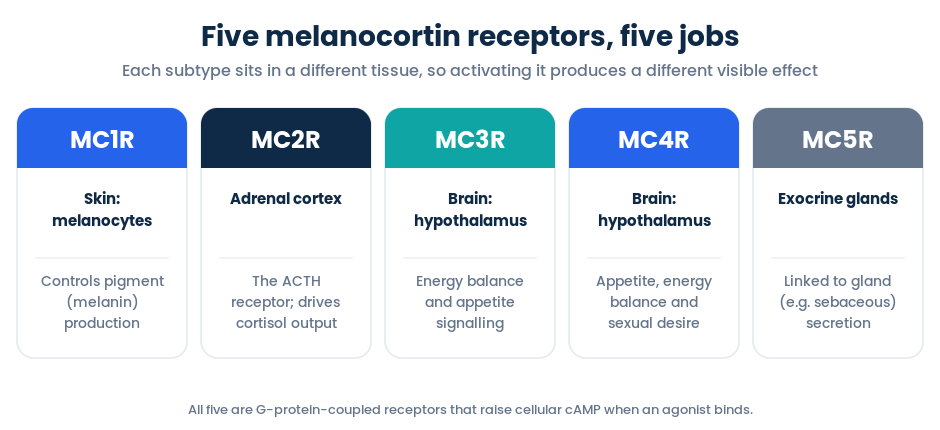
All five melanocortin receptors belong to the largest class of drug targets in the body: G-protein-coupled receptors (GPCRs). When an agonist binds, they signal through the stimulatory Gs protein and raise the level of a small intracellular messenger called cyclic AMP (cAMP), which sets off the tissue’s response. What makes the family interesting is not the shared signalling but the discrete distribution — each subtype is concentrated in a different place, so the same chemical signal produces a completely different outcome depending on which receptor it reaches.
Where each receptor lives and what it does
MC1R sits on melanocytes in the skin (and on several immune cells). It is essentially the receptor for α-melanocyte-stimulating hormone (α-MSH), and its best-known job is controlling how much melanin pigment your skin makes — the pathway behind tanning and hair colour.
MC2R is different from the rest: it lives in the adrenal cortex and responds only to ACTH (adrenocorticotropic hormone). It is the switch that drives production of the stress hormone cortisol. Because it ignores the MSH peptides, drugs aimed at the other subtypes have very little to do with it.
MC3R and MC4R are both found in the brain, especially the hypothalamus, where they help regulate energy balance, appetite and body weight. MC4R is the more famous of the two — inherited defects in MC4R are one of the most common single-gene causes of obesity — and it is also involved in sexual function. The precise division of labour between MC3R and MC4R is still an active research question, so it is fairer to say both are central energy-balance receptors than to give each a tidy, separate job.
MC5R is the least understood. It is linked to exocrine gland function — the glands that secrete substances like sebum — rather than to pigment, cortisol or appetite.
The signals that switch them on and off
The natural “on” signals for these receptors are a set of peptides all cut from a single large precursor protein called pro-opiomelanocortin (POMC). Depending on how POMC is processed, the body releases α-MSH, β-MSH, γ-MSH and ACTH. These are the endogenous agonists.
Just as importantly, the family has natural “off” signals. Two related molecules — agouti and agouti-related peptide (AgRP) — block the receptors rather than activate them. AgRP is a high-affinity antagonist at the brain’s MC3R and MC4R, while agouti acts on MC1R in the skin. This push-and-pull between activating and blocking peptides is how the body fine-tunes pigment and appetite, and it is why simply flooding the system with an agonist rarely produces a clean, single effect.
One drug, every receptor: bremelanotide (PT-141)
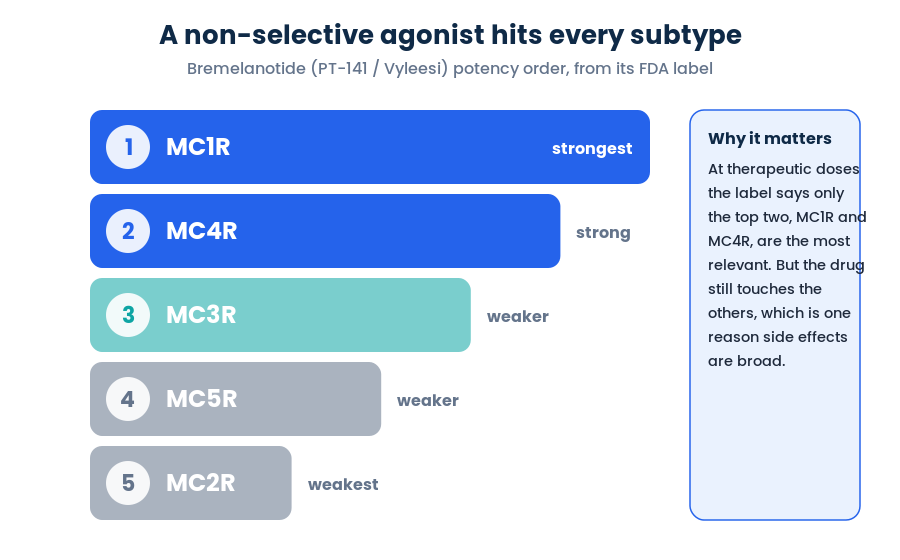
Bremelanotide — sold as the prescription drug Vyleesi and known in research circles as PT-141 — is the clearest example of a non-selective melanocortin agonist. Its FDA label states plainly that it “nonselectively activates several receptor subtypes,” and it even lists the order of potency: MC1R, then MC4R, then MC3R, MC5R and finally MC2R. The label adds that at therapeutic doses, binding to MC1R and MC4R is the most relevant.
Vyleesi is approved for one specific use: acquired, generalised hypoactive sexual desire disorder (HSDD) in premenopausal women. Notably, the label says the exact mechanism by which it improves HSDD “is unknown” — a useful reminder that even an approved, well-studied melanocortin drug still holds open questions. Its most common side effects in the pivotal trials were nausea (about 40%) and flushing (about 20%), along with injection-site reactions and headache. Those broad, whole-body side effects are a direct consequence of a drug that touches several receptor subtypes at once.
Why the same drug can tan skin or change desire
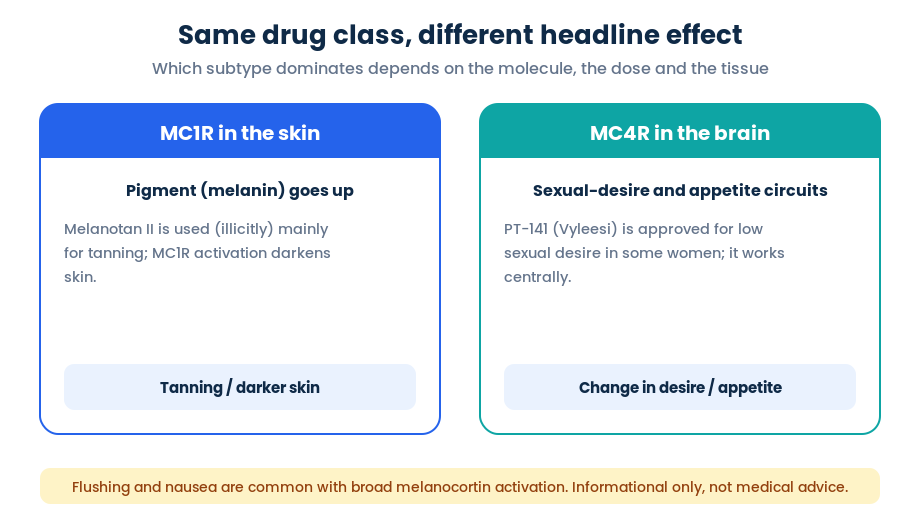
Because the subtypes sit in different tissues, the visible effect of a non-selective agonist depends on which receptor dominates at the dose and in the tissue that matters to that person. Activate MC1R in the skin and you push melanin production up — the reason Melanotan II, an unapproved non-selective agonist, is used illicitly mainly for tanning. Activate MC4R in the brain and you engage the circuits tied to sexual desire and appetite — the effect PT-141 was developed around.
The melanocortin drugs that are actually approved
Three melanocortin-targeting drugs are FDA-approved, each aimed at a different subtype, which nicely illustrates the “different receptor, different use” principle:
- Bremelanotide (Vyleesi) — a non-selective agonist most relevant at MC1R and MC4R, approved for HSDD in premenopausal women.
- Afamelanotide (Scenesse) — an MC1R agonist delivered as a small subcutaneous implant, approved to increase pain-free light exposure in adults with erythropoietic protoporphyria (EPP), a rare light-sensitivity disorder.
- Setmelanotide (Imcivree) — a selective MC4R agonist approved for weight management in specific, genetically defined forms of obesity.
By contrast, Melanotan II — widely sold in the research-peptide market — is not approved for human use anywhere, and its non-selective activity is the source of both its tanning effect and its reported side effects.
Frequently asked questions
Are melanocortin receptors the same as opioid or “MOR” receptors?
No. The abbreviation MCR (melanocortin receptor) is easy to confuse with MOR (mu-opioid receptor), but they are unrelated families with different ligands and roles. Melanocortin receptors respond to POMC-derived peptides like α-MSH and ACTH.
Why does PT-141 cause flushing and nausea if it is meant to act on the brain?
Because it is non-selective. Even though MC4R in the brain is the intended target, the drug also activates MC1R and other subtypes across the body, and broad melanocortin activation is associated with flushing and nausea. The Vyleesi label lists both as common.
Does activating MC1R actually protect skin?
MC1R drives melanin production, and melanin does absorb some UV. But that is a biological pathway, not a safety endorsement of tanning peptides — the pigment response and the drug’s side effects come as a package, and unapproved products are unregulated.
Is MC2R a useful drug target?
MC2R controls adrenal cortisol output and responds only to ACTH, so it sits apart from the MSH-type peptides most research compounds mimic. It is more relevant to endocrinology (for example, ACTH-related conditions) than to the tanning or appetite peptides.
References
- Vyleesi (bremelanotide) FDA Prescribing Information, 2019 — mechanism of action, potency order, indication, adverse reactions. accessdata.fda.gov
- Vyleesi label on DailyMed (U.S. National Library of Medicine). dailymed.nlm.nih.gov
- IUPHAR/BPS Guide to Pharmacology — Melanocortin receptors: Introduction (subtypes, tissue distribution, POMC ligands, AgRP antagonism). guidetopharmacology.org
- Xu Y, et al. The multifaceted melanocortin receptors (review of receptor pharmacology and Gs/cAMP signalling), PMC. pmc.ncbi.nlm.nih.gov
- Scenesse (afamelanotide) FDA Prescribing Information, 2019 — MC1R agonist, EPP indication. accessdata.fda.gov
- PubChem compound record — bremelanotide (CID 9941379). pubchem.ncbi.nlm.nih.gov
Informational only — not medical advice · 21+. Research peptides discussed here are not approved for human use except where a specific FDA-approved product is named.