
What Is Vasopressin (ADH)? The Body’s Water-Balance Hormone
Hormone biology
Vasopressin — also called antidiuretic hormone (ADH) — is the body’s main water-conservation signal: a tiny nine-amino-acid peptide that tells the kidneys how much water to hold on to, and helps defend blood pressure when volume runs low.
What is vasopressin?
Vasopressin is a nonapeptide — a peptide just nine amino acids long. Its sequence is Cys-Tyr-Phe-Gln-Asn-Cys-Pro-Arg-Gly, capped with an amide at the end, and a disulfide bridge between the two cysteines folds the first six residues into a small ring. That structure is almost identical to oxytocin; the two hormones differ by only two amino acids, which is why they are studied as a closely related pair.
It is built in the hypothalamus (by neurons of the supraoptic and paraventricular nuclei) as part of a larger precursor that also contains a carrier protein, neurophysin II, and a fragment called copeptin. The finished hormone travels down nerve fibres and is released from the posterior pituitary into the bloodstream. Chemically it carries the formula C46H65N15O12S2 with a molecular weight of about 1,084 daltons (PubChem lists it under the name argipressin), and the gene that encodes it is simply called AVP.
Two triggers: when vasopressin is released
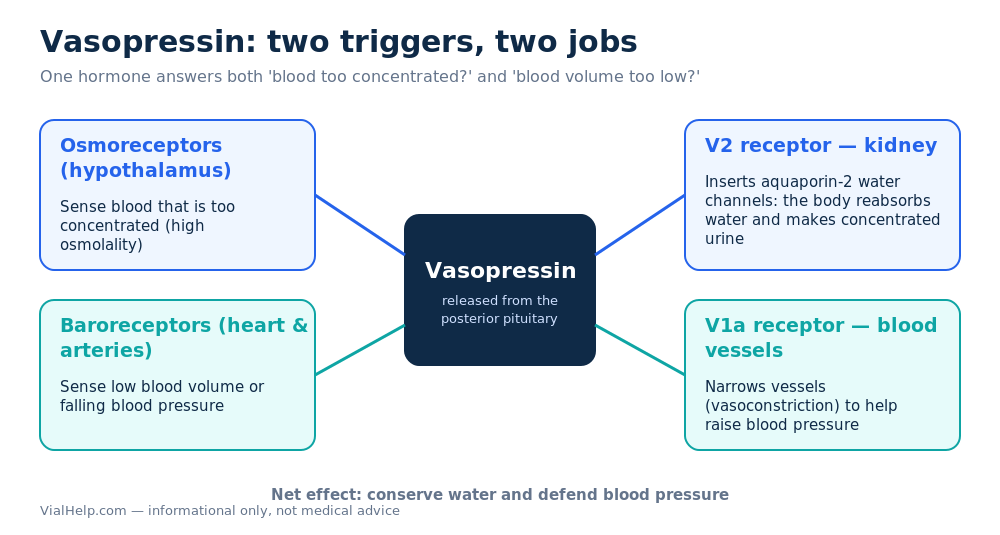
Vasopressin answers two different alarms. The first is osmoregulation: specialised osmoreceptors in the hypothalamus track how concentrated the blood is, and they are remarkably sensitive — a change in plasma concentration of only about 2 mOsm/L is enough to nudge vasopressin up or down. When blood becomes too concentrated, vasopressin rises and the kidneys reclaim water.
The second is baroregulation: stretch receptors in the heart and great arteries sense blood volume and pressure. When volume falls, they call for vasopressin too — and at higher levels the hormone also tightens blood vessels. Other signals tune this system: angiotensin II (a driver of the renin-angiotensin-aldosterone system) pushes vasopressin up, while atrial natriuretic peptide pushes it down. That places vasopressin squarely inside the same fluid-and-pressure network as the RAAS and the natriuretic peptides.
How vasopressin works: three receptors
Vasopressin acts through three receptors, all of them G-protein-coupled receptors, each in a different place and wired to a different internal signal.
- V1a — on vascular smooth muscle and liver; couples through Gq and phospholipase C; causes vasoconstriction that raises vascular resistance.
- V1b (also called V3) — in the anterior pituitary and brain; also Gq-coupled; helps stimulate release of ACTH, linking vasopressin to the stress axis.
- V2 — in the kidney’s collecting duct; couples through Gs and cAMP; inserts aquaporin-2 water channels into the cell membrane so water is reabsorbed and the urine becomes concentrated. This is the classic “antidiuretic” action.

Where vasopressin fits in fluid and blood-pressure control
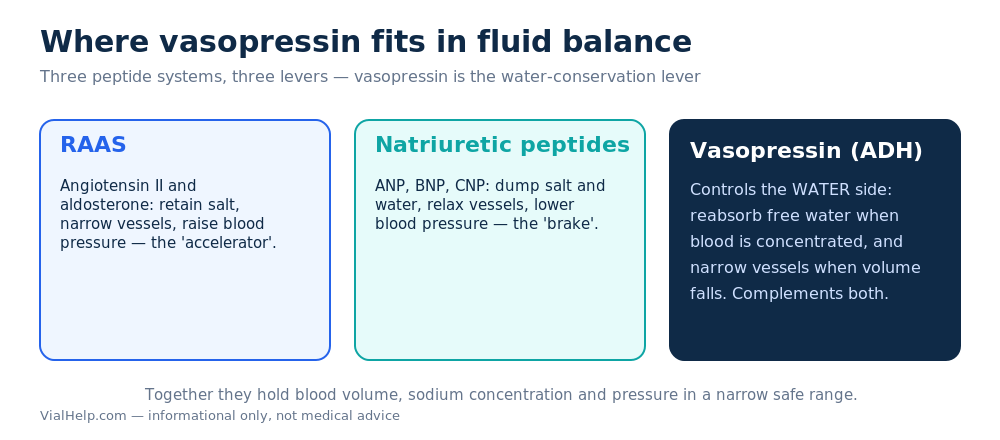
It helps to see vasopressin next to its neighbours. The renin-angiotensin-aldosterone system is the accelerator — it retains salt and raises pressure. The natriuretic peptides are the brake — they dump salt and water and relax vessels. Vasopressin works mainly on the water side of that balance: reclaim free water when the blood is concentrated, and tighten vessels when volume falls. Together the three systems keep blood volume, sodium concentration and pressure inside a narrow, safe range.
Copeptin: a stable stand-in
Vasopressin itself is hard to measure — it is short-lived in the blood and largely rides on platelets. So laboratories often measure copeptin instead: the 39-amino-acid tail of the same precursor, released in equal amounts with vasopressin but far more stable. Copeptin has become a practical surrogate marker used to help sort out water-balance disorders.
Vasopressin in medicine and research
Because it is a peptide, swallowed vasopressin would simply be digested, so it is given by injection or as chemically modified analogs. A few reference points, informational only:
- Desmopressin (DDAVP) is a synthetic analog with mostly V2 (water) action and little pressor effect; it is used for central diabetes insipidus and, separately, to raise clotting factors in certain bleeding conditions.
- Vasopressin injection (Vasostrict) is FDA-approved (initial U.S. approval 2014) to raise blood pressure in adults with vasodilatory shock.
- Vaptans such as tolvaptan and conivaptan are V2-receptor blockers that cause the kidneys to excrete free water (aquaresis); they are used for certain forms of low blood sodium.
Frequently asked questions
Is vasopressin the same thing as ADH?
Yes. Antidiuretic hormone (ADH) and arginine vasopressin (AVP) are two names for the same molecule. “Antidiuretic” describes its best-known job: signalling the kidneys to hold on to water.
How is vasopressin different from oxytocin?
They are near-twins. Both are nine-amino-acid ring peptides released from the posterior pituitary, and they differ at just two positions in the chain. Those small differences give vasopressin its water- and pressure-related actions and oxytocin its very different roles.
Why can’t vasopressin be taken as a pill?
Like most peptides, it would be broken down in the digestive tract before it could act — a general feature of how the body handles peptides. That is why vasopressin is injected and why analogs such as desmopressin are engineered for other routes.
What does vasopressin have to do with blood pressure?
At higher levels, vasopressin acts on V1a receptors to constrict blood vessels, which supports blood pressure when volume is low. That pressor action is why a form of vasopressin is used in shock — though its everyday role is water balance, not pressure.
- Cuzzo B, Padala SA, Lappin SL. Physiology, Vasopressin. StatPearls. ncbi.nlm.nih.gov/books/NBK526069
- PubChem. Argipressin (vasopressin), CID 644077. pubchem.ncbi.nlm.nih.gov/compound/644077
- IUPHAR/BPS Guide to Pharmacology. Vasopressin and oxytocin receptors. guidetopharmacology.org
- Endotext. The Neurohypophysis: Endocrinology of Vasopressin and Oxytocin. ncbi.nlm.nih.gov/books/NBK279157
- Working Group for Renaming Diabetes Insipidus. Endocrine Connections 2022;11(11). PMC9759163
- DailyMed. Vasostrict (vasopressin injection) label. dailymed.nlm.nih.gov
Informational only — not medical advice · 21+