
What Is Amylin? The Other Beta-Cell Hormone
Beta-cell biology
What is amylin? Amylin is a 37-amino-acid hormone released by the pancreas alongside insulin every time you eat. It is far less famous than insulin, but it is a co-star: the two hormones are stored together in the same beta-cell granules and secreted together in response to food. Amylin is also known as islet amyloid polypeptide (IAPP).
What is amylin?
Amylin is a small peptide hormone of 37 amino acids, with a disulfide bridge between its second and seventh residues and an amidated tail — both features it needs to be active. Its gene, IAPP, sits on chromosome 12, and the hormone is cut from a larger precursor (proIAPP) by the very same enzymes that process proinsulin. That shared machinery is a clue to its role: amylin is built and shipped as insulin’s partner, in far smaller amounts — on the order of about one percent of insulin on a molar basis.
What amylin does after a meal
Insulin lowers blood glucose directly. Amylin works differently: it restrains how fast glucose arrives in the blood after a meal, acting like a set of brakes.
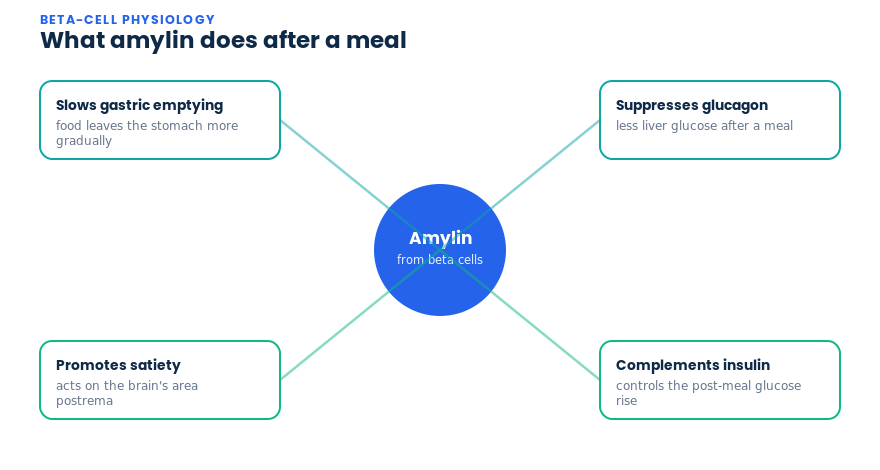
It has three to four core actions, all well documented on the FDA label for its analog and in review literature. Amylin slows gastric emptying, so food (and its glucose) leaves the stomach more gradually — without changing how much is ultimately absorbed. It suppresses glucagon, especially after eating, which means the liver releases less of its own glucose. And it promotes satiety by acting on the brain’s area postrema, helping signal fullness. Together these complement insulin in smoothing out the post-meal glucose rise.
The amylin receptor
There is no single dedicated “amylin receptor” gene. Instead, amylin acts on a complex: the calcitonin receptor core plus an accessory protein called a RAMP (receptor activity-modifying protein). Different RAMPs produce the AMY1, AMY2 and AMY3 receptor subtypes. The calcitonin receptor itself is a class B GPCR, coupling to cAMP — so amylin, like GLP-1 and GIP, ultimately signals through G-protein machinery, not a tyrosine kinase.
Where amylin fits among the meal-time hormones
It helps to see amylin next to the hormones it works with rather than in isolation.
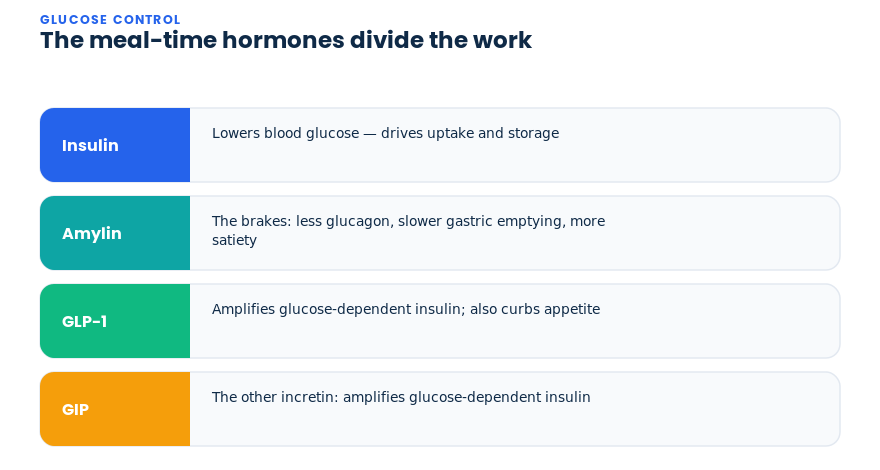
Think of it as a division of labour: insulin lowers glucose by driving uptake and storage; amylin applies the brakes (less glucagon, slower gastric emptying, more satiety); and the incretins GLP-1 and GIP turn up glucose-dependent insulin secretion when glucose is high. A useful one-liner: insulin lowers glucose, amylin restrains the meal, and the incretins amplify insulin exactly when it is needed.
Why the medicine isn’t human amylin: pramlintide
Here is a genuinely interesting wrinkle. You cannot simply bottle human amylin as a drug, because human amylin is amyloidogenic — it aggregates into sticky islet-amyloid deposits (a hallmark associated with beta-cell dysfunction in type 2 diabetes) and is hard to keep in solution.
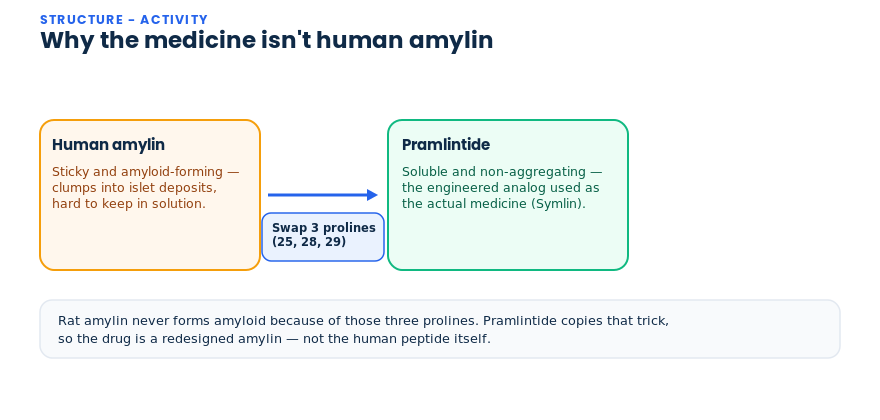
Rat amylin, by contrast, does not form amyloid, thanks to three proline residues that break up the aggregation-prone stretch. Drug designers borrowed that trick: pramlintide (brand name Symlin) is human amylin with proline substituted in at positions 25, 28 and 29, making it soluble and non-aggregating. Pramlintide was FDA-approved in 2005 as an adjunct to mealtime insulin in type 1 and type 2 diabetes, injected separately from insulin. It carries a boxed warning for insulin-induced severe hypoglycemia — we cover the safety profile in detail in our amylin peptide side effects article.
Cagrilintide and CagriSema
Amylin is having a second moment in obesity research. Cagrilintide is a long-acting, once-weekly amylin analog in development for weight management, and CagriSema pairs it with the GLP-1 drug semaglutide in a single once-weekly combination. In the phase 3 REDEFINE program, the combination produced substantial weight loss over 68 weeks. Importantly, as of 2026 cagrilintide and CagriSema remain investigational and not FDA-approved — the manufacturer filed its U.S. application in December 2025 and review is ongoing. If you are comparing the incretin drugs it is often studied against, see semaglutide vs tirzepatide.
Frequently asked questions
Is amylin the same as insulin?
No. They are made and released together by the same beta cells, but they are different hormones with different jobs. Insulin lowers blood glucose; amylin slows gastric emptying, suppresses glucagon and promotes satiety.
Is amylin an incretin like GLP-1 and GIP?
No. Incretins are gut hormones that amplify insulin secretion. Amylin is a beta-cell hormone co-secreted with insulin that restrains the post-meal glucose rise from a different angle.
Why is pramlintide used instead of amylin itself?
Human amylin clumps into amyloid and is hard to keep dissolved. Pramlintide swaps in three prolines (positions 25, 28, 29) to make a soluble, non-aggregating analog suitable as a medicine.
Is cagrilintide approved?
Not as of 2026. Cagrilintide and the CagriSema combination are investigational; a U.S. application was filed in December 2025 and remains under review.
References
- UniProt. Islet amyloid polypeptide (IAPP), human, P10997. uniprot.org/uniprotkb/P10997
- SYMLIN (pramlintide acetate) Prescribing Information, U.S. FDA, 2005. accessdata.fda.gov
- Akter R et al. Islet Amyloid Polypeptide: Structure, Function, and Pathophysiology. J Diabetes Res 2016. onlinelibrary.wiley.com
- Westermark P et al. Islet Amyloid Polypeptide, Islet Amyloid, and Diabetes Mellitus. Physiol Rev 2011. journals.physiology.org
- IUPHAR/BPS Guide to Pharmacology. Calcitonin receptors family (AMY1–3). guidetopharmacology.org
- Coadministered Cagrilintide and Semaglutide in Overweight or Obesity (REDEFINE 1). N Engl J Med 2025. nejm.org
Informational only — not medical advice. For research and educational use by adults 21+. Consult a qualified healthcare professional about any medication.