
Sermorelin Side Effects & Safety: What the Record Actually Shows
Peptide side effects & safety series
Sermorelin side effects are unusually well documented for a peptide in this series, because sermorelin was once an actual FDA-approved drug — not a gray-market research chemical. That gives us a real label and real pediatric trial data to work from, instead of the handful of tiny studies most of these compounds rely on.
What is sermorelin?
Sermorelin is a synthetic 29-amino-acid peptide, GRF(1–29), corresponding to the first 29 residues of growth-hormone-releasing hormone (GHRH), which is 44 amino acids long. Those 29 residues are the shortest fragment that keeps GHRH’s full activity. Chemically it is C149H246N44O42S with a molecular weight around 3,358 daltons (PubChem CID 16132413), and it has a short half-life of roughly 11–12 minutes. Its job is to be a growth hormone secretagogue: it stimulates the pituitary to release the body’s own GH, working as an agonist at the pituitary GHRH receptor rather than supplying GH from outside. That distinction — nudging the pituitary versus injecting a fixed dose of hormone — matters for its safety story. For how it differs from the ghrelin-type secretagogues, see GHRH analogs vs GHRPs.
The regulatory backstory: withdrawn is not the same as unsafe
This is the single most important thing to understand about sermorelin, and it is frequently misrepresented.

Sermorelin acetate was FDA-approved twice: as Geref Diagnostic in 1990 (to test pituitary GH reserve) and as Geref in 1997 (to treat idiopathic growth hormone deficiency in children with growth failure). The manufacturer discontinued both products in 2008, and FDA withdrew the approvals in 2009. Crucially, in a 2013 Federal Register determination the FDA stated in its own words that the products were “not withdrawn for reasons of safety or effectiveness” — the exit was a commercial decision. So “no longer on the market” here does not mean “found dangerous.” That nuance is exactly why sermorelin is a useful contrast in this series.
Sermorelin side effects in the FDA label
Because Geref went through the approval process, its adverse-event profile is anchored to a real label and a trial population of about 350 patients — a far stronger evidence base than the tiny physiology studies behind most research peptides.

The most common sermorelin side effect was a local injection-site reaction — pain, swelling or redness — in about one patient in six; of the 350 patients in trials, only 3 discontinued because of it. Other treatment-related events each occurred in under 1% of patients: headache, flushing, difficulty swallowing, dizziness, hyperactivity, sleepiness and hives. When used intravenously for the diagnostic test, reported reactions included facial flushing, injection-site discomfort, nausea, headache, vomiting, an altered sense of taste, pallor and chest tightness. The label also notes a 6.5% incidence of hypothyroidism during therapy, which is why thyroid function is monitored.
One item deserves care: a large proportion of patients developed anti-GHRH antibodies at some point during treatment. The label gives no percentage, says the significance is unclear, notes the antibodies were often transient, and reports they did not appear to affect growth or produce a specific adverse-reaction pattern. Any vendor citing a precise antibody rate is inventing it.
Mechanism-based and class-level considerations
The Geref label directly confirms that sermorelin can raise GH and IGF-1 (along with inorganic phosphorus and alkaline phosphatase). From there, the broader cautions that apply to any stimulation of the GH axis — fluid retention, joint aches, carpal-tunnel-type symptoms, effects on insulin sensitivity and glucose, and the theoretical IGF-1/proliferation concern — are mechanism-based extrapolations from GH pharmacology. They were not enumerated as sermorelin trial findings, and it is important not to present them as if they were. Because sermorelin acts through the pituitary, GH output stays subject to the body’s own negative feedback (somatostatin) and finite pituitary reserve, giving it a self-limiting ceiling that a fixed dose of injected GH does not have. That is a reasonable pharmacologic argument, not a proven long-term outcome. The same GH-axis themes run through our growth hormone peptide side effects overview and the FDA-approved GHRH analog tesamorelin.
Contraindications and interactions
From the label: sermorelin is contraindicated in anyone with known sensitivity to it or its excipients. It is not recommended in patients whose GH deficiency stems from an intracranial lesion (that group was not studied). Concomitant glucocorticoids can blunt the response, and untreated hypothyroidism can jeopardize it, so thyroid status is checked before and during use. It was Pregnancy Category C, and carcinogenicity and fertility studies were not performed. Physiologically, somatostatin opposes GHRH, though that is biology rather than a listed drug interaction.
Two different kinds of risk
The honest bottom line splits into two separate questions that often get blurred together.
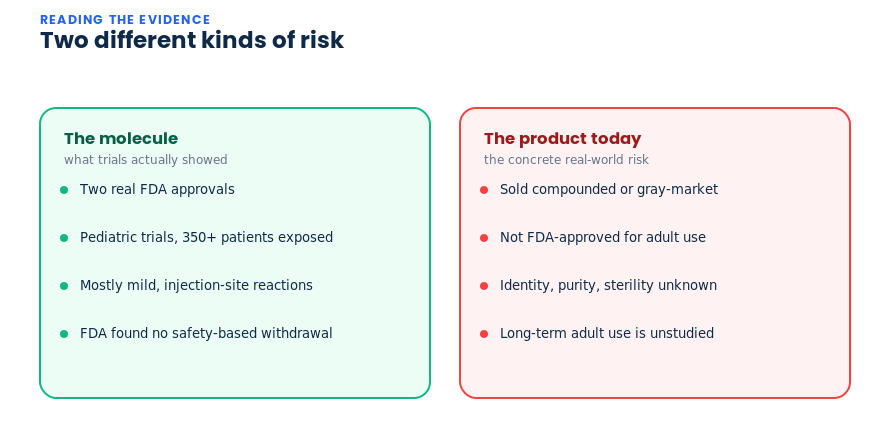
The molecule has a relatively reassuring, injection-site-dominated safety record from real pediatric trials and two FDA approvals, and the FDA found no safety-based reason for its withdrawal. The product you can actually buy today is a different matter. Geref is no longer marketed; sermorelin now comes from 503A compounding pharmacies or gray-market “research” vendors, is not FDA-approved, and its long-term use in healthy adults for anti-aging or bodybuilding is off-label and essentially unstudied. In that setting the concrete, real-world risk is product identity, purity and sterility — not the peptide’s intrinsic trial profile. Careful reconstitution and sterile technique reduce handling risk but cannot fix an unverified product.
Frequently asked questions
Is sermorelin FDA-approved?
Not anymore. It was approved as Geref (1990 and 1997) but the approvals were withdrawn in 2009 after the maker discontinued it for commercial reasons. Today’s sermorelin is compounded or gray-market and is not FDA-approved.
What are the most common sermorelin side effects?
In trials, injection-site reactions (pain, swelling, redness) were most common, at about one patient in six. Other events — headache, flushing, dizziness and similar — each occurred in under 1%, and hypothyroidism was noted in 6.5%.
Was sermorelin withdrawn because it was dangerous?
No. The FDA formally determined it was not withdrawn for reasons of safety or effectiveness; the decision was commercial.
Is sermorelin banned in sport?
Yes. As a GHRH analog it falls under WADA class S2 (growth-hormone-releasing factors) and is prohibited at all times. See our WADA prohibited list explainer.
References
- Determination That GEREF (Sermorelin Acetate) Was Not Withdrawn for Safety or Effectiveness. Federal Register, 78 FR 14095, 2013. federalregister.gov
- Federal Register official PDF (govinfo), 2013-04827. govinfo.gov
- Sermorelin Acetate (Geref) Prescribing Information. rxlist.com/sermorelin-acetate-drug
- Sermorelin. PubChem CID 16132413 (C149H246N44O42S). pubchem.ncbi.nlm.nih.gov
- Sermorelin: a review of its use in idiopathic GH deficiency in children. PubMed 18031173. pubmed.ncbi.nlm.nih.gov/18031173
- WADA Prohibited List — S2 Peptide Hormones, Growth Factors. wada-ama.org/en/prohibited-list
Informational only — not medical advice. For research and educational use by adults 21+. This article summarizes published label and trial data and is not guidance for personal use; consult a qualified healthcare professional.