
Tesamorelin (Egrifta) Side Effects: What the FDA Label Shows
Tesamorelin side effects are unusually well documented — and that is exactly what makes this compound worth a close look. Most peptides discussed in the research community have little or no human safety data. Tesamorelin is the rare exception: it is an actual FDA-approved drug, sold as Egrifta, with a prescribing label that lists real adverse-reaction rates from controlled trials. That gives us something almost no other “GHRH analog” has — numbers.
What tesamorelin is
Tesamorelin is a synthetic analog of human growth-hormone-releasing hormone (GHRH). It is the full 44-amino-acid GHRH sequence with a small chemical cap added to the N-terminus to make it more stable. Like natural GHRH, it acts on the pituitary gland to stimulate the release of growth hormone, which in turn raises IGF-1. The FDA approved it in 2010 (manufacturer Theratechnologies) for one specific use: reducing excess visceral abdominal fat in people with HIV-associated lipodystrophy. It is explicitly not approved as a general weight-loss drug.
Tesamorelin side effects reported in trials
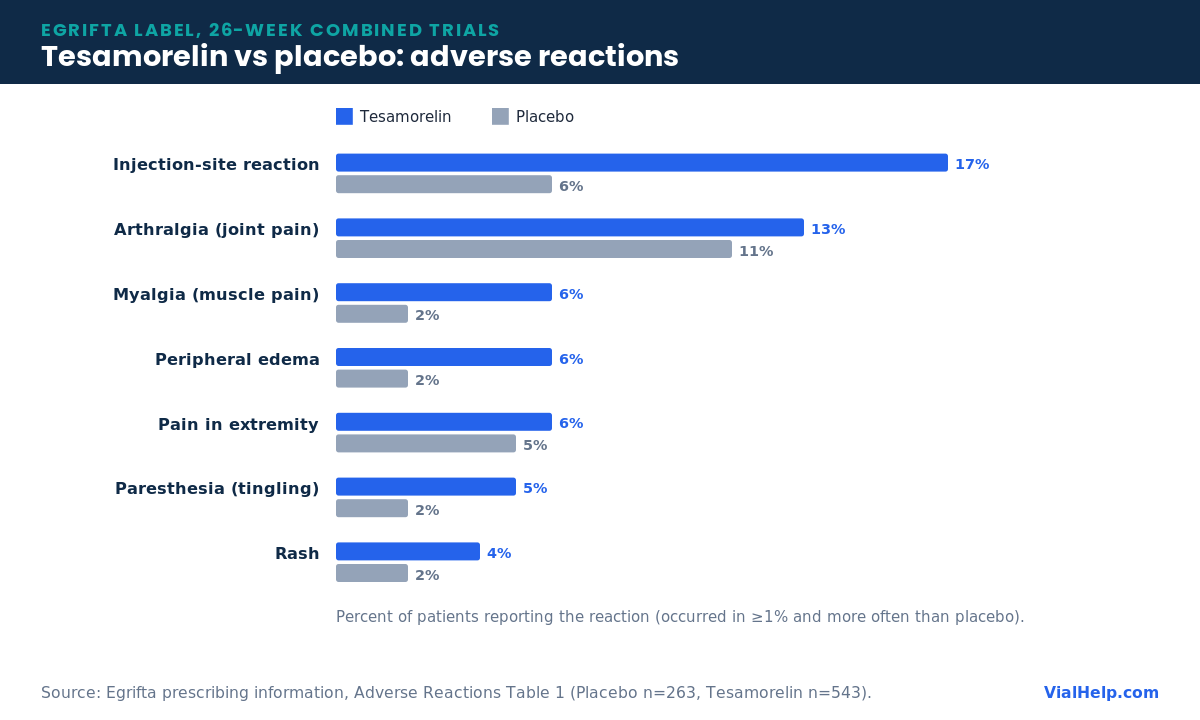
The most common reactions on the label — those occurring in more than 5% of patients and more often than placebo — were joint pain (arthralgia), injection-site reactions (redness, itching, pain), pain in the extremities, swelling (peripheral edema), and muscle pain (myalgia). From the label’s combined 26-week adverse-reaction table (placebo n=263, tesamorelin n=543):
- Injection-site reaction — 17% vs 6% placebo (a broader tally in the Warnings section puts injection-site reactions at 25% vs 14%).
- Arthralgia — 13% vs 11%.
- Myalgia — 6% vs 2%; peripheral edema — 6% vs 2%; pain in extremity — 6% vs 5%.
- Paresthesia (tingling) — 5% vs 2%; rash — 4% vs 2%.
Hypersensitivity reactions (itching, redness, flushing, hives) occurred in about 4% of treated patients.
What the label tells doctors to monitor
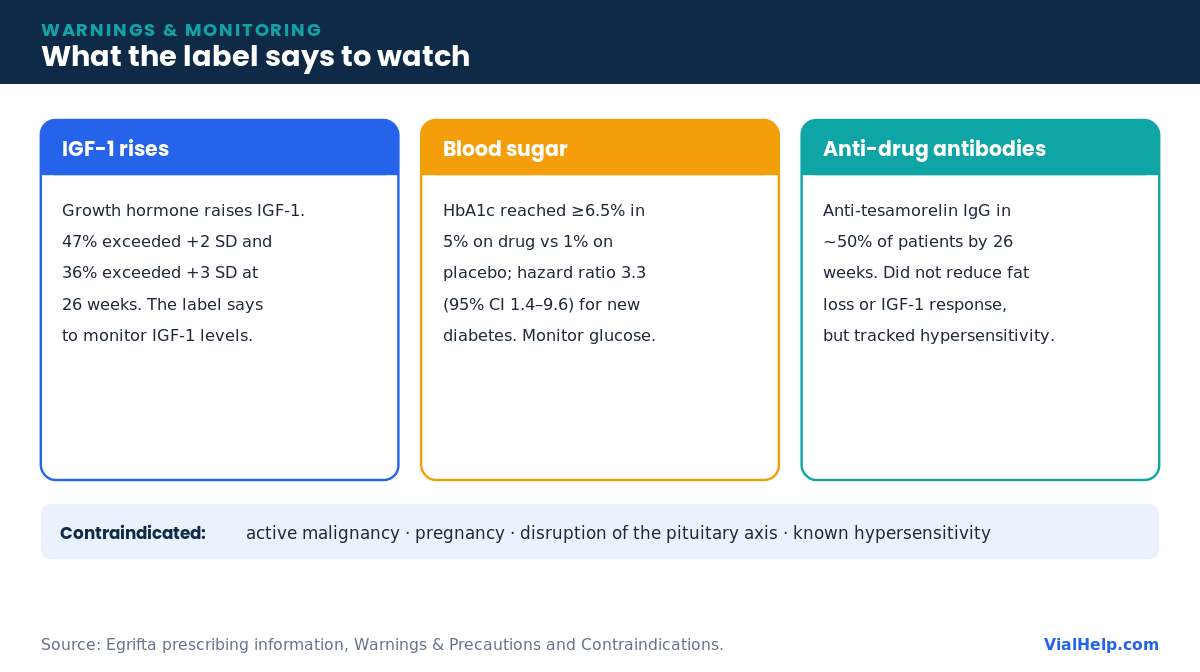
Beyond the reaction list, the label carries several warnings that reflect how the drug works — it raises growth hormone and IGF-1:
- Elevated IGF-1. Because tesamorelin raises growth hormone, IGF-1 climbs. In trials, 47% of patients exceeded +2 standard deviations and 36% exceeded +3 SD by 26 weeks. The label advises monitoring IGF-1 and considering stopping if it stays high.
- Glucose intolerance. New elevated HbA1c (≥6.5%) occurred in 5% on drug vs 1% on placebo, with a hazard ratio of 3.3 (95% CI 1.4–9.6) for developing diabetes. Blood sugar should be monitored.
- Fluid retention. Edema, joint pain, and carpal tunnel syndrome can occur and are often transient.
- Anti-drug antibodies. Roughly 50% of patients developed anti-tesamorelin antibodies by 26 weeks. Notably, these did not reduce fat loss or the IGF-1 response, though they were more common in patients who had hypersensitivity reactions.
Contraindications: who should not use it
The label lists clear contraindications: active malignancy (growth hormone is a growth factor, so any prior cancer must be inactive), disruption of the hypothalamic-pituitary axis (pituitary surgery, tumor, radiation, or head trauma), pregnancy, and known hypersensitivity to tesamorelin. These are not fine print — they are the situations where the drug’s mechanism becomes a real hazard.
The bigger lesson: approved drug vs gray-market “GHRH analog”
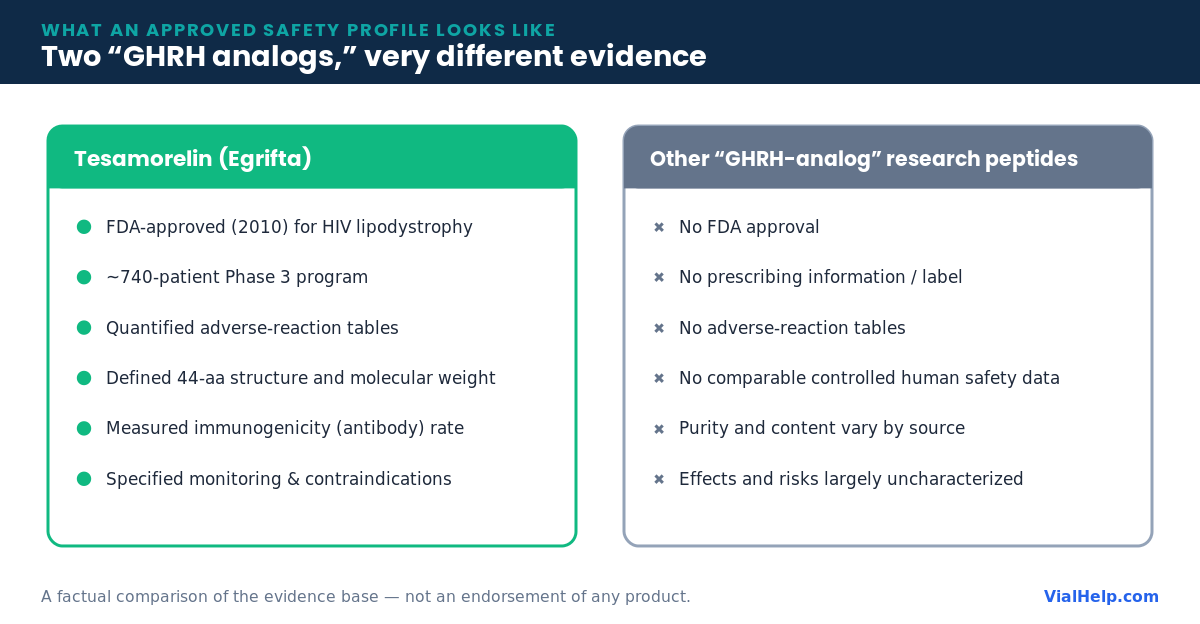
Tesamorelin is worth studying precisely because it shows what a genuinely evidenced peptide safety profile looks like: a defined structure and molecular weight, a controlled trial program, quantified adverse-reaction tables, a measured antibody rate, and specific monitoring and contraindications. By contrast, other marketed “GHRH-analog” research peptides — CJC-1295 is the usual example — have no FDA approval, no prescribing information, no adverse-reaction tables, and no comparable controlled human safety data. That is a factual difference in the evidence base, stated without endorsing or condemning any product.
What this does not mean
Tesamorelin’s data come from a specific population (adults with HIV-associated lipodystrophy) at a specific dose. They do not translate into a safety clearance for using it — or any GHRH analog — for other goals, at other doses, or from unregulated sources. A well-characterized side-effect profile is information, not permission. Decisions about any of these compounds belong with a qualified clinician.
Frequently asked questions
Is tesamorelin the same as CJC-1295 or sermorelin?
They are related — all act on the GHRH pathway to raise growth hormone — but they are different molecules with very different regulatory status. Tesamorelin is an FDA-approved drug with a full label; CJC-1295 and gray-market sermorelin products are not approved and lack comparable safety datasets.
What is the most common tesamorelin side effect?
Injection-site reactions and joint pain are the most frequently reported. On the label, injection-site reactions appear in 17–25% of patients depending on how they are tallied, and arthralgia in about 13%.
Why does tesamorelin affect blood sugar?
Growth hormone opposes some of insulin’s actions, so raising it can nudge glucose upward. In trials this showed up as more patients crossing into an elevated HbA1c and a higher hazard ratio for diabetes, which is why glucose monitoring is on the label.
Do the anti-drug antibodies make it stop working?
In the trials, no — about half of patients developed antibodies, but fat loss and IGF-1 response were unaffected. Antibodies did track with a higher chance of hypersensitivity reactions.
- Egrifta (tesamorelin) prescribing information — current FDA label. https://www.accessdata.fda.gov/drugsatfda_docs/label/2025/022505s020lbl.pdf
- DailyMed — EGRIFTA SV (tesamorelin) label. https://dailymed.nlm.nih.gov/dailymed/drugInfo.cfm?setid=3d783378-b02d-4f19-99dd-0fc91a042224
- FDA original approval letter, NDA 22-505 (2010). https://www.accessdata.fda.gov/drugsatfda_docs/appletter/2010/022505s000ltr.pdf
- Falutz J, et al. Metabolic effects of a growth hormone-releasing factor in patients with HIV. N Engl J Med. 2007;357:2359–2370. https://www.nejm.org/doi/full/10.1056/NEJMoa072375
- Falutz J, et al. Long-term safety and effects of tesamorelin, a GHRH analogue, in HIV patients. J Acquir Immune Defic Syndr. 2010;53:311–322. https://pubmed.ncbi.nlm.nih.gov/20101189/
- LiverTox: Tesamorelin monograph, NIH. https://www.ncbi.nlm.nih.gov/books/NBK548730/
Informational only — not medical advice. This summarizes published label and trial data; it is not a recommendation to use tesamorelin or any peptide. VialHelp does not sell or recommend peptides. Consult a qualified healthcare professional. 21+.