
Can Peptides Cross the Blood-Brain Barrier?
Guide
Peptides and the blood-brain barrier have a complicated relationship. The barrier that protects your brain is very good at keeping large, water-loving molecules out — and most research peptides are exactly that. This guide explains what the blood-brain barrier is, why most peptides struggle to cross it, the specific routes that do let some through, and why intranasal “nose-to-brain” claims deserve a careful read.
What is the blood-brain barrier?
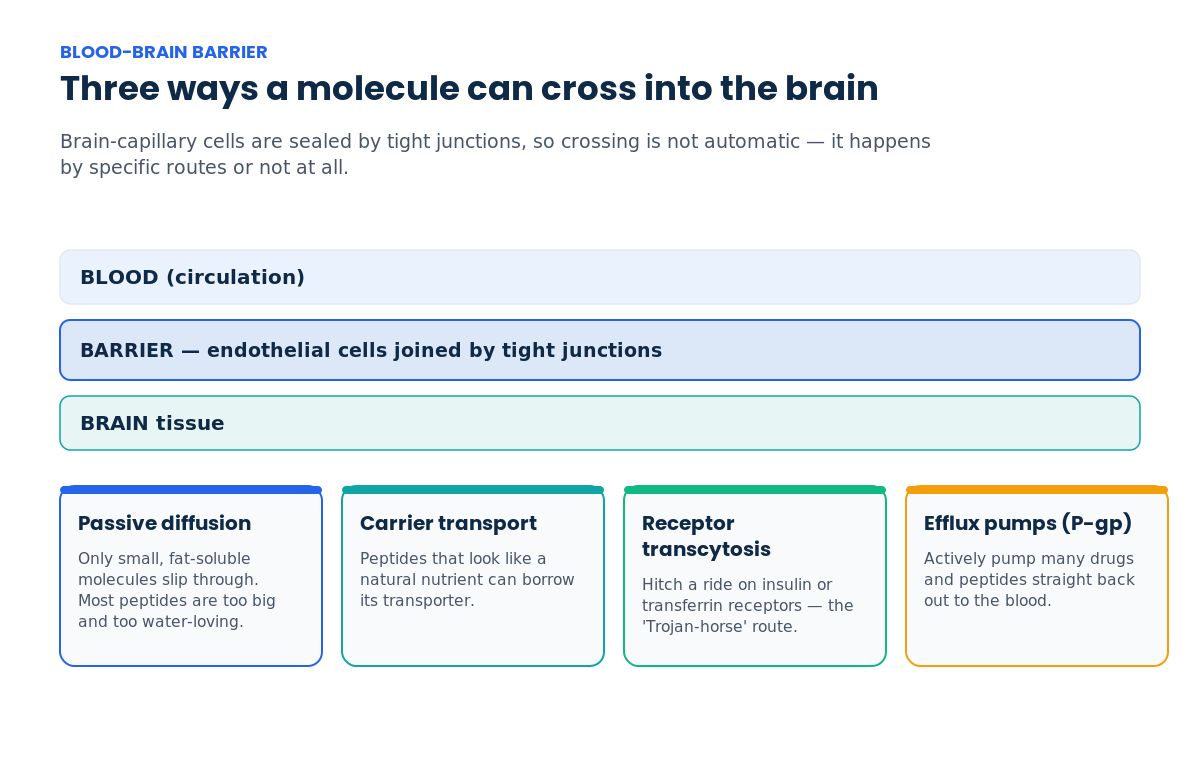
The blood-brain barrier (BBB) is a selective filter formed by the endothelial cells that line the tiny blood vessels feeding the brain. Unlike vessels elsewhere in the body, these cells are stitched together by tight junctions — protein seals (claudins, occludin) that close the gaps between neighbouring cells — and they carry very little of the bubble-like vesicle traffic that ferries material across other tissues. The result is a wall that blocks the casual passage of molecules from blood into brain tissue, shielding neurons from toxins, pathogens, and swings in blood chemistry.
Because the route between cells is essentially sealed, anything entering the brain generally has to go through the cells — and that favours small, fat-soluble molecules. A common rule of thumb, associated with the work of William Pardridge, is that a molecule diffuses across best when it is lipid-soluble, only a few hundred daltons in size, and carries few hydrogen-bond-forming groups. Treat that as an approximation, not a hard cutoff.
Why most peptides don’t cross the blood-brain barrier
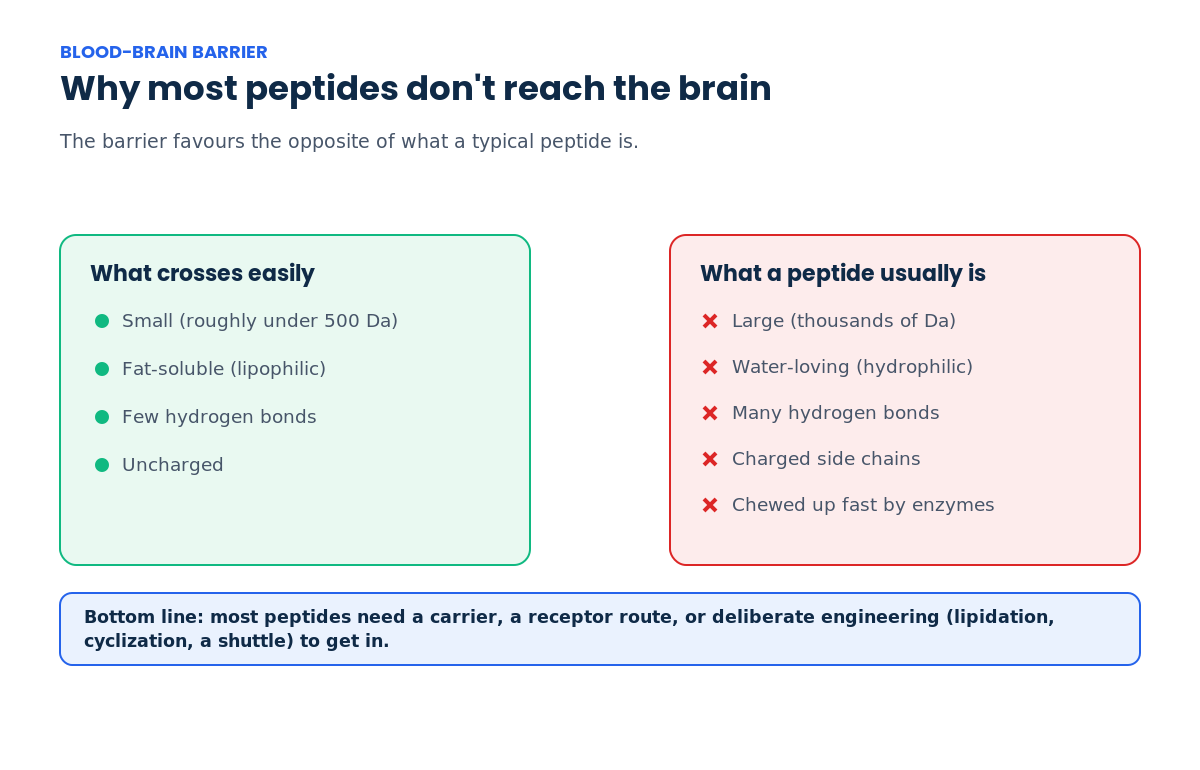
Peptides are, almost by definition, the opposite of what the barrier lets through. They tend to be relatively large, hydrophilic (water-loving), and carry charged side chains. Three additional factors stack the odds against them:
- Enzymatic breakdown. Peptidases in the blood and at the vessel wall chew up intact peptide before much of it can cross.
- Efflux pumps. Transporters such as P-glycoprotein (P-gp) and the MRP family actively pump many peptides and drugs straight back out into the blood.
- Charge and polarity. The sealed junctions and vessel surface disfavour charged, polar molecules.
So even a peptide that is stable in the bloodstream may never reach brain tissue in meaningful amounts. This is a big reason why so many “brain peptides” show striking effects in a dish or in rodents yet have thin human data.
The routes that do let some peptides in
Some molecules genuinely cross — by specific, catalyzed mechanisms rather than by drifting through:
- Carrier-mediated transport. A peptide-like molecule that resembles a natural nutrient can borrow that nutrient’s dedicated transporter.
- Receptor-mediated transcytosis (RMT). The barrier naturally shuttles certain circulating proteins across using receptors — notably the insulin receptor and the transferrin receptor. This is the basis of the “molecular Trojan horse” strategy, in which a therapeutic is attached to a ligand that binds one of these receptors and hitches a ride.
- Adsorptive-mediated transcytosis. Positively charged (cationic) peptides bind the negatively charged vessel surface and are taken up — the mechanism behind cell-penetrating peptides such as TAT.
Intranasal delivery: partly bypassing the barrier
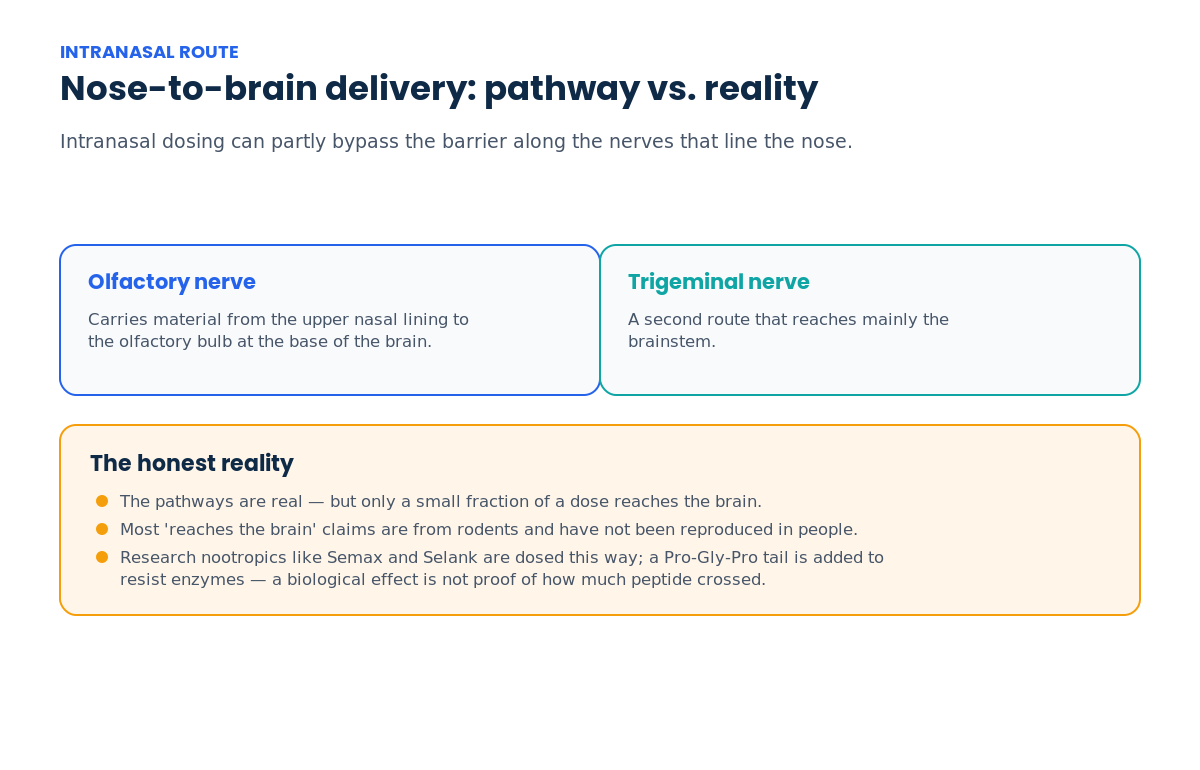
One route sidesteps the bloodstream entirely: intranasal, or “nose-to-brain,” dosing. Material deposited high in the nasal cavity can travel toward the central nervous system along two nerves that pass through the nose — the olfactory nerve (toward the olfactory bulb) and the trigeminal nerve (mainly toward the brainstem) — plus some movement through cerebrospinal fluid and lymphatics. Peptides and proteins, not just small molecules, have been shown to move this way in models.
This is why research nootropic peptides such as Semax and Selank are studied intranasally. Both carry a Pro-Gly-Pro tail added specifically to slow enzymatic breakdown; Semax is a fragment analog related to ACTH, and Selank is derived from the immune peptide tuftsin.
What the evidence does — and doesn’t — show
Engineering peptides to reach the brain
Because the default answer is “no,” drug developers use deliberate tricks to improve brain penetration: raising lipophilicity (including backbone modifications like N-methylation), cyclizing the peptide to resist enzymes and improve permeability, attaching cell-penetrating peptides, or using the Trojan-horse approach of targeting a transferrin- or insulin-receptor to ride across. Some strategies combine more than one. None of this turns an ordinary research peptide into a brain-penetrant one — it takes design. For a broader look at how peptides differ from ordinary drugs, see peptides vs. small-molecule drugs and what is a peptide?
Handling note (research context)
Whatever a peptide’s brain-penetration profile, the lab basics are unchanged: reconstitute and store it correctly, and work out concentrations before anything else. Our reconstitution calculator handles the mg/mL math. Brain penetration is a property of the molecule and its formulation — not something reconstitution changes.
Frequently asked questions
Can peptides cross the blood-brain barrier?
A few can, but most cannot in meaningful amounts. Crossing depends on size, water-solubility, charge, enzymatic stability, and whether the peptide can use a carrier or receptor route. Most research peptides are large and water-loving — exactly what the barrier turns away.
Does taking a peptide intranasally guarantee it reaches the brain?
No. Intranasal dosing opens a pathway along the olfactory and trigeminal nerves, but only a small fraction of the dose typically reaches the central nervous system, and much of the supporting data is preclinical.
Why do Semax and Selank use the nasal route?
Both are studied intranasally to take advantage of the nose-to-brain pathways, and both include a Pro-Gly-Pro tail to resist enzymes. That improves stability; it does not by itself prove how much intact peptide reaches the human brain. See also nootropic peptide side effects.
What makes a peptide more likely to cross?
Being small and fat-soluble, carrying few hydrogen bonds, resisting enzymes, and being able to use a carrier or receptor route. Deliberate engineering — lipidation, cyclization, cell-penetrating peptides, receptor targeting — is often required.
References
1. Delivery of Therapeutic Peptides and Proteins to the CNS. PMC6087545
2. Peptide Shuttles for Blood–Brain Barrier Drug Delivery. PMC9505527
3. Pardridge WM. Molecular Trojan horses for blood-brain barrier drug delivery. PubMed 16839816
4. Smuggling Drugs into the Brain: ligands targeting transcytosis. PMC4279133
5. Structure and Function of the Blood-Brain Barrier Tight Junction. PMC7424030
6. Intranasal Drug Delivery for CNS Diseases: challenges and advances. PMC12197310
Informational only — not medical advice. Consult a qualified healthcare professional. For adults 21+.