
Dihexa
Summary
Dihexa (PNB-0408) is a synthetic, brain-penetrant peptidomimetic derived from angiotensin IV, studied in animals as a potent inducer of synapse formation via the HGF/c-Met system. All Dihexa data are preclinical, several foundational papers have been retracted, and it is not approved anywhere.
Quick facts
| Also known as | PNB-0408; N-hexanoic-Tyr-Ile-(6)-aminohexanoic amide; angiotensin IV analog |
| Category | Cognitive / neurotrophic (research) |
| Status | Research chemical — not FDA-approved; preclinical evidence only |
| CAS | 1401708-83-5 |
| Formula | C27H44N4O5 |
| Molecular weight | 504.66 g/mol |
| Sequence | Peptidomimetic — modified Tyr-Ile core of angiotensin IV (not a standard peptide sequence) |
| Half-life | Not established in humans (reported orally active/long-acting in rodents) |
| Storage | Lyophilized: ~-20 C, dry and dark. Reconstituted: refrigerate; minimise freeze-thaw. |
In Plain English
Dihexa is a lab-made compound built from a small piece of a natural body chemical, tweaked so it lasts longer and can reach the brain. In animal experiments it appears to help brain cells form new connections, which is why researchers have studied it for memory and learning. Almost everything known about Dihexa comes from studies in rats and in cell dishes rather than people, and several of the original studies have since been withdrawn.
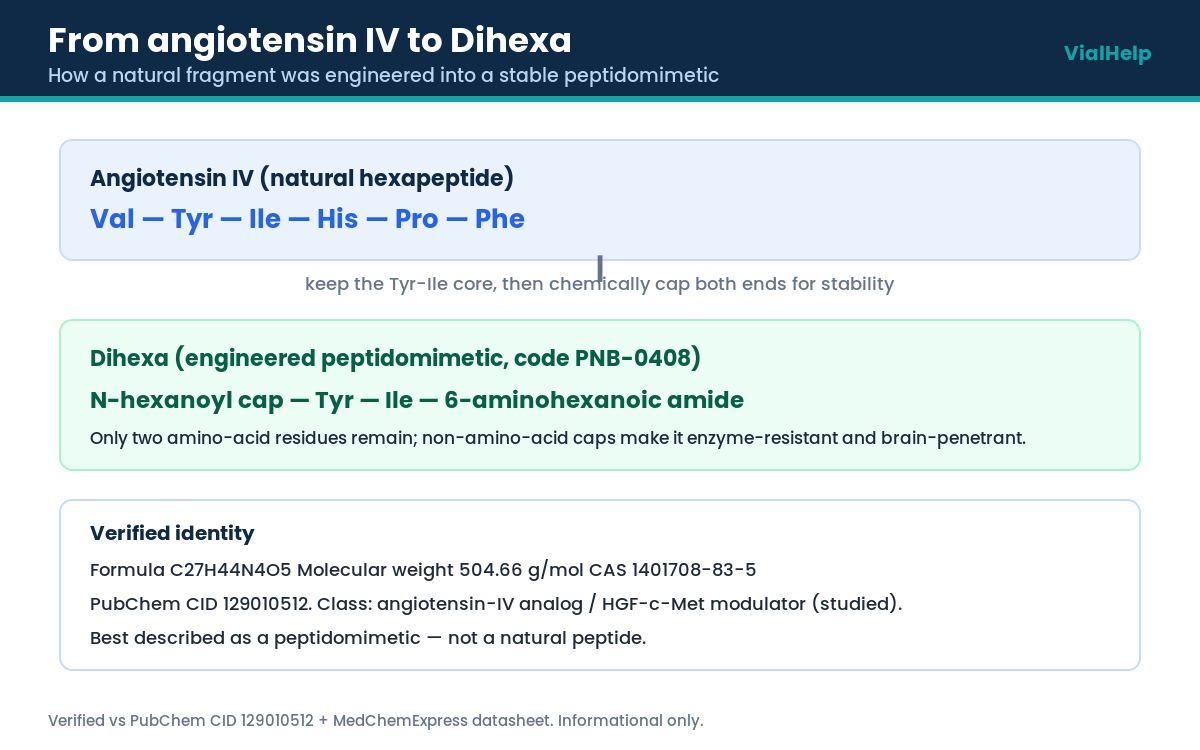
Dihexa (development code PNB-0408) is an orally active, brain-penetrant compound engineered from angiotensin IV that has been studied in animals as a potent trigger of new synapse formation. It is best described not as a natural peptide but as a peptidomimetic — a small molecule built around just two amino-acid residues of angiotensin IV, chemically capped at both ends so it survives in the body and crosses into the brain. Interest in Dihexa centres on cognition and neurorepair, but that interest rests entirely on preclinical work, and several of its foundational papers have since been retracted or flagged.
What is Dihexa?
Dihexa is a synthetic angiotensin IV (AngIV) analog studied as a pro-cognitive / neurotrophic agent. Its systematic name is N-hexanoic-Tyr-Ile-(6)-aminohexanoic amide; it carries CAS number 1401708-83-5, the molecular formula C27H44N4O5 and a molecular weight of about 504.66 g/mol (PubChem CID 129010512). Angiotensin IV is a six-residue fragment of angiotensin II (Val-Tyr-Ile-His-Pro-Phe). Dihexa keeps only the Tyr-Ile core and adds a hexanoyl group on the tyrosine and a 6-aminohexanoic amide on the isoleucine. Those non-amino-acid “caps” are what make it metabolically stable and able to cross the blood-brain barrier — and also why it behaves as a peptidomimetic rather than a true tripeptide. It was invented at Washington State University and licensed to the company that became Athira Pharma.
How Dihexa is studied to work
In the laboratory, Dihexa was designed to amplify a growth-factor signalling system in the brain rather than to act like a classic neurotransmitter. The idea was that boosting this system would help neurons build new connections (synapses). The main proposed pathways and targets are:
- Hepatocyte growth factor (HGF) / c-Met (MET) receptor system — the proposed central target; Dihexa was reported to potentiate HGF signalling so that even low HGF levels produce stronger “build new connections” activity.
- Angiotensin IV / AT4 (IRAP) relationship — Dihexa is derived from AngIV, historically linked to the AT4 site (later identified as insulin-regulated aminopeptidase, IRAP); the developers argued the pro-cognitive effect runs mainly through HGF/c-Met.
- Downstream synaptic plasticity — reported dendritic spine formation and synaptogenesis in cultured neurons; a separate 2021 study implicated PI3K/AKT signalling.
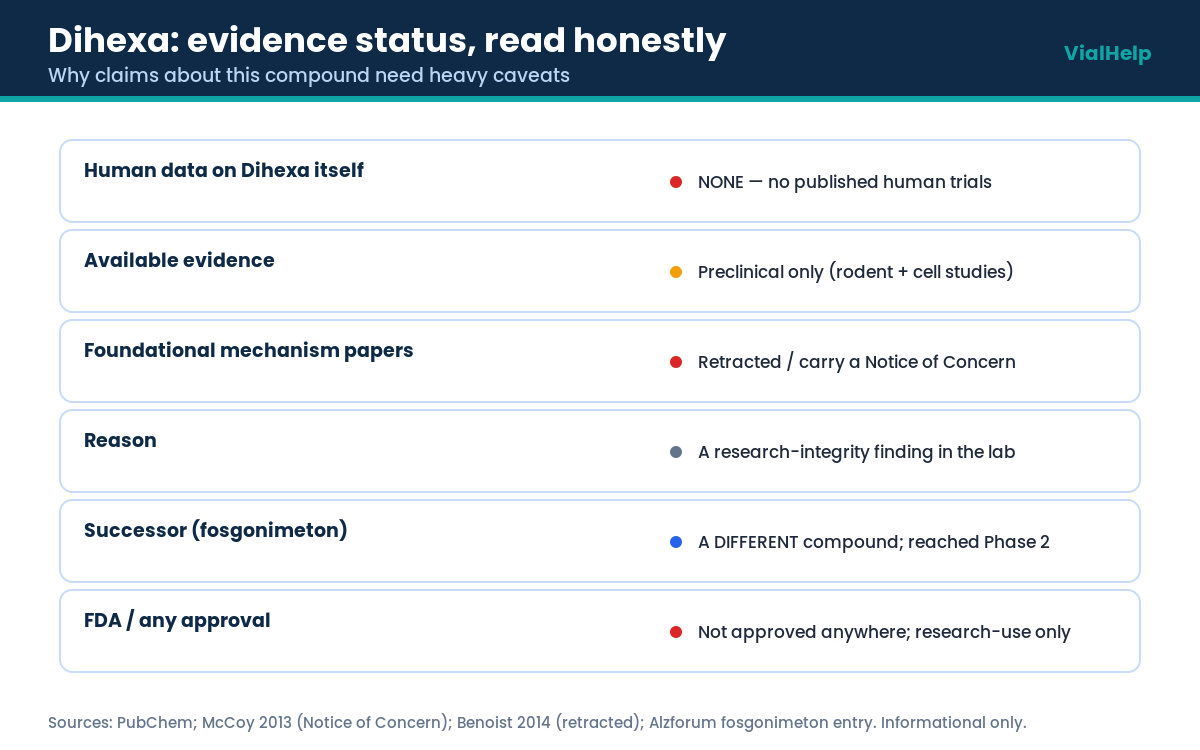
Important caveat: two of the papers that established the specific HGF/c-Met mechanism have since been retracted, so this mechanism should be read as proposed and partly discredited in its original detail, with only partial independent corroboration.
Reported effects and benefits in the research literature
Reported findings are largely from rodent and cell-culture work, and some originate in papers now flagged or withdrawn:
- Reported reversal of chemically-induced (scopolamine) memory deficits in rats in the Morris water maze.
- Reported improved learning in aged rats.
- Induction of dendritic spine formation and synaptogenesis in cultured hippocampal neurons.
- Potentiation of HGF-dependent c-Met activation in vitro.
- Described as orally active, blood-brain-barrier permeable and long-acting in rodents.
What this does not mean: these are animal and cell-culture observations, several from studies that now carry a Notice of Concern or have been retracted. None of them establishes that Dihexa improves cognition, or is safe, in humans.
What the human evidence shows
There are no published human clinical trials of Dihexa itself — all efficacy data are preclinical. The research program reached humans only through a different, structurally related successor molecule, fosgonimeton (ATH-1017), which is its own compound and advanced into Phase 2 trials in Alzheimer’s disease and dementia; it remains investigational and is not approved. Critically, the scientific foundation of this work was compromised: an independent research-integrity investigation led to the retraction of key papers and a Notice of Concern on others. Neither Dihexa nor fosgonimeton is FDA-approved, and Dihexa is not approved for any use in any country.
Handling, storage and reconstitution (research context)
- Lyophilized powder is typically stored cold (around -20 °C for long-term; short periods refrigerated), protected from moisture and light.
- Dihexa is poorly water-soluble; research-supplier datasheets cite solubility in DMSO for in-vitro use only.
- Any reconstituted solution should be refrigerated and freeze-thaw cycles minimised.
- For the lab math of turning a powder mass into a concentration, see the reconstitution calculator and the explainer on why units are not a dose.
Cautions and considerations
- Dihexa is a research chemical, not a medicine, and is not approved anywhere.
- Its evidence base is compromised by retractions and a research-misconduct finding — treat mechanism and efficacy claims cautiously.
- There are no human safety, toxicology or dosing data for Dihexa itself.
- As an unregulated research chemical, identity and purity vary by vendor; a certificate of analysis (COA) is essential for identity confidence.
- This page is informational only and is not medical advice.
Frequently asked questions
Is Dihexa a peptide?
Not exactly. It is a peptidomimetic — a small molecule built around only two amino-acid residues (Tyr-Ile) from angiotensin IV, with non-amino-acid chemical caps on each end. Some vendors loosely call it a “3-amino-acid” compound, which is a simplification.
Is Dihexa FDA-approved?
No. Dihexa is not approved for any use in any country and has no FDA status. It is sold only as a laboratory research chemical.
What is the difference between Dihexa and fosgonimeton?
They are different molecules. Fosgonimeton (ATH-1017) is a distinct, later compound from the same research lineage that actually entered human trials; Dihexa itself has never been tested in humans.
Why are Dihexa’s studies considered controversial?
Several foundational papers were retracted or received a Notice of Concern after a research-integrity investigation found altered images in related work, which undercuts much of the most-cited Dihexa evidence.
Related compounds and further reading
- How to reconstitute peptides
- Sterile technique
- Semax, Selank and Cerebrolysin (other compounds studied for cognition)
- Browse the full peptide library and the guides
- IU vs mL: why units are not a dose
Share this article
References
For informational use only. Not medical advice; consult a qualified healthcare professional. 21+.
Dihexa reconstitution calculator
Use the calculator below to find the concentration (mg/mL), draw volume and U-100 syringe units for Dihexa once it is reconstituted with bacteriostatic water. Dihexa has molecular formula C27H44N4O5 and a molecular weight of 504.66 g/mol. Enter your vial amount and the water volume to see the lab math — informational use only, not dosing advice.