
What Is Galanin? The Neuropeptide and Its Three Receptors
Articles · Neuropeptides
Galanin is a neuropeptide discovered in 1983 that acts on three receptors, GalR1, GalR2 and GalR3, and has been studied in sleep, seizure, gut and metabolic research. This article summarises its structure, signalling and evidence, mostly from animal studies, for educational purposes only.
What is galanin?
Galanin is an endogenous neuropeptide first isolated in 1983 from porcine (pig) intestine by Tatemoto, Rökaeus, Jörnvall, McDonald and Mutt. In the original assays it contracted rat intestinal smooth muscle and raised blood glucose in dogs. In most mammals it is 29 amino acids long with an amidated C-terminus; human galanin is 30 amino acids and ends in a free acid (non-amidated). A 2026 review reports about 85% homology across species.
The GAL gene sits on chromosome 11q13.3–q13.5. Its product, preprogalanin, is cleaved into galanin and a second fragment called galanin message-associated protein (GMAP). Two related peptides, galanin-like peptide (GALP) and spexin (also called neuropeptide Q), are endogenous ligands of galanin receptors with varying affinities.
How galanin is studied to work
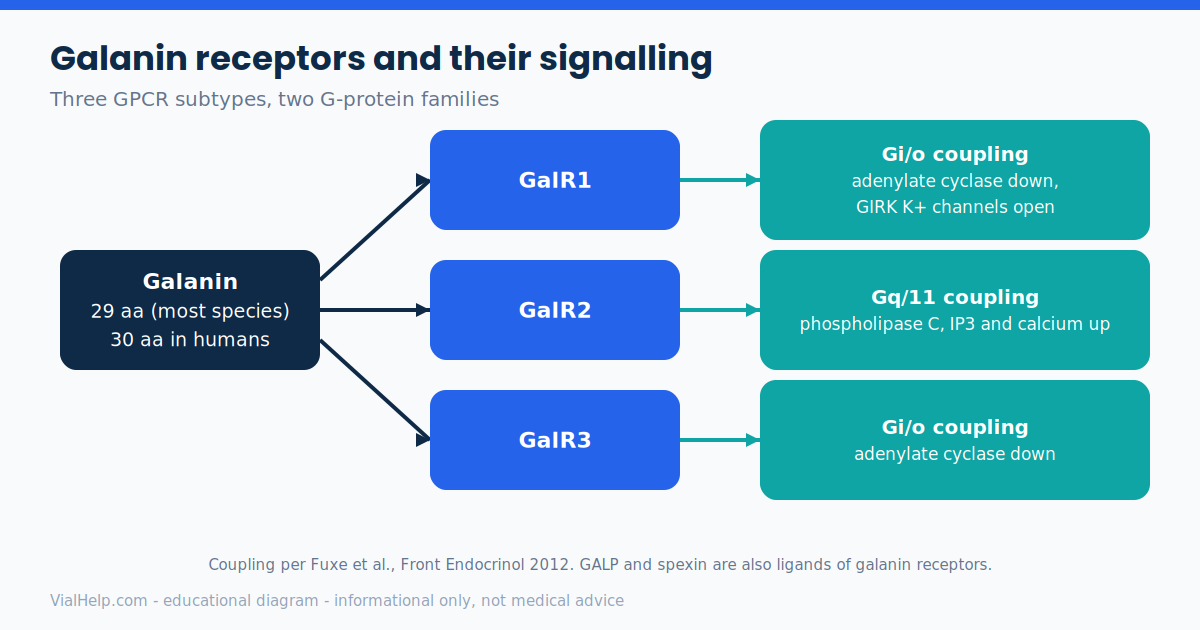
Galanin acts on three G-protein-coupled receptors, GalR1, GalR2 and GalR3 (background in what is a GPCR). According to a Frontiers in Endocrinology review, GalR1 and GalR3 couple to Gi/o proteins, which lowers adenylate cyclase activity and, for GalR1, increases MAPK activity and opens GIRK potassium channels; GalR2 couples to Gq/11, raising phospholipase C activity, IP3 and intracellular calcium. Both GalR1 and GalR2 are widespread in the central nervous system and bind galanin with high affinity.
Reported roles in the research literature
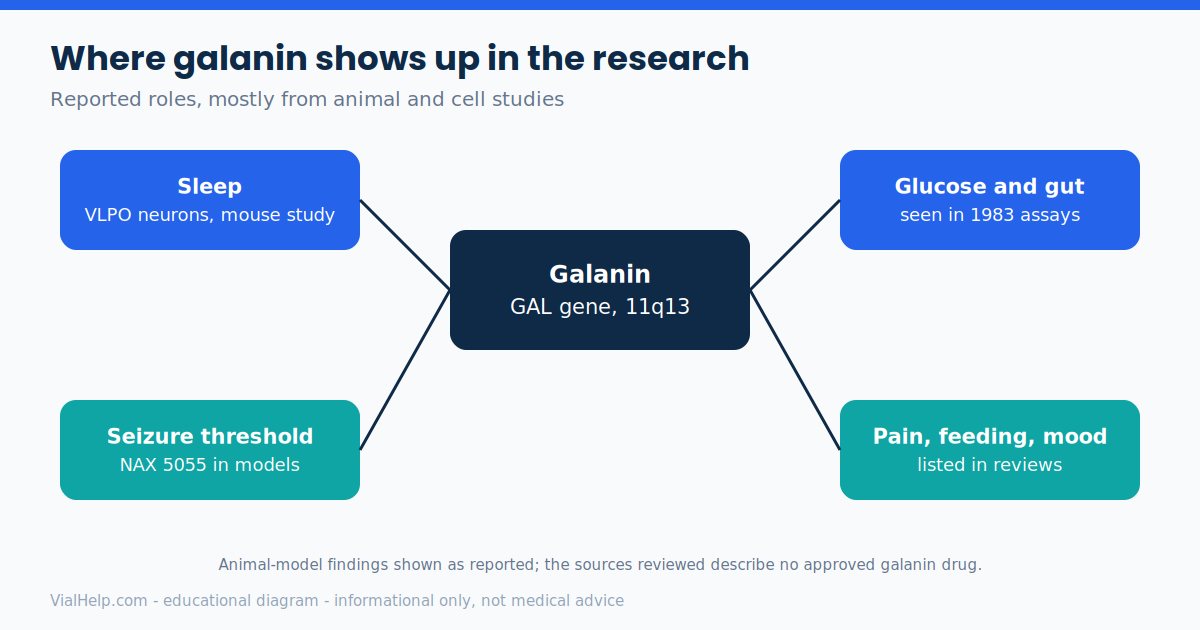
The receptor reviews link galanin signalling to neuroendocrine, cardiovascular and mood regulation, pain control, food intake and seizure threshold. A 2026 review adds glucose homeostasis, gastrointestinal motility, hepatic metabolism, adipogenesis, reproduction and cell growth. Two examples stand out for their specificity:
- Sleep. A 2018 Nature Communications study reported that galanin-expressing neurons in the mouse ventrolateral preoptic area promote sleep, with low-frequency (1–4 Hz) stimulation increasing sleep and chemogenetic activation causing hypothermia. Compare the sleep-wake peptide orexin.
- Seizures. A systemically active galanin analogue called NAX 5055 was characterised in epilepsy models in a 2009 Neurotherapeutics paper, one of several attempts to turn galanin biology into a drug.
What the human evidence shows
Human evidence is thin compared with the animal literature. The 2026 review lists synthetic galanin-receptor ligands (M15, M35, M40, M617, NAX 5055, galnon and galmic), and notes that many are unavailable in the US and that receptor-specificity information is incomplete. In the sources reviewed for this article, no approved galanin-based drug was found, and this article makes no claim about ongoing trials. For neighbouring peptide systems, see neuropeptide Y (feeding), endogenous opioid peptides and substance P (pain signalling).
Handling and measurement considerations (research context)
Research-grade galanin and its analogues are handled like other lyophilised peptides: follow the supplier’s sheet, use aseptic technique and double-check concentration arithmetic. The reconstitution calculator, concentration converter and sterile technique pages cover the basics. Receptor-specific tool compounds vary in selectivity, so read the pharmacology for the exact ligand used.
Cautions and considerations
Galanin and its analogues are research tools. Nothing here recommends using any galanin-related product, and anyone with sleep, seizure or metabolic concerns should consult a qualified clinician.
Frequently asked questions
How long is galanin?
Most mammals have a 29-amino-acid, C-terminally amidated galanin; humans have a 30-amino-acid form with a free-acid C-terminus.
What do the galanin receptors do?
GalR1 and GalR3 couple to Gi/o proteins; GalR2 couples to Gq/11. Together they are linked to pain, feeding, mood, seizure threshold and neuroendocrine signalling in the reviews.
Does galanin affect sleep?
In mice, galanin-expressing neurons in the ventrolateral preoptic area promote sleep. That is animal evidence, not proof for humans.
Is there a galanin drug?
No approved galanin-based drug was found in the sources reviewed. Analogues such as NAX 5055 were studied in epilepsy models.
References
- Mireles P, Wang Y, Rhodes K, DeMorrow S. Biochemical and Physiological Effects of Galanin in Health and Disease. 2026
- Fuxe K, Borroto-Escuela DO, Romero-Fernandez W, et al. On the existence and function of galanin receptor heteromers in the central nervous system. Front Endocrinol, 2012
- Kroeger D, et al. Galanin neurons in the ventrolateral preoptic area promote sleep and heat loss in mice. Nat Commun, 2018
- Developing novel antiepileptic drugs: characterization of NAX 5055, a systemically-active galanin analog, in epilepsy models. Neurotherapeutics, 2009
- Galanin Receptors in the Central Nervous System: Exploring Ligand Interactions, Signal Transduction, and Potential Clinical Implications. Molecules, 2026
Informational only. This guide is for educational and laboratory/measurement purposes and is not medical advice. It does not recommend or instruct personal human use. Consult a qualified healthcare professional for any health decision. Content is intended for adults 21+. Verify scientific details against the primary sources cited.