
The Endocrine Pancreas: Islets of Langerhans and Blood-Sugar Control
Endocrine biology · Glands behind the axes
The endocrine pancreas is the hormone-making part of the pancreas — scattered clusters of cells called the islets of Langerhans. They make up only a small fraction of the organ, yet they run the body’s blood-sugar balance and connect directly to some of the most-discussed research peptides: insulin, glucagon, somatostatin, amylin analogs, and the incretin mimetics.
One organ, two very different jobs
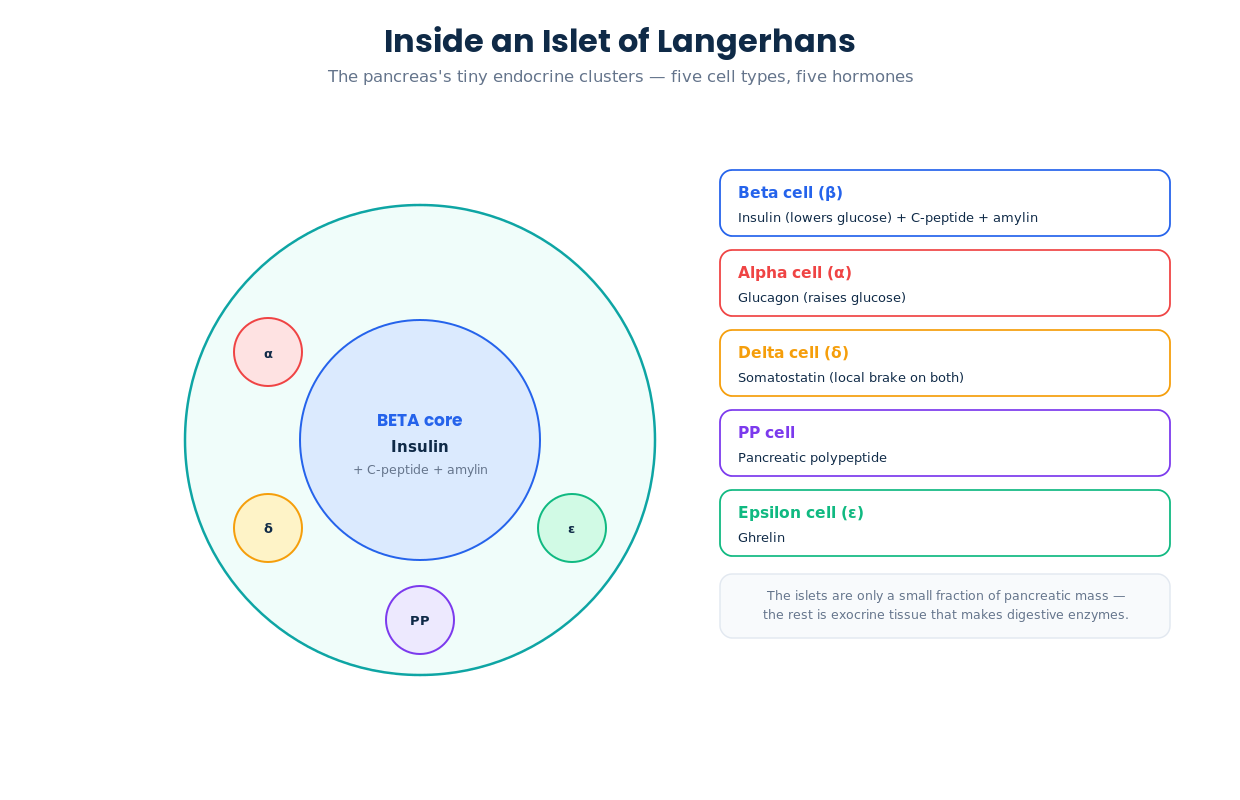
The pancreas is a dual-purpose organ. Most of it is exocrine tissue: acinar cells that make digestive enzymes and pour them through ducts into the small intestine. Threaded through that tissue are the endocrine islets of Langerhans, first described by Paul Langerhans in 1869, which release hormones directly into the blood. The islets are only a small fraction of the pancreas by mass, but they are the part that regulates metabolism.
The cells of the islet
Each islet is a tiny, richly vascularized micro-organ containing several cell types, each with its own hormone:
- Beta (β) cells — the most abundant, forming the central core — make insulin, along with C-peptide and amylin.
- Alpha (α) cells — the next most common — make glucagon.
- Delta (δ) cells make somatostatin.
- PP cells make pancreatic polypeptide.
- Epsilon (ε) cells make ghrelin.
Beta and alpha cells are the major populations; delta, PP, and epsilon cells are minority types arranged around them.
The blood-sugar seesaw: insulin vs. glucagon
The core job of the islet is keeping blood glucose in a healthy range, and it does so with a pair of hormones that pull in opposite directions.
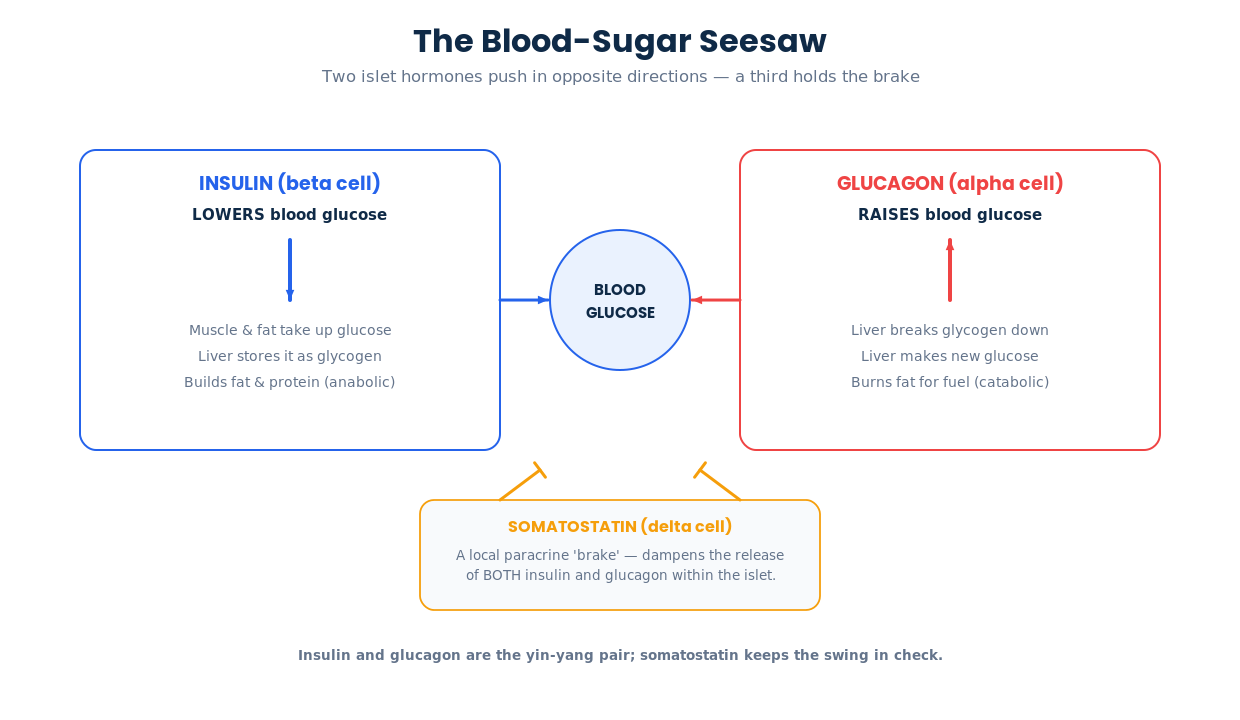
Insulin lowers blood glucose. It tells muscle and fat to take glucose up, tells the liver to store it as glycogen, and generally drives building and storage. Glucagon does the reverse: it acts on the liver to break glycogen down and make new glucose, raising blood sugar — the body’s main catabolic counter-signal. Sitting between them, somatostatin from the delta cells acts as a local “brake,” dampening the release of both insulin and glucagon so the swing stays controlled.
Insulin, C-peptide, and amylin
Insulin is a peptide hormone of 51 amino acids arranged in two chains held together by disulfide bonds. It is built as a larger precursor: an endopeptidase snips out a middle segment called C-peptide, which is released into the blood in equal amounts with insulin. C-peptide has no strong action of its own, but because it tracks insulin one-to-one, it is a useful marker of how much insulin the body is making on its own.
Beta cells also co-release amylin (IAPP) with insulin. Amylin suppresses glucagon, slows stomach emptying, and promotes fullness — which is exactly why stable amylin analogs like pramlintide and cagrilintide are of research and clinical interest.
Made in the islet vs. made in the gut: the incretins
Here is a distinction that is easy to get wrong. The famous incretins — GLP-1 and GIP — are not islet hormones. GLP-1 is made by L-cells and GIP by K-cells, both in the wall of the intestine. After a meal they travel to the pancreas and act on the beta cell to boost glucose-triggered insulin release — the “incretin effect.” Both are broken down within minutes by the enzyme DPP-4.
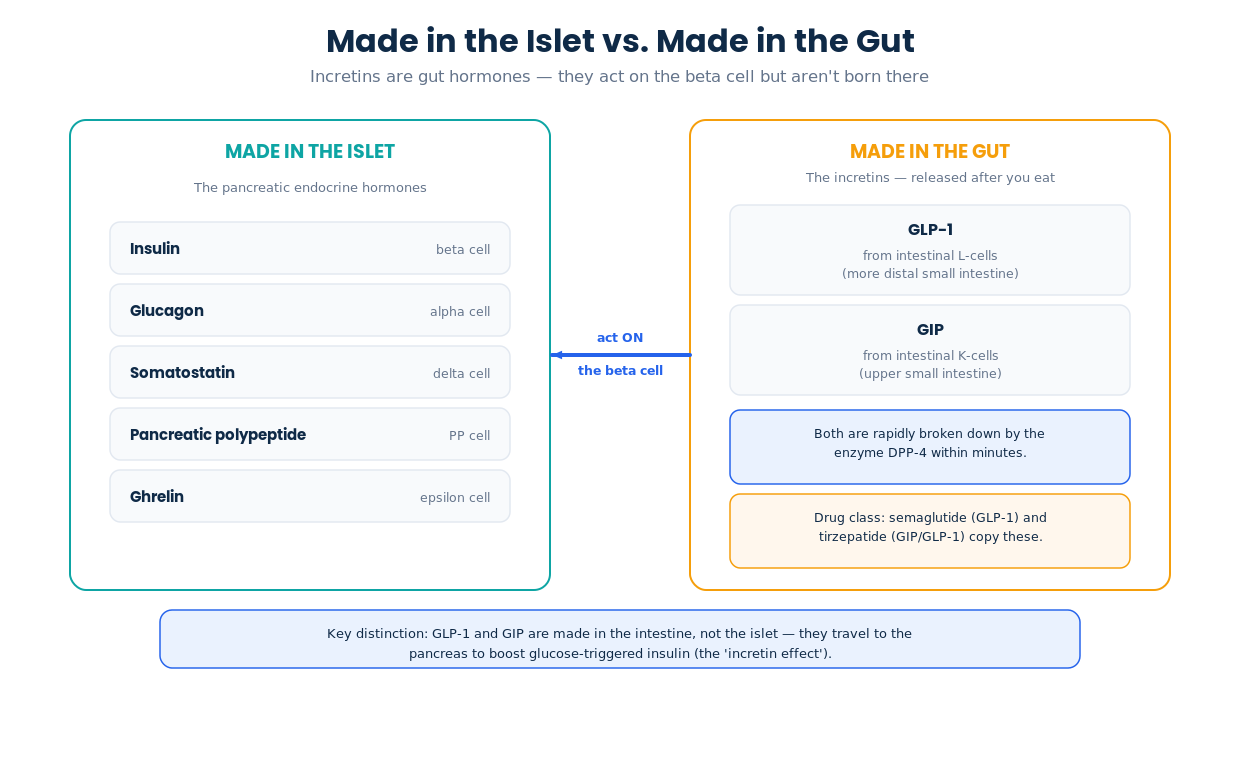
This is why modern incretin-based compounds map onto islet biology from the outside in: semaglutide is a GLP-1 receptor agonist and tirzepatide targets both the GIP and GLP-1 receptors. Meanwhile the somatostatin analog octreotide mimics the delta cell’s braking hormone.
Paracrine crosstalk inside the islet
The islet is not just five cell types sitting side by side — they talk to each other locally. Insulin (and amylin) restrain glucagon from alpha cells; somatostatin restrains both insulin and glucagon; and the cells are physically arranged and vascularized so these local signals can fine-tune each other before hormones ever reach the bloodstream.
When the system breaks down
For background only: in type 1 diabetes, the immune system destroys the insulin-making beta cells, causing insulin deficiency. In type 2 diabetes, the body becomes resistant to insulin and beta-cell output eventually can’t keep up. An insulinoma is the most common hormone-secreting islet tumor, producing too much insulin. None of this is diagnostic or treatment guidance.
Why this matters for peptide research
Few areas of biology map so cleanly onto the research-peptide conversation. Insulin (beta cell), glucagon (alpha cell), somatostatin and octreotide (delta cell), amylin analogs like pramlintide and cagrilintide (beta-cell co-secretion), and the incretin mimetics semaglutide and tirzepatide (gut hormones acting on the beta cell) all trace back to the endocrine pancreas. Knowing which cell makes what — and which “islet” hormones are actually made in the gut — makes the whole class easier to keep straight. Informational only.
Frequently asked questions
What is the endocrine pancreas?
It is the hormone-producing part of the pancreas — the islets of Langerhans — as opposed to the larger exocrine part that makes digestive enzymes.
Which cells make insulin and glucagon?
Beta cells make insulin (the central, most abundant cells) and alpha cells make glucagon. Delta cells add somatostatin, which brakes both.
Are GLP-1 and GIP made in the pancreas?
No. They are incretins made in the intestine (L-cells and K-cells). They act on the pancreatic beta cell to enhance insulin release, but they are not islet hormones.
How does the pancreas connect to research peptides?
Insulin, glucagon, somatostatin/octreotide, amylin analogs, and incretin mimetics all relate to islet biology. This article is background biology, not medical or dosing advice.
References
- Shahid Z, Singh G. Physiology, Islets of Langerhans. StatPearls, NCBI Bookshelf.
- Kamel-ElSayed SA, Mukherjee S. Physiology, Pancreas. StatPearls, NCBI Bookshelf.
- Octreotide. StatPearls, NCBI Bookshelf.
- Reimann F, Gribble FM, et al. Nutrient detection by incretin-secreting cells (L-cells and K-cells; GLP-1 and GIP). PMC.
- Research progress on the GIP/GLP-1 receptor coagonist tirzepatide. PMC.
- Da Silva Xavier G. The Cells of the Islets of Langerhans. J Clin Med (PMC).
Informational and educational only — not medical advice. Consult a qualified healthcare professional. Intended for adults 21+.