
What Is Oxytocin? The Body’s Bonding-and-Birth Hormone
Hormone biology
Oxytocin is a tiny nine-amino-acid hormone with an outsized reputation. Made deep in the brain and released from the back of the pituitary gland, it powers childbirth and breastfeeding — and has become popular shorthand for a “love hormone.” The core biology is rock-solid; some of the fame, as we will see, runs ahead of the evidence.

What is oxytocin?
Oxytocin is a nonapeptide — a chain of nine amino acids (Cys-Tyr-Ile-Gln-Asn-Cys-Pro-Leu-Gly, capped with an amide) pinched into a small ring by a disulfide bond between its two cysteines. It is built in specialized neurons of the hypothalamus (the supraoptic and paraventricular nuclei), packaged with a carrier protein called neurophysin I, shipped down long nerve fibers, and released into the bloodstream from the posterior pituitary gland.
Its near-twin is vasopressin, the body’s water-balance hormone. The two are both nine-residue rings from the same gene family, and they differ at only two positions (3 and 8) — yet those two swaps are enough to send them down very different jobs. Oxytocin’s actions are coordinated by the pituitary gland, the master relay for the body’s hormone axes.
How oxytocin works
Oxytocin signals through a single receptor, the oxytocin receptor (OXTR), which is a class A G-protein-coupled receptor. When oxytocin binds, the receptor couples to the Gq pathway, activates the enzyme phospholipase C, and raises calcium inside the cell — the trigger that makes smooth muscle contract. Because oxytocin and vasopressin are structurally so close, each can weakly cross-react with the other’s receptors, which is one reason drug designers work hard to make selective versions.
What oxytocin actually does
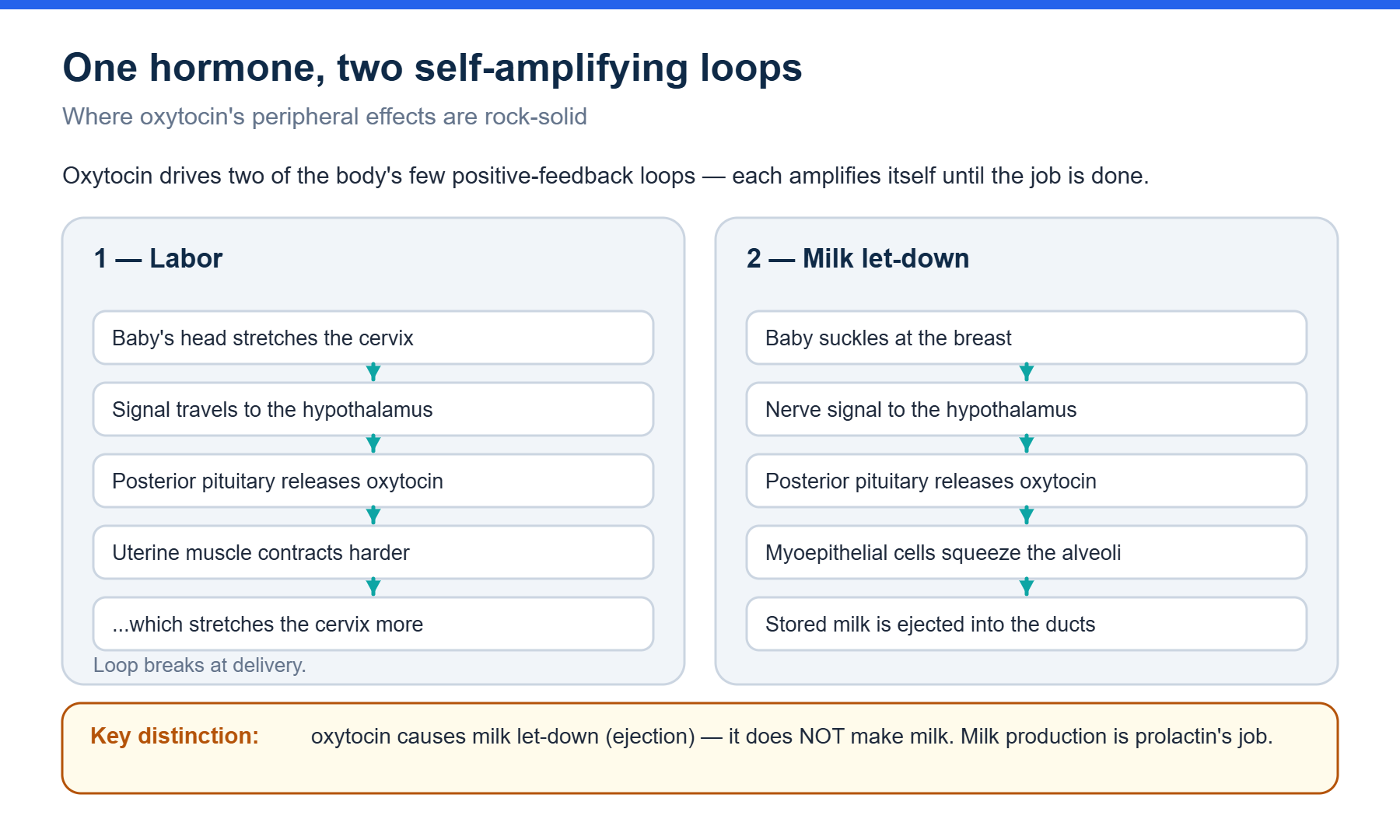
Two of oxytocin’s roles are beyond dispute, and both are rare examples of positive feedback — loops that amplify themselves until a task is finished. In labor, pressure from the baby’s head on the cervix signals the hypothalamus to release more oxytocin, which strengthens uterine contractions, which increases the pressure, and so on until delivery (the Ferguson reflex). In breastfeeding, suckling triggers oxytocin release, which contracts the myoepithelial cells wrapped around the milk-producing alveoli, squeezing stored milk into the ducts — the “let-down” reflex.
The “love hormone”: what the evidence really says
Oxytocin is also released during sex, birth and nursing, and animal studies — especially the famous work in monogamous prairie voles — tie it to pair-bonding, maternal care and social behavior. That has fueled a popular image of oxytocin as a “trust” or “cuddle” hormone. The honest picture is more cautious: the strongest behavioral evidence is in animals, while human studies of intranasal oxytocin have been inconsistent.

A large, NIH-funded randomized trial found that intranasal oxytocin did not improve social function in children and adolescents with autism, and researchers still debate how much of a nasal dose actually reaches the brain. The takeaway: trust the birth-and-milk biology, and treat the sweeping social-superpower claims as unsettled.
Oxytocin as a medicine
Synthetic oxytocin (Pitocin, Syntocinon) is FDA-approved to induce or strengthen labor and to control bleeding after delivery. Carbetocin is a longer-acting oxytocin-receptor agonist used in some countries to prevent postpartum hemorrhage, and atosiban is an oxytocin-receptor antagonist used in Europe to delay preterm labor. All are given by injection or IV drip: oxytocin is a peptide, so it would be destroyed in the stomach — there is no oxytocin pill.
Oxytocin and the research-peptide market
Oxytocin is also sold in “research peptide” and nasal-spray channels for claimed effects on bonding, mood and libido. It is worth being clear-eyed here: the well-established, medically recognized uses are the injectable obstetric ones, while the recreational “bonding” claims rest on weak and inconsistent human data. If you are working with any lyophilized research peptide, our reconstitution calculator can help you turn a target concentration into the right volume of diluent.
Frequently asked questions
Is oxytocin the same as vasopressin?
No, but they are close relatives — nine-residue ring peptides from the same family that differ at just two positions. Oxytocin is best known for birth and lactation; vasopressin (ADH) governs water balance and blood pressure.
Does oxytocin make breast milk?
No. Oxytocin triggers the let-down that ejects stored milk. Milk is produced under the influence of prolactin.
Can you take oxytocin as a pill?
No. As a peptide it is broken down in the gut, so medical oxytocin is given by injection or IV. Nasal sprays exist in research settings, but how much reaches the brain is debated.
Is oxytocin really the “love hormone”?
It plays genuine roles in bonding and social behavior in animals, but in humans the effects are modest and inconsistent. The nickname oversells what the human evidence supports.
- UniProt P01178 — Oxytocin-neurophysin 1 (human OXT gene)
- PubChem CID 439302 — Oxytocin (C43H66N12O12S2)
- Osilla EV, et al. Oxytocin. StatPearls (NBK507848)
- IUPHAR/BPS Guide to Pharmacology — Oxytocin (OT) receptor
- Sikich L, et al. Intranasal oxytocin in autism (NEJM 2021, PMC9701092)
- The oxytocin-receptor system and its antagonists as tocolytic agents (PMC3235456)
Informational only — not medical advice · 21+. This article summarizes published science for educational purposes. It is not a recommendation to use, buy or dose any substance. Consult a qualified healthcare professional for medical concerns.