
What Is Cholecystokinin (CCK)? The Gut’s Satiety and Digestion Hormone
Digestive hormones
Cholecystokinin, or CCK, is the small intestine’s multitasking hormone. Released when fat and protein arrive, it empties the gallbladder, unleashes digestive enzymes, and tells the brain you are full.
What is cholecystokinin?
Cholecystokinin (CCK) is a peptide hormone released by I cells in the duodenum and jejunum — the upper small intestine — and it also acts as a neuropeptide in the brain and the gut’s own nervous system. Its name is literal: from Greek roots meaning “move the bile-bladder,” because its first-described action was contracting the gallbladder. It was once known separately as “pancreozymin” for its effect on the pancreas, until scientists realized the two were the same molecule. CCK circulates in several lengths (CCK-58, CCK-33, CCK-22 and the short CCK-8); CCK-58 is the main circulating form, while the eight-residue CCK-8 is the version most used in the laboratory.
One meal, five jobs
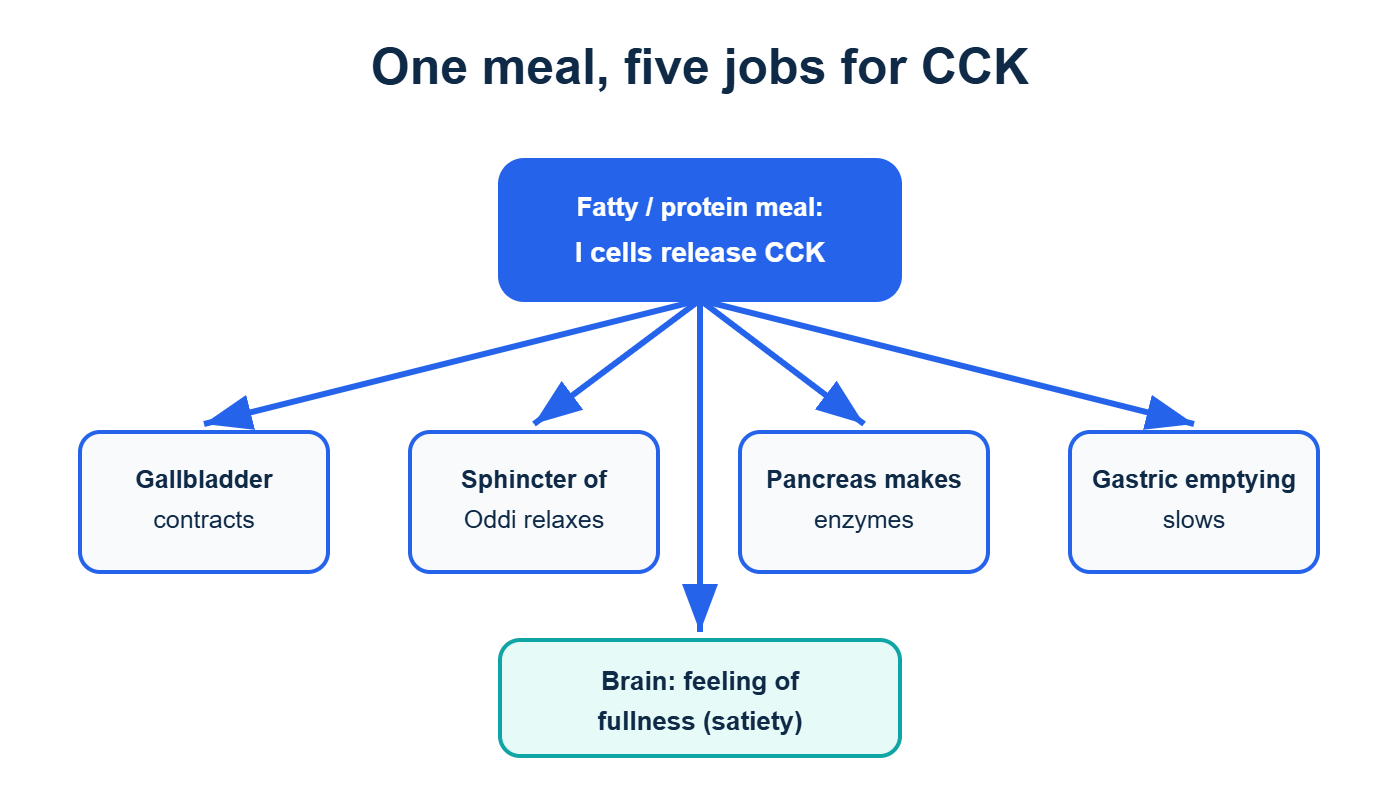
CCK is a coordinator. When a fatty or protein-rich meal reaches the small intestine, CCK is released and sets off a coordinated response:
- it makes the gallbladder contract, squeezing stored bile into the intestine to emulsify fat;
- it relaxes the sphincter of Oddi so bile and pancreatic juice can flow in;
- it stimulates the pancreatic acinar cells to release digestive enzymes;
- it slows gastric emptying so the intestine is not overwhelmed;
- and it signals fullness to the brain.
CCK, the satiety signal
CCK is one of the body’s original satiety hormones. It acts on CCK1 receptors on the vagus nerve, whose fibers carry the “full” message to the brainstem. CCK does not work alone: it is part of a network of appetite signals that includes GLP-1 and PYY (fullness), leptin (long-term energy stores) and ghrelin (hunger). This is why CCK is of ongoing interest in appetite and metabolism research — though it is short-acting, cleared from the blood within minutes.

How CCK works — and why sulfation matters
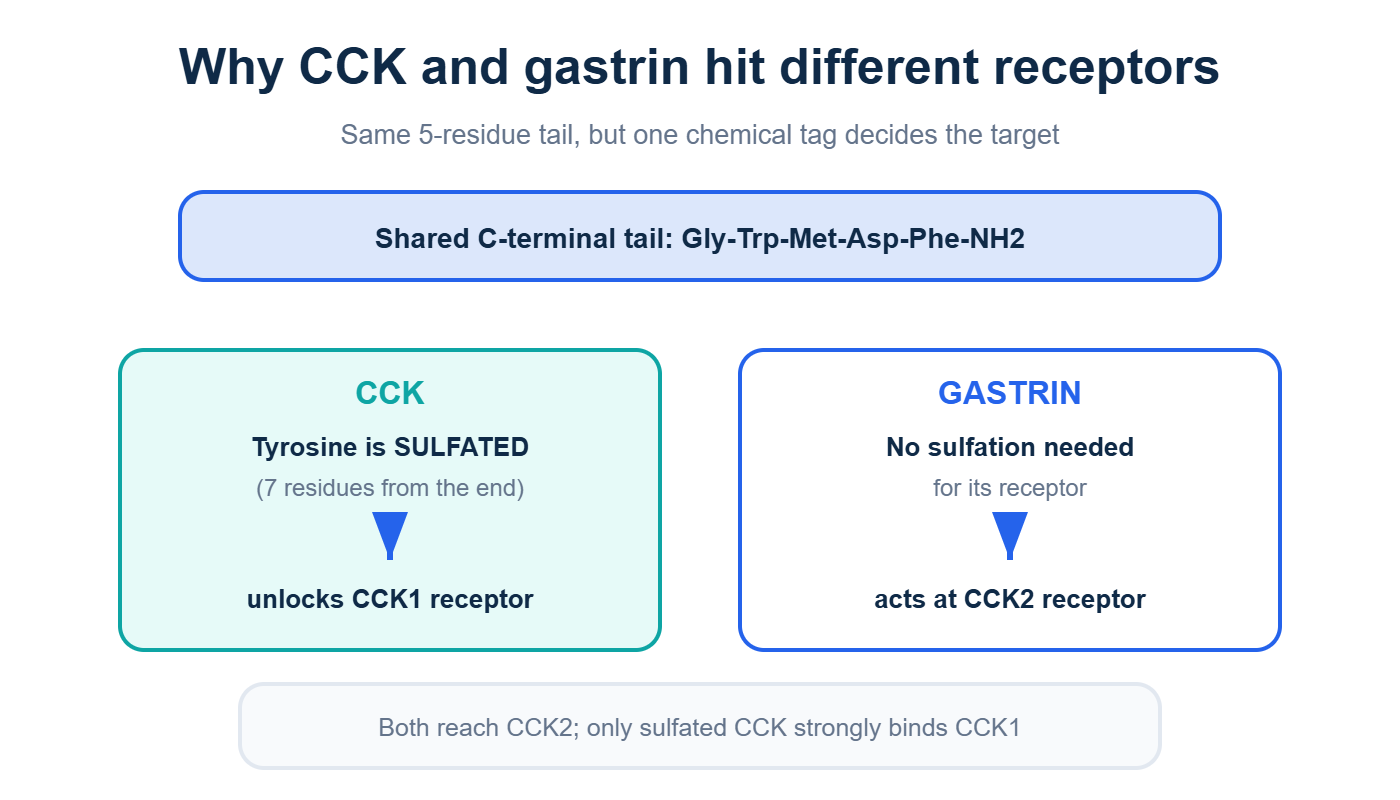
CCK acts through two G-protein-coupled receptors: CCK1 (formerly CCK-A), mostly in the periphery on the gallbladder, pancreas and vagal nerves, and CCK2 (formerly CCK-B), in the brain and stomach — the same receptor gastrin uses. Here is the elegant structural twist: CCK and gastrin share the same five-amino-acid active tail, but CCK carries a sulfated tyrosine near that tail, and that sulfate group is what lets CCK strongly bind the CCK1 receptor. Gastrin lacks that requirement and works mainly at CCK2. One small chemical tag decides which receptor each hormone prefers.
CCK in the clinic and the lab
A synthetic form of CCK-8 called sincalide is used diagnostically to make the gallbladder contract during imaging tests of gallbladder function. In neuroscience, CCK is among the most widely distributed peptides in the brain, and a fragment called CCK-4 is used in research to study anxiety and panic.
The digestive hormone trio
CCK completes the classic digestive relay: gastrin prepares the stomach with acid, secretin neutralizes that acid in the small intestine, and CCK triggers the bile and enzymes that actually break the meal down. Together with the hormones of the endocrine pancreas, they turn a meal into absorbable nutrients.
Frequently asked questions
What does cholecystokinin do?
It contracts the gallbladder, releases pancreatic enzymes, slows stomach emptying, and signals fullness after a meal.
What triggers CCK release?
Fatty acids and protein-digestion products (amino acids and peptides) in the small intestine; carbohydrates are not a strong trigger.
Is CCK an appetite hormone?
Yes. CCK is a satiety signal that promotes fullness, acting alongside GLP-1, PYY, leptin and ghrelin.
How is CCK related to gastrin?
They share an identical active tail; CCK needs a sulfated tyrosine to bind its CCK1 receptor, while gastrin acts mainly at the shared CCK2 receptor.
Related reading
Reconstitution calculator · Peptide library · Guides & how-tos
References
- Okonkwo O, et al. Biochemistry, Cholecystokinin. StatPearls. ncbi.nlm.nih.gov/books/NBK534204
- Parikh A, Thevenin C. Physiology, Gastrointestinal Hormonal Control. StatPearls. ncbi.nlm.nih.gov/books/NBK537284
- CCK — Cholecystokinin, Homo sapiens. UniProt P06307. uniprot.org/uniprotkb/P06307
- Cholecystokinin octapeptide (sincalide), PubChem CID 134694162. pubchem.ncbi.nlm.nih.gov/compound/134694162
- Reeve JR Jr, et al. CCK-58 is the only detectable endocrine form of cholecystokinin in rat. PMID 12686511. pubmed.ncbi.nlm.nih.gov/12686511
- Gastrin/CCK C-terminal pentapeptide at the CCK2 receptor. PMC9899899. pmc.ncbi.nlm.nih.gov/articles/PMC9899899
Informational only — not medical advice; consult a qualified healthcare professional. 21+.