
What Is Alpha-MSH? The Melanocortin Peptide Explained
Peptide science
Alpha-MSH (alpha-melanocyte-stimulating hormone) is a 13-amino-acid peptide hormone that the body cuts out of a larger precursor protein, and it is the natural signal that switches on several melanocortin receptors. It earned its name from its effect on pigment cells, but it also acts in the brain’s appetite circuits and has been studied for anti-inflammatory activity.
What is alpha-MSH?
Alpha-MSH is one of the products of pro-opiomelanocortin, or POMC, a single precursor protein that is processed into several different peptides depending on the tissue. In the human POMC entry in UniProt (P01189), alpha-MSH occupies residues 138 to 150, which is the front end of the 39-residue hormone ACTH. The same entry lists an N-acetylserine at position 138 and a valine amide at position 150, so the mature peptide is chemically capped at both ends, a modification that distinguishes it from a plain 13-residue fragment of ACTH.
POMC is processed by prohormone convertases, and the peptides released differ between tissues. For background on the parent hormone, see what is ACTH; for the receptor family alpha-MSH acts on, see melanocortin receptors explained.

How alpha-MSH is studied to work
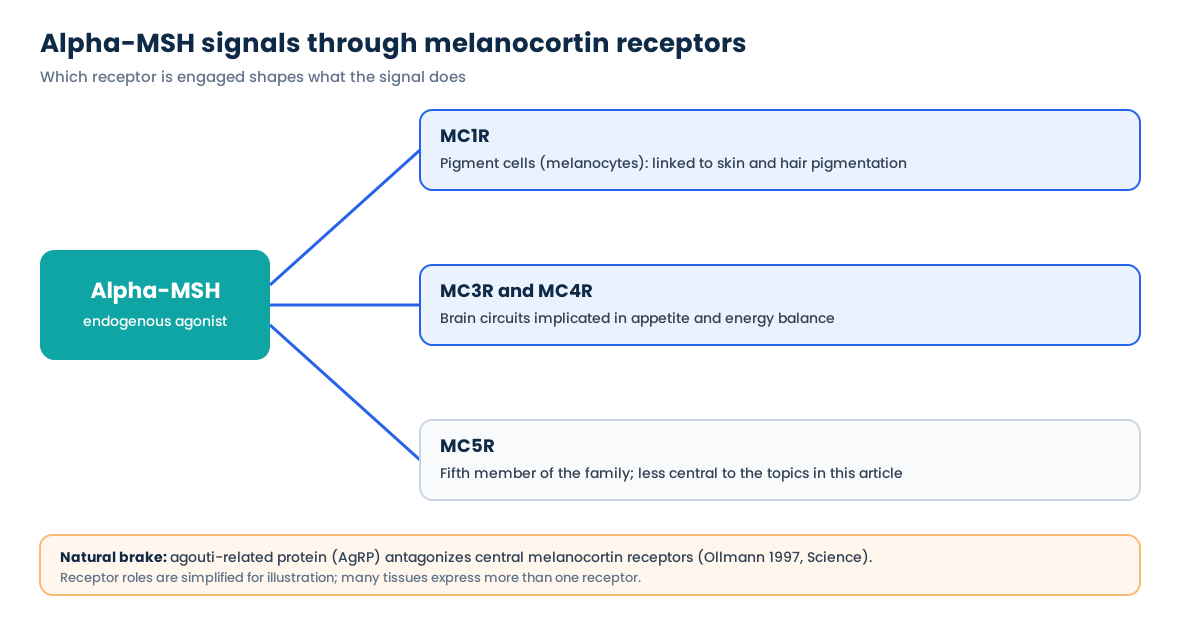
Alpha-MSH is an agonist: it binds melanocortin receptors, which are G-protein-coupled receptors (see what is a GPCR), and activates them. Two receptor groups matter most in the literature. MC1R sits on pigment-producing cells and is tied to skin and hair pigmentation. MC3R and MC4R are found in brain circuits implicated in appetite and energy balance. A fifth receptor, MC5R, belongs to the same family.
The system also has a natural brake. Agouti-related protein (AgRP) antagonizes central melanocortin receptors, as shown in a 1997 Science paper, so the balance between agonist signal and antagonist signal helps set the tone of the pathway. The general logic of receptor activation and blockade is covered in agonists vs antagonists.
What the research literature reports
Pigmentation and appetite. Two human genetics papers anchor the story. In 1998, Krude and colleagues described children with severe early-onset obesity, adrenal insufficiency and red hair caused by POMC mutations, a combination that fits loss of ACTH (adrenal), of alpha-MSH signalling at MC1R (hair pigment) and of melanocortin signalling in the brain (appetite). In 2003, Farooqi and colleagues characterized the clinical spectrum of obesity in people with mutations in the MC4R gene, showing that this receptor is a common single-gene contributor to severe obesity.
Inflammation. A 1996 Journal of Clinical Investigation study reported that alpha-MSH reduced endotoxin-induced liver inflammation in animals, and later work has examined its immune actions in cells. These are preclinical findings.
What the human evidence shows
Native alpha-MSH is not itself a marketed drug, but two synthetic melanocortin agonists are approved in the United States, and their labels show what has been tested in humans. Afamelanotide (Scenesse) is a MC1R agonist indicated, per its label, to increase pain-free light exposure in adults with a history of phototoxic reactions from erythropoietic protoporphyria; the pivotal results appeared in the New England Journal of Medicine in 2015. Setmelanotide (Imcivree) is an MC4R agonist; its current label lists chronic weight management in specific settings, including obesity from POMC, PCSK1 or LEPR deficiency, Bardet-Biedl syndrome, and acquired hypothalamic obesity. A 2020 Lancet Diabetes and Endocrinology trial reported efficacy and safety in people with LEPR or POMC deficiency.
The setmelanotide label also lists warnings, including disturbance in sexual arousal, depression and suicidal ideation, and hypersensitivity reactions. These are prescription products for narrow, genetically defined groups; they are not evidence about unregulated melanocortin peptides sold online. For the safety picture of the latter, see melanocortin peptide side effects.
Handling and storage in a research context
Peptides of this size are generally supplied as lyophilized powders and are sensitive to heat, moisture and repeated handling. General principles, rather than compound-specific claims, are in peptide degradation and peptide half-life explained. Concentration arithmetic is a lab-math exercise; see the reconstitution calculator and the IU vs mL explainer.
Cautions and considerations
Alpha-MSH and its synthetic relatives act on pigmentation, appetite and immune pathways at once, so effects are rarely confined to one target. Related research peptides such as Melanotan II and PT-141 have their own Library entries. Anyone with a health concern should speak with a qualified clinician rather than rely on an educational article.
Frequently asked questions
Is alpha-MSH the same as ACTH?
No. Alpha-MSH corresponds to the first 13 residues of ACTH’s 39, but it is a separate, chemically capped peptide with different receptor preferences; ACTH acts mainly at the adrenal MC2 receptor.
Where is alpha-MSH made?
Within POMC-expressing cells, including neurons in the hypothalamus; the review literature also describes production in the pituitary and in skin cells. Cleavage by prohormone convertases determines which peptides each cell releases.
Why does POMC deficiency cause red hair?
Krude 1998 attributed the red hair to missing alpha-MSH signalling at MC1R in the hair follicle, alongside loss of ACTH and of central melanocortin signalling.
Is alpha-MSH approved as a drug?
The native peptide is not. Synthetic analogs afamelanotide and setmelanotide are approved for the specific indications on their labels.
References
- UniProt P01189, POMC_HUMAN: feature table for alpha-MSH, ACTH and related peptides
- Krude H et al. Severe early-onset obesity, adrenal insufficiency and red hair pigmentation caused by POMC mutations in humans. Nat Genet 1998. PMID 9620771
- Farooqi IS et al. Clinical spectrum of obesity and mutations in the melanocortin 4 receptor gene. N Engl J Med 2003. PMID 12646665
- Ollmann MM et al. Antagonism of central melanocortin receptors in vitro and in vivo by agouti-related protein. Science 1997. PMID 9311920
- Alpha-melanocyte-stimulating hormone reduces endotoxin-induced liver inflammation. J Clin Invest 1996. PMID 8621792
- Langendonk JG et al. Afamelanotide for erythropoietic protoporphyria. N Engl J Med 2015. PMID 26132941
- Clement K et al. Efficacy and safety of setmelanotide in severe obesity due to LEPR or POMC deficiency. Lancet Diabetes Endocrinol 2020. PMID 33137293
Informational only — not medical advice. This article is for educational purposes. It does not recommend, sell or instruct personal human use of any compound. Consult a qualified healthcare professional for any health decision. Content is intended for adults 21+. Verify scientific details against the primary sources cited.