
DSIP (Delta Sleep-Inducing Peptide)
Summary
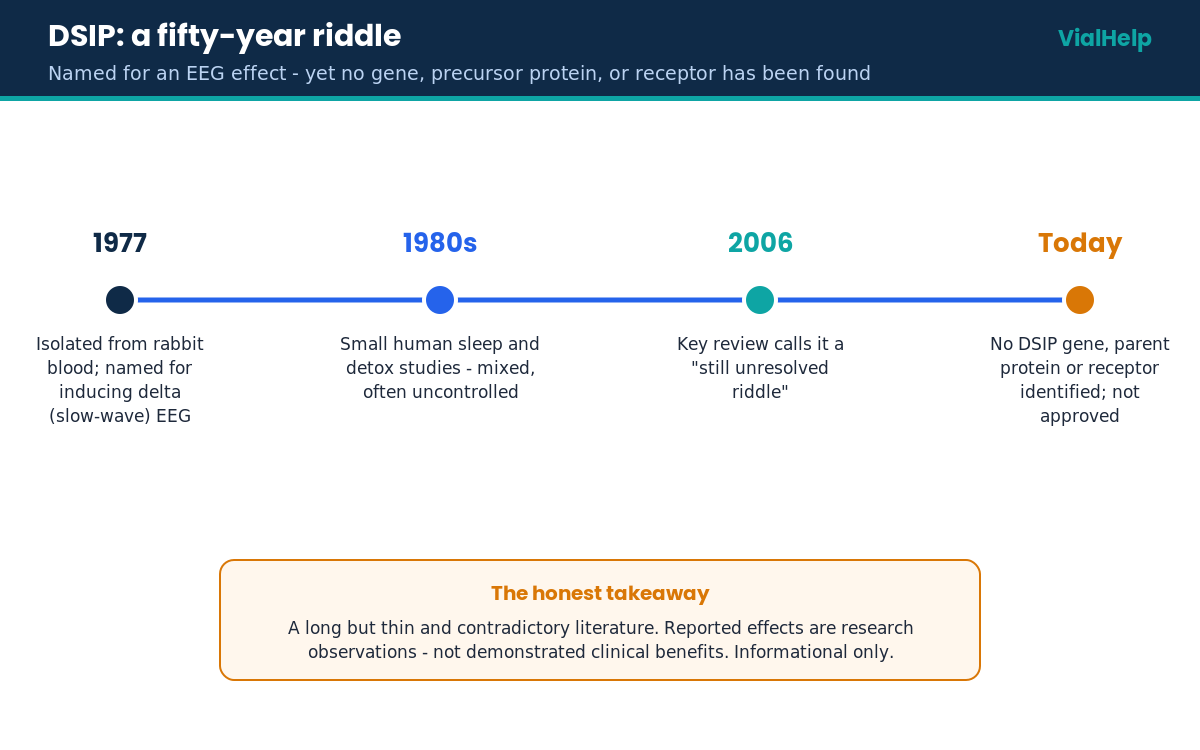
DSIP (delta sleep-inducing peptide) is a nine-amino-acid neuropeptide isolated in the 1970s and named for inducing slow-wave EEG — yet after roughly 50 years it still has no identified gene, precursor, or receptor, and a thin, contradictory evidence base.
Quick facts
| Also known as | Delta sleep-inducing peptide; emideltide; delta-EEG-inducing nonapeptide |
| Category | Neuropeptide (nonapeptide) |
| Status | Research compound — not FDA-approved |
| CAS | 62568-57-4 |
| Formula | C35H48N10O15 |
| Molecular weight | 848.8 g/mol |
| Sequence | Trp-Ala-Gly-Gly-Asp-Ala-Ser-Gly-Glu (WAGGDASGE) |
| Half-life | ~15 minutes in vitro (low confidence; rapidly degraded) |
| Storage | Lyophilized: 2-8 C short-term, -20 C long-term, sealed and dark. Reconstituted: refrigerate, use within a short window; avoid freeze-thaw. |
In Plain English
DSIP, or delta sleep-inducing peptide, is a small naturally occurring peptide first noticed in connection with deep sleep. Researchers study it for possible roles in sleep, stress, and the body’s daily rhythms, though its exact effects are still not well understood. The evidence is limited and comes mostly from older laboratory and animal studies, and it is not an approved drug.
DSIP (delta sleep-inducing peptide) is a nine-amino-acid neuropeptide that has fascinated and frustrated researchers for nearly fifty years. First isolated from rabbit blood in the 1970s and named for its ability to induce delta (slow-wave) EEG activity, DSIP carries one of the most curious profiles in peptide science: a well-defined sequence, a long literature, and yet — to this day — no identified gene, precursor protein, or dedicated receptor. A landmark review summed it up by calling DSIP a “still unresolved riddle.”
What is DSIP?
DSIP is an amphiphilic endogenous neuropeptide with the sequence Trp-Ala-Gly-Gly-Asp-Ala-Ser-Gly-Glu (one-letter: WAGGDASGE). It was discovered by Monnier and Schoenenberger, who reported that infusing it into the brain of rabbits promoted slow-wave sleep patterns. Its alias list includes delta sleep-inducing peptide and the INN “emideltide”; a separate, more stable phosphorylated form (P-DSIP) also appears in the literature. Despite being labeled “endogenous,” a central caveat runs through everything written about DSIP: no DSIP gene or parent protein has ever been found, and many older studies relied on imprecise “DSIP-like immunoreactivity” assays rather than the peptide itself.
How DSIP is studied to work
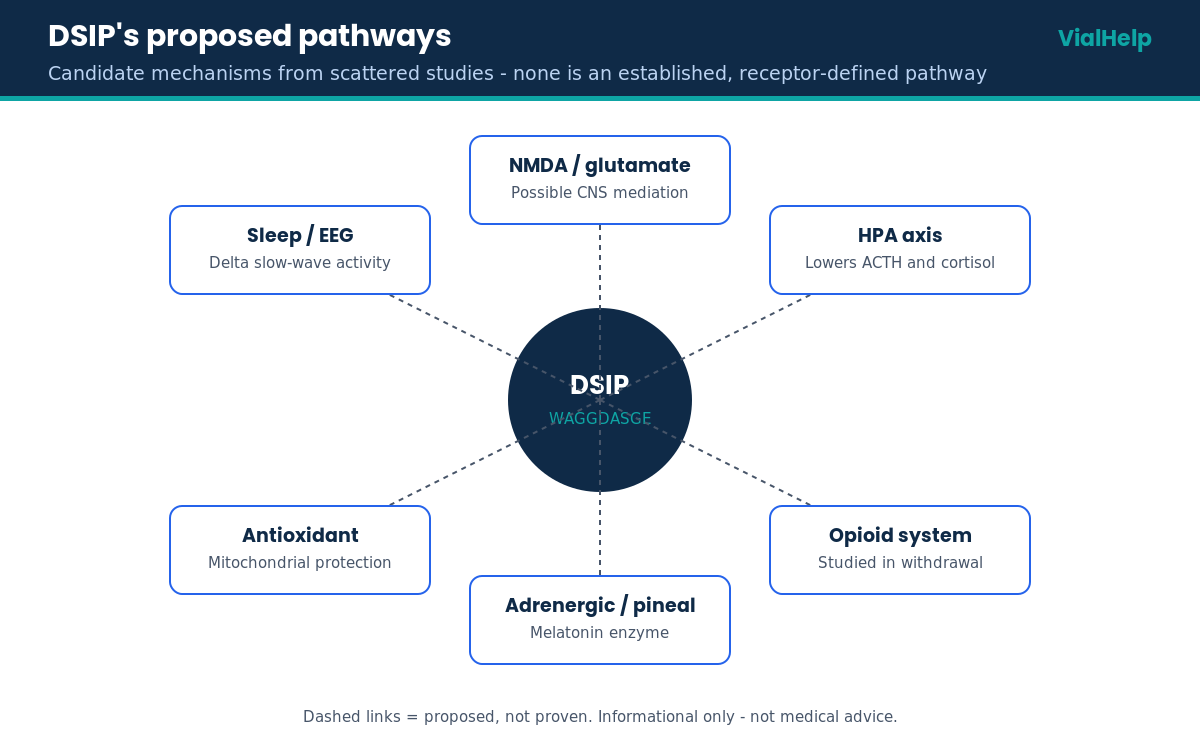
Here honesty is essential: DSIP’s mechanism of action — and even its true endogenous role — are unresolved and controversial. After roughly fifty years, no receptor has been identified, so any “mechanism” is inferred from downstream effects rather than a defined signaling pathway. The proposed (not proven) pathways that appear across the literature include:
- Sleep / EEG modulation — the original observation of delta-wave (slow-wave) induction, though findings across species are contradictory.
- HPA-axis / stress modulation — reported to lower basal ACTH and act as a “stress-limiting” factor.
- Antioxidant / mitochondrial — improved oxidative-phosphorylation efficiency in rat brain mitochondria in one study.
- Glutamatergic — possible mediation via NMDA receptors.
- Adrenergic / pineal — modulation of the melatonin-synthesis enzyme via alpha-1 receptors.
- Opioid system — proposed antagonism, the basis for withdrawal studies.
Reported effects and benefits in the research literature
What studies have actually reported — mostly from the 1970s–2000s, animal-heavy, small, and often inconsistent — includes:
- Sleep: delta/slow-wave EEG in rabbits; some small human studies reported improved disturbed sleep, while others found no effect.
- Stress resistance: described as a stress-limiting factor in rodent models; lowers ACTH.
- Analgesia: antinociceptive effects when given centrally in mice.
- Withdrawal: open clinical trials reported symptom relief during opioid and alcohol detox.
- Antioxidant / anti-hypoxic: mitochondrial protection under experimental hypoxia.
- Thermoregulation and other exploratory effects in rodents.
What this does not mean: none of this establishes DSIP as an effective treatment for insomnia, anxiety, pain, addiction, or aging in humans. Much of the literature is decades old, conducted in animals, uses non-standardized assays, relies on central (not peripheral) dosing, and is frequently contradicted by other studies. Reported effects are research observations, not demonstrated clinical benefits, and long-term safety is not established.
What the human evidence shows
DSIP is not FDA-approved and has no recognized therapeutic indication anywhere. The human studies that exist are limited, dated, and methodologically weak: small sleep-disturbance trials in the 1980s; open-label opioid and alcohol detox trials in the 1990s that reported high symptom-relief rates but lacked rigorous blinding and controls; and an anesthesia-adjunct study in which DSIP unexpectedly reduced anesthetic depth and increased heart rate — i.e., it did not behave as a simple sedative. There is no defined human pharmacokinetics, no replication in modern randomized controlled trials, and unestablished long-term safety. A regional preparation called “Deltaran” has appeared in some research but is not an internationally approved drug.
Handling, storage and reconstitution (research context)
- Lyophilized powder: the most stable form; typically refrigerated (2–8 °C) for short-term and frozen (-20 °C or colder) for long-term, kept sealed and protected from light and moisture.
- Reconstituted: much less stable — DSIP is described as rapidly degraded (an in-vitro half-life on the order of ~15 minutes has been reported, with low confidence for in-vivo). Generally reconstituted with bacteriostatic or sterile water, refrigerated, used within a short window, and protected from repeated freeze–thaw.
- General: minimize warm-up time, avoid vigorous agitation, and follow the lot’s certificate of analysis. See our reconstitution calculator and units explainer.
Cautions and considerations
- DSIP is a research compound with no approved use; human safety and efficacy are not established.
- The evidence base is old, thin, and contradictory, with no identified gene or receptor.
- Unregulated material varies in purity and endotoxin — review a meaningful certificate of analysis.
- This page is informational only and not medical advice; intended for an audience 21+.
Frequently asked questions
What is DSIP?
DSIP is a naturally occurring nine-amino-acid neuropeptide (sequence WAGGDASGE), first isolated from rabbit blood in the 1970s and named for inducing delta (slow-wave) EEG activity. It has no approved medical use.
Does DSIP actually make you sleep?
The evidence is genuinely mixed — some animal and small human studies report slow-wave-sleep promotion while others find none, and a key 2006 review concluded the DSIP–sleep link remains weak and poorly documented.
How is DSIP thought to work?
Its mechanism is not established. No DSIP gene, precursor, or receptor has been found, and proposed pathways (NMDA, HPA/ACTH–cortisol, antioxidant, opioid) come from scattered downstream observations rather than a defined receptor mechanism.
Is DSIP FDA-approved or proven safe?
No. DSIP is not FDA-approved and has no approved indication anywhere; human studies are few, old, and methodologically weak, and long-term safety has not been established.
Related compounds and further reading
- How to reconstitute peptides — step-by-step handling guide.
- Sterile technique — clean handling fundamentals.
- Selank and Semax — other neuropeptides studied for stress and cognition.
- Epitalon — a pineal-associated peptide studied in longevity research.
- Oxytocin — a well-characterized neuropeptide for contrast.
- Browse the full peptide library and our handling guides.
Share this article
References
- PubChem — Delta Sleep-Inducing Peptide, CID 68816
- Monnier M et al. (1977) DSIP comparative properties (PMID 862769)
- Schoenenberger GA et al. (1977) DSIP amino-acid sequence and synthesis (PMID 568769)
- Kovalzon VM & Strekalova TV (2006) DSIP: a still unresolved riddle (PMID 16539679)
- Khvatova EM et al. (2003) DSIP and brain mitochondria under hypoxia (PMID 12668217)
- Backmund M et al. (1998) Opioid detoxification with DSIP (PMID 9617990)
For informational use only. Not medical advice; consult a qualified healthcare professional. 21+.
DSIP (Delta Sleep-Inducing Peptide) reconstitution calculator
Use the calculator below to find the concentration (mg/mL), draw volume and U-100 syringe units for DSIP (Delta Sleep-Inducing Peptide) once it is reconstituted with bacteriostatic water. DSIP (Delta Sleep-Inducing Peptide) has molecular formula C35H48N10O15 and a molecular weight of 848.8 g/mol. Enter your vial amount and the water volume to see the lab math — informational use only, not dosing advice.
Open the full calculator · Back to the DSIP (Delta Sleep-Inducing Peptide) profile