Pharmacopeias move toward recombinant Factor C for endotoxin testing
Peptide endotoxin testing is quietly changing method. Both the European Pharmacopoeia and the United States Pharmacopeia have now formally recognised recombinant Factor C (rFC) — a synthetic reagent — alongside the traditional horseshoe-crab-derived limulus amoebocyte lysate (LAL) reagents that have dominated bacterial endotoxin testing for decades. For anyone reading a Certificate of Analysis, the practical takeaway is unchanged but worth restating: endotoxin is its own test, separate from the purity and identity results printed on the same page.
What an endotoxin test actually measures
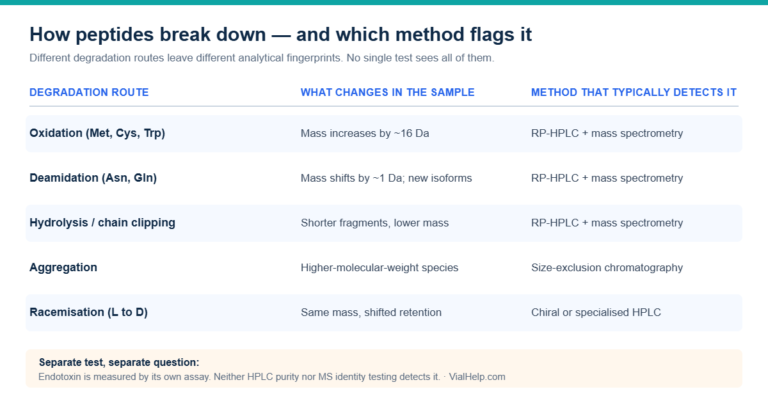
Bacterial endotoxins are lipopolysaccharide fragments from the outer membrane of Gram-negative bacteria. They are not detected by the chromatography or mass spectrometry used to characterise a peptide, because they are a different class of molecule entirely. The bacterial endotoxins test (BET) is a separate assay, reported in endotoxin units, usually normalised per milligram of substance. A material can be highly pure by HPLC and still carry endotoxin, and vice versa.
What changed in Europe
On 26 January 2026 the EDQM announced that the European Pharmacopoeia Commission has integrated recombinant Factor C as one of the seven methods in general chapter 2.6.14. Bacterial endotoxins. The EDQM states that rFC was adopted on the basis of mature, evidence-backed data demonstrating equivalence to traditional LAL methods, and that laboratories and manufacturers retain full method choice, guided by risk assessment and product suitability under chapter 5.1.13. Pyrogenicity.
The change sits alongside a separate milestone: the rabbit pyrogen test has been suppressed from Ph. Eur. monographs as of 1 January 2026. The EDQM has published an FAQ to support the transition. It also clarified that recombinant cascade reagents (rCR) are a distinct case — described as promising but still in the data-generation phase, with the Commission encouraging data generation rather than adopting them now.
What changed in the United States
USP took a different route to a similar place. Rather than fold recombinant reagents into the existing chapter 〈85〉 Bacterial Endotoxins Test, the Microbiology Expert Committee developed a separate chapter, 〈86〉 Bacterial Endotoxins Test Using Recombinant Reagents, covering methods based on both rFC and recombinant cascade reagents. USP’s own announcement frames this as part of a commitment to transition methods away from animal-derived materials toward synthetic and recombinant ones.
The companion guidance chapter 〈1085〉 was then revised. Among the changes proposed by the Microbiology Expert Committee: the chapter title was reworked, the glossary was removed in favour of the microbiology glossary in 〈1117.1〉, and — the substantive point — the document was updated to include recombinant reagents, revising the terminology so that it covers both lysate and recombinant reagents. Industry reporting describes the revised 〈1085〉 as released in July 2025 and becoming official in February 2026, with the practical effect that methods falling outside 〈85〉 or 〈86〉 are treated as alternative methods requiring full validation and product-specific verification.
Why this matters when you read a COA
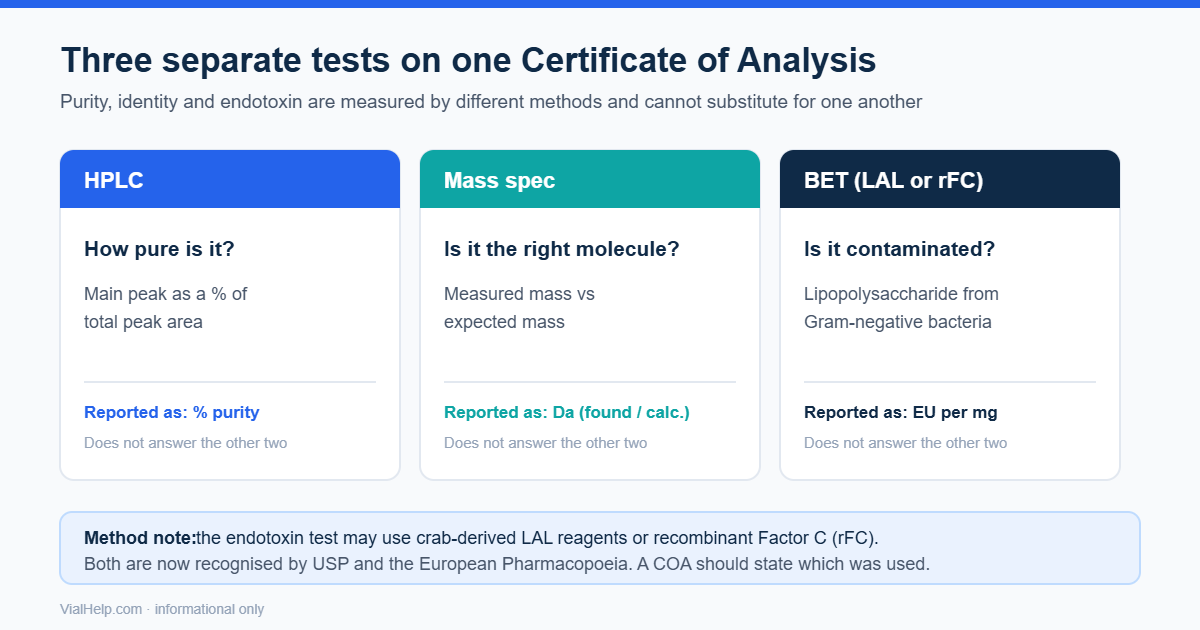
A complete Certificate of Analysis answers three different questions with three different techniques, and it is easy to conflate them:
- Purity — typically by HPLC, reported as the main peak as a percentage of total peak area. It says how much of the material is the target compound relative to other UV-absorbing species. It says nothing about endotoxin.
- Identity — typically by mass spectrometry, comparing the measured mass against the expected mass for the stated sequence. It confirms you have the right molecule, not how clean it is.
- Endotoxin — by the bacterial endotoxins test, now performable with LAL or rFC reagents, reported in endotoxin units. It is a contamination measure, and it is the only one of the three that speaks to pyrogenicity.
Two further points follow from the pharmacopeial changes. First, a COA that reports an endotoxin result should say which method was used; “rFC” and “LAL” are now both compendially recognised, so naming the method is informative rather than a red flag. Second, the absence of an endotoxin line does not mean a material passed — it means the test was not reported. Our guide to reading a Certificate of Analysis walks through the rest of the document field by field.
Endotoxin and innate immune response testing has also been a live topic on the regulatory side: the revised draft product-specific guidances FDA published for generic peptide products in July 2026 addressed impurity thresholds and immune-response testing among other quality expectations. See our summary of the 17 revised draft PSGs for that thread.
Related on VialHelp
- How to read a Certificate of Analysis
- FDA publishes 17 revised draft guidances for generic peptide products
- More VialHelp News