Boehringer Ingelheim’s Triple Receptor Agonist BI 3034701 Enters Phase II
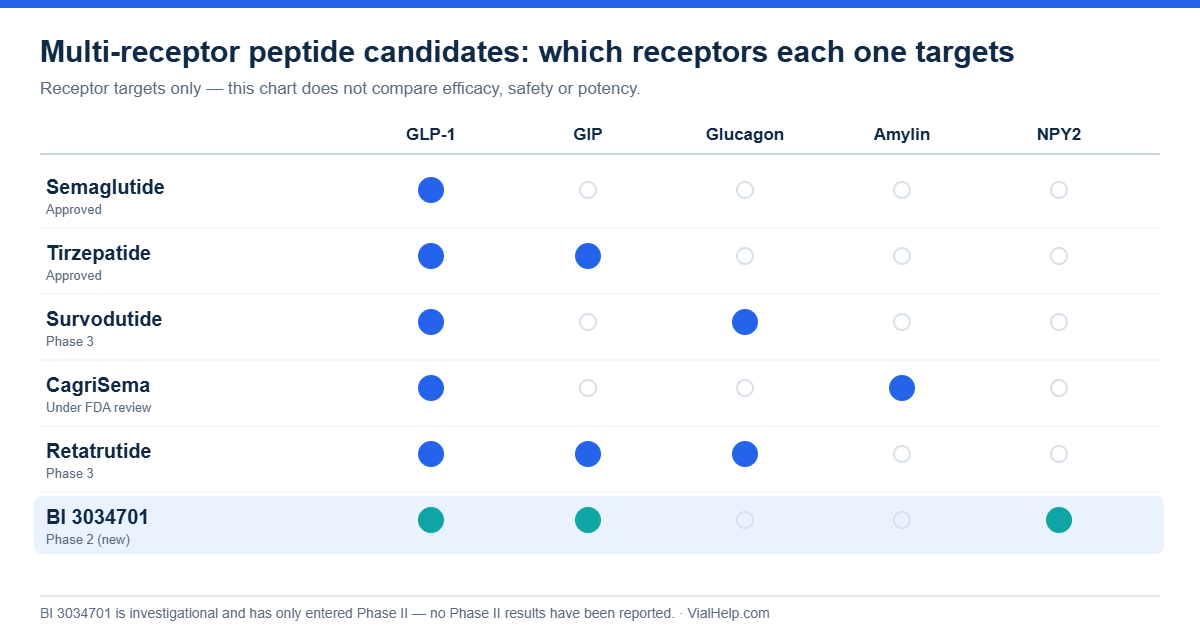
BI 3034701, an investigational peptide from Boehringer Ingelheim, has entered Phase II clinical development for obesity and overweight, the company announced on 16 July 2026. What makes BI 3034701 unusual is its target profile: it is designed to act on three receptors at once — GLP-1, GIP and neuropeptide Y2 (NPY2) — a combination the company describes as potentially first-in-class.
What the company actually announced
According to the company’s announcement, Boehringer Ingelheim has started a Phase II trial evaluating the efficacy and safety of BI 3034701 in people living with obesity and overweight. The company says the study includes dose finding alongside a broader clinical evaluation, and it lists the trial on ClinicalTrials.gov under the identifier NCT07662122.
The company states that in Phase I studies the molecule showed a “generally favourable safety and tolerability profile,” which it gives as the basis for advancing the programme. That characterisation is the company’s own; no Phase I dataset has been published alongside the release, and no Phase II efficacy or safety results exist yet. Boehringer Ingelheim also notes that BI 3034701 was developed in cooperation with Gubra, and that Boehringer is solely responsible for further development. The release was issued from the company’s German headquarters and carries a notice that it is not intended for UK and US audiences.
The three receptors, in plain terms
- GLP-1 receptor — the most familiar target in this category, associated in the literature with satiety and metabolic regulation. It is the shared backbone of almost every recent multi-receptor candidate.
- GIP receptor — the second incretin receptor. Combined GLP-1/GIP activity is already the basis of marketed dual agonists.
- NPY2 receptor — the genuinely new element here. The company cites published work indicating that NPY2 activation modulates central hunger signalling, while stating plainly that its broader effect on eating behaviour “remains to be fully elucidated.”
That last caveat is worth holding on to. The NPY2 arm is the part of this molecule that has the least clinical track record behind it, and it is also the part that makes the candidate novel.
Where BI 3034701 sits in the multi-receptor trend
Metabolic peptide development has moved steadily from single-receptor to multi-receptor designs. Semaglutide acts at one receptor; tirzepatide at two; retatrutide, which recently reported Phase 3 topline results, adds a glucagon receptor arm. Other programmes pair a peptide with a different hormone class entirely, as with the semaglutide-plus-cagrilintide combination now under FDA review.
BI 3034701 is a third variation on the theme: it keeps the GLP-1/GIP pairing but substitutes NPY2 for glucagon. Boehringer Ingelheim’s own portfolio already includes survodutide, a glucagon/GLP-1 dual agonist in later-stage development, so the two candidates explore different mechanisms rather than duplicating one.
What this milestone does — and does not — mean
- Entering Phase II is a decision, not a result. It means a sponsor has chosen to test a compound in a larger patient population. It is not evidence that the compound works.
- No efficacy data exist. The company has not disclosed doses under study, a readout timeline, or any Phase II outcome. Anyone quoting a weight-loss figure for BI 3034701 is not quoting the company.
- It is not approved anywhere. BI 3034701 is investigational. Most compounds that enter Phase II do not reach approval.
- It says nothing about material sold online. A code number appearing in a corporate pipeline release carries no implication about the identity, purity or handling of anything sold under a similar name.
Why the naming matters
Early-stage development codes like BI 3034701 tend to circulate widely once a press release lands, often long before any peer-reviewed characterisation exists. A development code identifies a programme, not a verified molecule in a vial — the only way to know what a given material actually is comes from analytical documentation. Our guide on how to read a certificate of analysis covers what those documents do and do not establish.
Sources
- Boehringer Ingelheim, “Boehringer Ingelheim strengthens obesity pipeline as potential first-in-class triple receptor agonist BI 3034701 enters Phase II development,” company press release via GlobeNewswire, 16 July 2026.
- ClinicalTrials.gov, study record NCT07662122.
More regulatory and pipeline coverage is collected on the VialHelp news page.