
Cyclosporine: The Cyclic Peptide Immunosuppressant Explained
Peptide science
Cyclosporine is a cyclic peptide of 11 amino acids, first found as a fungal metabolite, that became one of the most important immunosuppressant drugs in medicine. It is unusual because a peptide this large can be absorbed from the gut at all, and because its mechanism, blocking the enzyme calcineurin in T cells, opened up a whole class of drugs.
What is cyclosporine?
The US prescribing label describes cyclosporine as a cyclic polypeptide of 11 amino acids produced as a metabolite by a fungus. Its formula is C62H111N11O12 and its molecular weight is about 1202.6 Da (PubChem; KEGG DRUG). Historical accounts place its discovery in a Sandoz screening program in the 1970s, where a compound first examined for antifungal activity turned out to suppress immune responses (Borel, 2002). Its structure was determined in 1976 (Rüegger et al.).
Unlike the hormone-like peptides covered elsewhere on this site, cyclosporine is a natural product built by a fungal enzyme machine. Studies of its biosynthesis describe synthesis through a single linear undecapeptide precursor that is then cyclized (Dittmann et al., 1994). General background on ring-shaped peptides is in our explainer on cyclic peptides and macrocyclization.
Unusual structure: D-amino acids, N-methylation and MeBmt
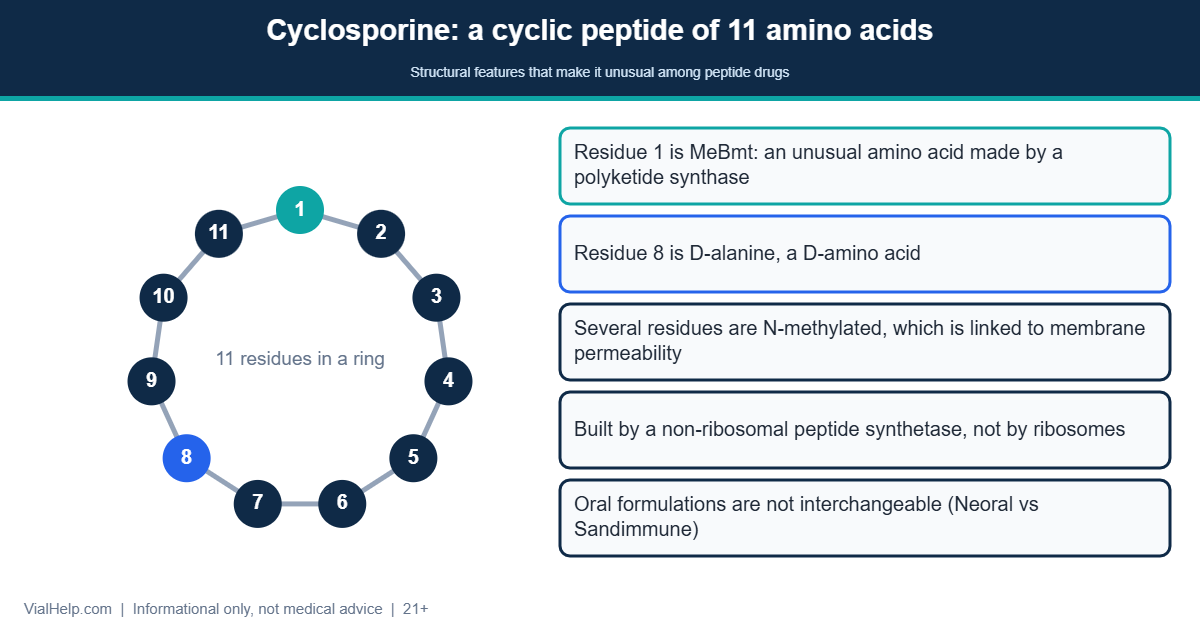
Cyclosporine departs from the textbook peptide in several ways. It contains one D-amino acid (D-alanine at position 8; see D-amino acids in peptides), an unusual amino acid called MeBmt at position 1, and several N-methylated residues. N-methylation removes backbone hydrogen-bond donors, a feature commonly linked in the literature to better membrane permeability and resistance to proteases. Those traits help explain why cyclosporine can be given by mouth even though most peptides cannot (see why peptides are not pills and oral peptide delivery).
How cyclosporine works
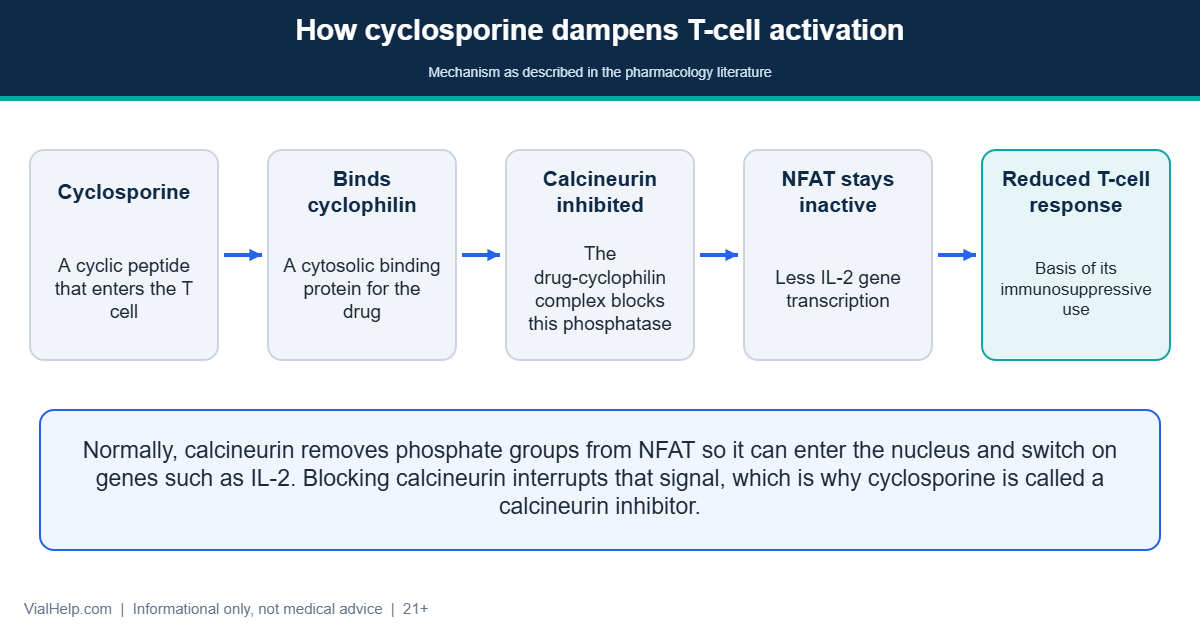
Cyclosporine enters T cells and binds a cytosolic protein called cyclophilin; the original identification of cyclophilin as a specific binding protein for cyclosporin A was reported in 1984 (Handschumacher et al.). The drug-cyclophilin complex then inhibits calcineurin, a phosphatase that normally activates the transcription factor NFAT. Without active NFAT, genes such as IL-2 are not switched on efficiently, and T-cell activation is dampened (Matsuda and Koyasu, 2000; KEGG DRUG).
What cyclosporine is labeled for
The US label for the microemulsion product Neoral lists prophylaxis of organ rejection in kidney, liver and heart allogeneic transplants, severe active rheumatoid arthritis that has not responded adequately to methotrexate, and severe recalcitrant plaque psoriasis in adults who are not immunocompromised. These are prescription uses under specialist care.
Safety and handling themes on the label
The Neoral boxed warning says only physicians experienced in systemic immunosuppressive therapy should prescribe it, that blood concentrations should be monitored in transplant and rheumatoid arthritis patients, and that Neoral and Sandimmune are not bioequivalent and cannot be used interchangeably without physician supervision. The Warnings section also covers nephrotoxicity and hepatotoxicity, thrombotic microangiopathy, hyperkalemia, malignancies such as lymphoma and skin cancer, serious infections including polyomavirus infections, and neurotoxicity including seizures. For the psoriasis indication, renal dysfunction and hypertension are highlighted.
The non-interchangeability point is a good illustration of a wider principle: with peptides and other large molecules, formulation changes absorption, so two products containing the same active ingredient are not automatically equivalent. See also peptides versus small molecules.
Cyclosporine among peptide drugs
Cyclosporine sits alongside other naturally derived cyclic peptide medicines such as the glycopeptide and lipopeptide antibiotics described in peptide antibiotics. Both families show that nature-derived cyclic scaffolds can solve problems, such as stability and target binding, that simple linear peptides struggle with.
Frequently asked questions
Is cyclosporine really a peptide?
Yes. It is a cyclic peptide made of 11 amino acids, although several are modified, so it looks quite different from a typical hormone peptide.
Why is it called a calcineurin inhibitor?
Because the cyclosporine-cyclophilin complex blocks calcineurin, the enzyme that activates NFAT in T cells. Tacrolimus is another drug that inhibits calcineurin through a different binding partner.
Can one cyclosporine brand be swapped for another?
Not automatically. The Neoral label states that Neoral and Sandimmune are not bioequivalent and cannot be used interchangeably without physician supervision.
Why does cyclosporine need blood-level monitoring?
The label notes that blood concentrations should be monitored in transplant and rheumatoid arthritis patients, since toxicity can occur at high levels and rejection risk at low levels.
References
- Neoral and Sandimmune (cyclosporine) US prescribing information, FDA
- KEGG DRUG D00184: cyclosporine
- Handschumacher RE et al. Cyclophilin: a specific cytosolic binding protein for cyclosporin A. Science 1984. PMID 6238408
- Borel JF. History of the discovery of cyclosporin and of its early pharmacological development. 2002. PMID 12422576
- Rüegger A et al. Cyclosporin A, a peptide metabolite (structure determination). Helv Chim Acta 1976. PMID 950308
- Matsuda S, Koyasu S. Mechanisms of action of cyclosporine. Immunopharmacology 2000. PMID 10878286
- Dittmann J et al. Mechanism of cyclosporin A biosynthesis: evidence for synthesis via a single linear undecapeptide precursor. 1994. PMID 8300618
Informational only — not medical advice. This article is for educational purposes. It does not recommend, sell or instruct personal human use of any compound. Consult a qualified healthcare professional for any health decision. Content is intended for adults 21+. Verify scientific details against the primary sources cited.