
Somatostatin Analogs: Octreotide, Lanreotide and Pasireotide Explained
Peptide science
Somatostatin analogs are synthetic peptides modeled on the natural hormone somatostatin and redesigned to resist breakdown, so they last far longer than the original. The three best known are octreotide, lanreotide and pasireotide. They differ in structure, in which somatostatin receptors they favor, and in their US-labeled uses.
What are somatostatin analogs?
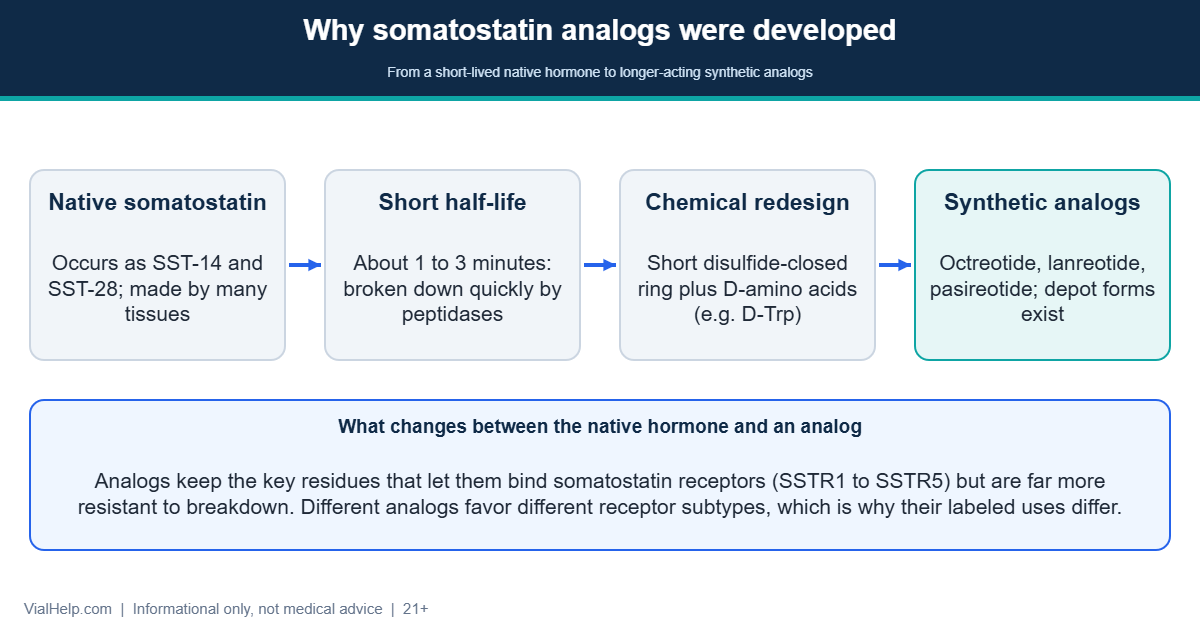
Somatostatin is a regulatory peptide that restrains the release of many other hormones; the full background is in our guide to what somatostatin is. As a medicine the natural molecule has a serious drawback. A 2020 review notes that native somatostatin has a half-life of only about 1 to 3 minutes because peptidases break it down quickly, which is why longer-acting synthetic analogs were developed (Gomes-Porras et al., Int J Mol Sci 2020).
Somatostatin analogs keep the part of the molecule that lets it bind somatostatin receptors, but they change the rest so the peptide survives much longer. The general ideas behind that redesign, such as how peptides are degraded and strategies for extending half-life, apply here directly.
How somatostatin analogs are built
All three analogs are small, constrained peptides. Octreotide is a synthetic octapeptide with the sequence D-Phe-Cys-Phe-D-Trp-Lys-Thr-Cys(-ol), closed into a ring by a disulfide bond between its two cysteines, and ending in the alcohol threoninol rather than a free acid. Its formula is C49H66N10O10S2 (about 1019 Da). Lanreotide is also an octapeptide, D-2Nal-Cys-Tyr-D-Trp-Lys-Val-Cys-Thr-NH2 with a disulfide bridge, listed on its US label with a molecular weight of about 1096 Da. Pasireotide is a cyclohexapeptide, a six-residue ring, supplied as a diaspartate salt.
Two design features recur: a small ring held together by a disulfide bond, and the use of D-amino acids such as D-Trp, which peptidases recognize poorly. More background is in our explainer on cyclic peptides.
Receptor selectivity: five somatostatin receptors
Somatostatin acts through five receptor subtypes, SSTR1 to SSTR5, and the analogs do not bind them equally. The reviews and labels describe octreotide as having high affinity for SSTR2. The lanreotide label reports high affinity for SSTR2 and SSTR5 and reduced affinity for SSTR1, 3 and 4. The pasireotide label reports substantially higher affinity than octreotide for SSTR1, 3 and 5 and similar affinity for SSTR2, with its highest affinity at SSTR5 (IC50 0.16 nmol/L) followed by SSTR2 (1.0 nmol/L). That broader profile is the main reason pasireotide is used in a different condition from the other two.
Somatostatin analogs compared
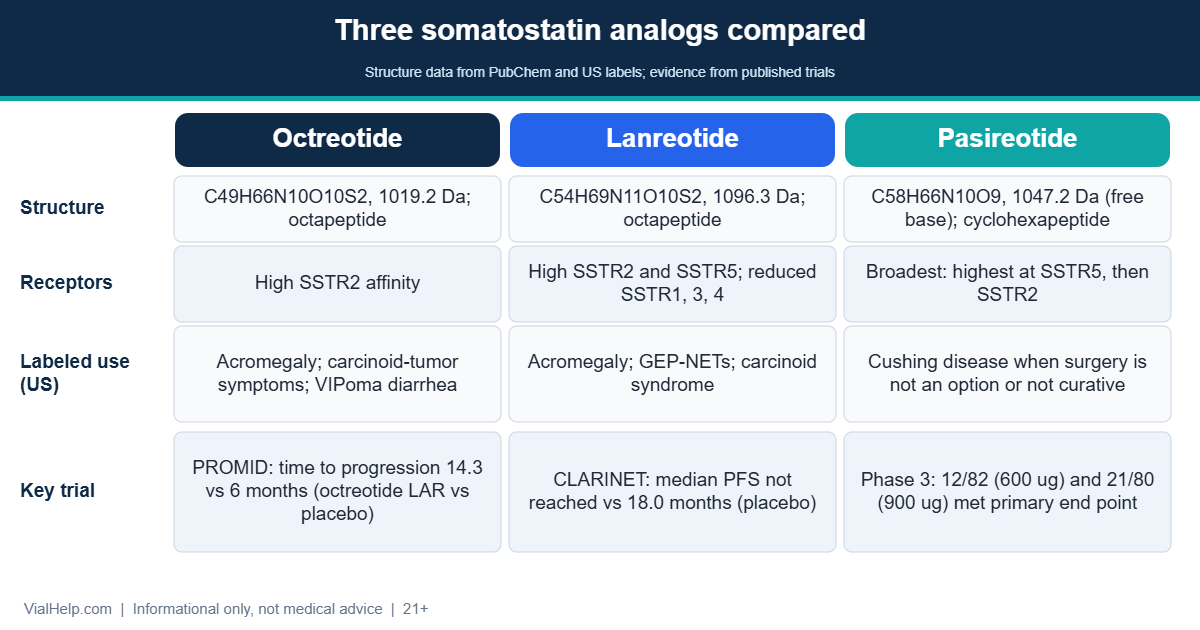
On their US labels, octreotide is indicated for acromegaly, for severe diarrhea and flushing from metastatic carcinoid tumors, and for watery diarrhea from VIP-secreting tumors. Lanreotide is indicated for acromegaly, for unresectable gastroenteropancreatic neuroendocrine tumors (to improve progression-free survival) and for carcinoid syndrome. Pasireotide is indicated for adults with Cushing’s disease when pituitary surgery is not an option or has not been curative. Products are supplied as prepared injectable medicines, for example octreotide LAR as a kit, lanreotide as a prefilled syringe and pasireotide as an ampule.
What the clinical evidence shows
Three published trials are widely cited. In PROMID, patients with metastatic midgut neuroendocrine tumors were randomized to octreotide LAR or placebo; median time to tumor progression was 14.3 months versus 6 months (hazard ratio 0.34, 95% CI 0.20 to 0.59), and stable disease at 6 months was seen in 66.7% versus 37.2% (Rinke et al., J Clin Oncol 2009). In CLARINET, lanreotide significantly prolonged progression-free survival in patients with non-functioning, somatostatin receptor-positive grade 1 or 2 enteropancreatic neuroendocrine tumors (median not reached versus 18.0 months with placebo; Caplin et al., N Engl J Med 2014).
In a 12-month phase 3 study of pasireotide in Cushing’s disease, 12 of 82 patients in the 600 microgram group and 21 of 80 in the 900 microgram group met the primary end point, median urinary free cortisol fell by roughly half by month 2, and hyperglycemia-related adverse events occurred in 118 of 162 patients (Colao et al., N Engl J Med 2012). These findings are specific to the tumor types, populations and products studied.
Safety themes described on the labels
Several adverse-effect themes recur across the three labels. Reduced gallbladder motility and gallstones (cholelithiasis) are listed for all three. Effects on blood glucose are listed too: octreotide can cause either hypo- or hyperglycemia, while the pasireotide label describes worsening glycemia in nearly all study patients. Bradycardia and, for octreotide and pasireotide, QT changes are described, and gastrointestinal effects such as diarrhea, abdominal pain and nausea are common. Because somatostatin analogs suppress other hormones, they are used under clinical supervision; our broader coverage of peptide side effects explains how to read this kind of safety information.
Frequently asked questions
Why isn’t native somatostatin used directly?
Its half-life is only a few minutes because peptidases degrade it quickly, so analogs with D-amino acids and constrained rings were developed to last longer.
Do all somatostatin analogs bind the same receptors?
No. Octreotide has high SSTR2 affinity, lanreotide favors SSTR2 and SSTR5, and pasireotide binds a broader set with its highest affinity at SSTR5.
Are somatostatin analogs the same as growth hormone peptides or GLP-1 drugs?
No. Somatostatin analogs inhibit hormone release, whereas growth hormone secretagogues and GLP-1 receptor agonists act on different receptors; see GHRH versus GHRP for the growth-hormone side.
Do the tumor trials mean these drugs work for any tumor?
No. PROMID and CLARINET enrolled specific neuroendocrine tumor populations, and their results do not extend to other cancers.
References
- Sandostatin LAR Depot (octreotide) US prescribing information, FDA
- Somatuline Depot (lanreotide) US prescribing information, Ipsen
- Signifor (pasireotide) US prescribing information, Recordati Rare Diseases
- Gomes-Porras M et al. Somatostatin analogs in clinical practice: a review. Int J Mol Sci 2020;21:1682
- Rinke A et al. Octreotide LAR in metastatic midgut neuroendocrine tumors (PROMID). J Clin Oncol 2009. PMID 19704057
- Caplin ME et al. Lanreotide in metastatic enteropancreatic neuroendocrine tumors (CLARINET). N Engl J Med 2014. PMID 25014687
- Colao A et al. A 12-month phase 3 study of pasireotide in Cushing’s disease. N Engl J Med 2012. PMID 22397653
Informational only — not medical advice. This article is for educational purposes. It does not recommend, sell or instruct personal human use of any compound. Consult a qualified healthcare professional for any health decision. Content is intended for adults 21+. Verify scientific details against the primary sources cited.