
Peptides vs Small Molecules: How the Two Drug Classes Differ
Comparison
Peptides vs small molecules is one of the most consequential distinctions in drug and research-compound design: two chemical classes with different sizes, different manufacturing routes, and — most practically — different rules for how they have to be handled. A small molecule like aspirin can cross a cell membrane and survive a trip through the stomach; a peptide like insulin generally cannot do either. Understanding why explains a lot about how peptide research compounds actually get used.
What counts as a “small molecule” versus a “peptide”?
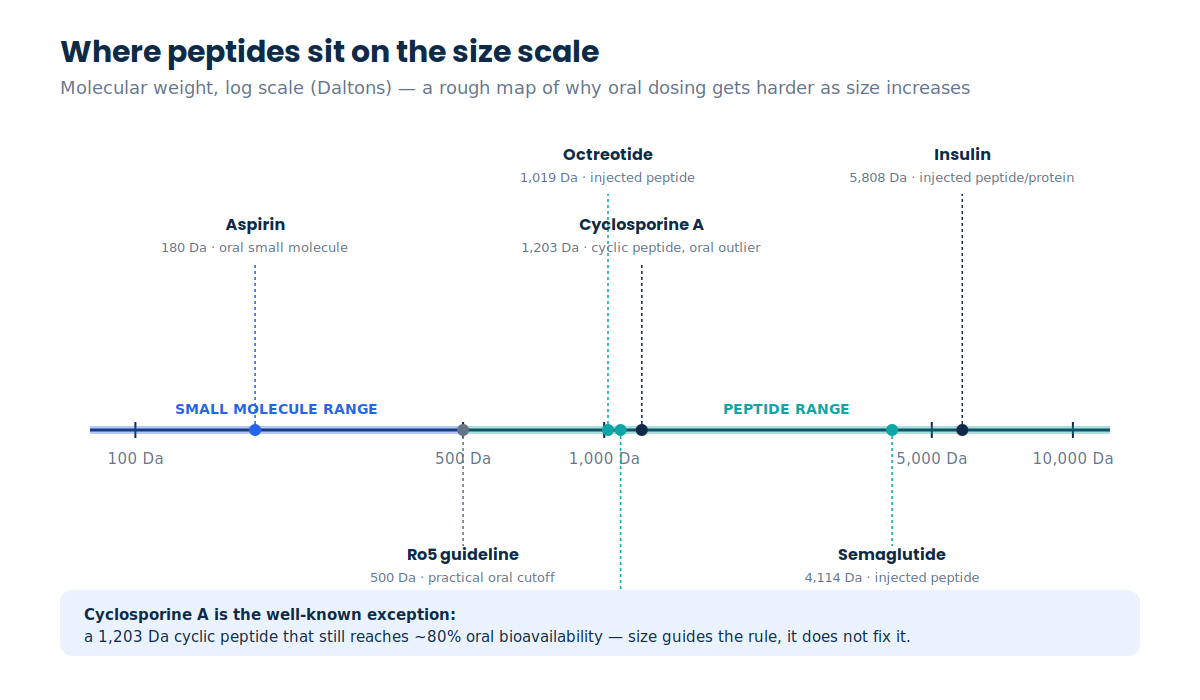
The dividing line is size, and medicinal chemists have a specific rule of thumb for it. Christopher Lipinski’s “Rule of Five” (Ro5) — the classic 1997 heuristic for drug-like small molecules — flags a compound as a poor oral-drug candidate if it breaks more than one of: molecular weight under 500 Daltons (Da), no more than 5 hydrogen-bond donors, no more than 10 hydrogen-bond acceptors, and a LogP (fat-versus-water solubility) no higher than 5. Peptides are explicitly called out in the medicinal chemistry literature as a class that routinely breaks these rules — they typically run from about 500 to 5,000 Da, built from fewer than 50 amino acids, which puts nearly every peptide of research interest above the small-molecule ceiling and below the larger therapeutic-protein/biologic range (generally >5,000 Da).
Why size decides the route: oral versus injectable
Size is not a cosmetic detail — it is the main reason small molecules are usually pills and peptides are usually injections. A small, compact molecule can slip between the cells lining the gut and survive digestion. A peptide, built from the same kind of amide bonds that digestive enzymes are specifically designed to cut, is treated by the gastrointestinal tract as food. Oral semaglutide (marketed as Rybelsus) is the clearest documented case: the FDA’s own clinical pharmacology review of its New Drug Application puts its absolute oral bioavailability at approximately 1%, and it only reaches useful blood levels at all because it is co-formulated with an absorption-enhancing excipient (SNAC). Insulin is the more extreme case — it cannot be dosed orally in any practical form, because, in the FDA-reviewed literature’s own framing, it is “reduced to fragments” by the gut “whereupon all activity is lost.”
Cyclosporine A is the well-known exception that proves the rule: a 1,203 Da cyclic peptide that still reaches roughly 80% oral bioavailability, because its closed-ring structure and internal hydrogen bonding let it behave more like a small molecule when crossing a membrane. Rule-of-thumb generalizations like Ro5 describe a strong tendency, not a law of chemistry. For the fuller mechanics of why most peptides can’t simply be swallowed, see our guide on why peptides aren’t pills.
Target specificity: a large interaction surface versus a small one
The flip side of “peptides are hard to dose orally” is “peptides tend to bind their targets more precisely.” Because a peptide presents a large, complex three-dimensional surface to its receptor, the medicinal chemistry literature describes peptide-target interactions as showing “extremely high levels of target specificity and high binding affinities, commonly in the nanomolar to picomolar range.” Small molecules, by contrast, make contact with a much smaller patch of a target, which means they more easily also fit — imperfectly — into unrelated binding pockets. That broader, less selective binding is generally described in the literature as an off-target or polypharmacology effect, and it’s a common source of the side effects small-molecule drugs are prone to. This is a difference in degree, not an absolute rule: it does not mean peptides are risk-free, only that their chemistry tends toward higher target selectivity.
Half-life: minutes versus weeks, and how that gets engineered
Left unmodified, most peptide hormones don’t last long in the bloodstream. Native GLP-1, the hormone semaglutide and liraglutide are modeled on, has a plasma half-life of roughly 1.5 to 2 minutes — it is degraded by an enzyme (DPP-4) almost as fast as it’s released. Endogenous insulin is cleared within minutes as well, with a plasma half-life of about 4 to 6 minutes. That’s a real problem for turning a hormone into a once-daily or once-weekly research or therapeutic tool, so a large part of applied peptide chemistry is half-life engineering.
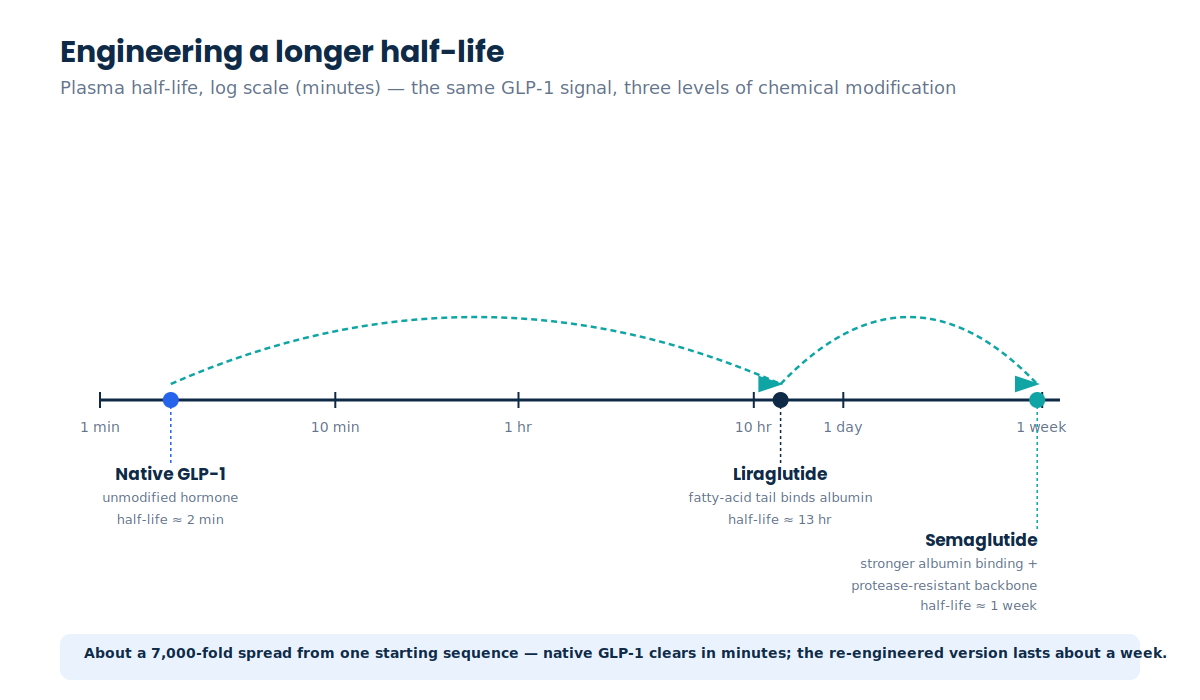
The GLP-1 family shows the engineering arc clearly. Liraglutide attaches a fatty-acid tail that binds circulating albumin (itself a protein with a half-life of 2 to 4 weeks), stretching its own half-life to roughly 11 to 15 hours. Semaglutide combines stronger albumin binding with a more protease-resistant backbone and reaches an elimination half-life of about a week (roughly 145 to 167 hours, per the FDA’s clinical pharmacology review). Octreotide, a synthetic analog of the hormone somatostatin, was deliberately engineered the same way — extending its activity well beyond the natural hormone’s — and shows a reported elimination half-life on the order of 100 minutes after subcutaneous injection.
Manufacturing: why peptides generally cost more to make
Small molecules are typically built through conventional organic synthesis — reaction steps that scale in fairly predictable, well-understood ways. Peptides are usually built through Solid-Phase Peptide Synthesis (SPPS): iterative cycles of coupling one amino acid at a time to a chain anchored on a solid resin bead, then removing a protecting group, then coupling the next residue. For longer chains, separately synthesized fragments can be stitched together by native chemical ligation. Purification, not the coupling chemistry itself, tends to dominate the cost: one industry analysis notes that a 10% increase in crude purity can cut purification costs by more than half, and difficult, aggregation-prone sequences can add tens of hours of extra synthesis and clean-up time. Add cGMP-grade clean-room requirements and low-endotoxin specifications for research- or clinical-grade material, and it’s easy to see why peptide production is generally described as significantly more complex — and more expensive — than small-molecule manufacturing, even before any specific dollar figure is attached. See our guide on solid-phase peptide synthesis for the chemistry in more detail.
How this compares to other biologic classes
Peptides aren’t the only alternative to small molecules. Antibodies — much larger proteins, typically well over 100,000 Da — sit even further along the same size-versus-specificity spectrum: even larger, even more selective, even more restricted to injection, and generally slower and more expensive to manufacture than peptides. We cover that comparison directly in peptides vs antibodies. Newer hybrid approaches — peptide-drug conjugates and PROTACs — deliberately combine peptide-like or bifunctional chemistry specifically to go “beyond Rule-of-Five,” reaching drug targets that neither a classic small molecule nor a classic peptide can address well on its own.
Cautions and considerations
None of the above is a safety ranking. Higher target specificity is a tendency, not a guarantee of safety, and a short or long half-life is a pharmacological property, not a verdict on risk. This article is informational — it describes documented differences between two chemical classes for research and educational purposes. It is not medical advice, and it is not a guide to dosing any compound in humans or animals. Research-use compounds should be handled only in appropriate research settings, and any human-use decision belongs to a licensed clinician working from an approved label.
Frequently asked questions
Why can’t most peptides be taken as a pill?
Two compounding problems: peptides are generally too large and too polar to cross the intestinal wall by passive diffusion (the same Ro5 logic that applies to small molecules), and the gastrointestinal tract is full of enzymes specifically built to break the amide bonds that hold a peptide together. Oral semaglutide gets around this only partially, and only with a specialized absorption-enhancing excipient — its own absolute bioavailability is still approximately 1%.
Why do some peptides last minutes in the body while others last a week?
Half-life is chemistry, not a fixed property of “being a peptide.” Unmodified hormones like native GLP-1 are cleared in minutes by enzymes and the kidneys. Attaching a fatty-acid tail that binds albumin (as in liraglutide and semaglutide), adding protease-resistant backbone modifications, or cyclizing a structure can each extend a peptide’s circulating time from minutes to hours to about a week.
Are peptides inherently safer than small molecules?
Not inherently, no. Peptides tend to show higher target specificity, which can reduce certain kinds of off-target side effects, but that is a tendency in the research literature, not a blanket safety claim. Immunogenicity, formulation stability, and compound-specific risks still apply, and quality/purity of the material itself (see our COA-reading guide) matters regardless of drug class.
What makes peptide manufacturing more expensive than small-molecule manufacturing?
Mainly purification and process complexity. Solid-phase synthesis builds a peptide one residue at a time, difficult sequences can require extensive optimization, and reaching research- or pharmaceutical-grade purity (with low endotoxin) typically demands more processing steps than a conventional small-molecule synthesis route.
References
- Lipinski CA. “Lipinski’s rule of five” — foundational Ro5 criteria for oral drug-likeness. en.wikipedia.org/wiki/Lipinski’s_rule_of_five
- “Pharmaceutical Peptides: From Synthesis and Mechanistic Pharmacology to Future Biologic Therapeutics.” Pharmaceuticals (MDPI), 2026. mdpi.com/1424-8247/19/6/811
- “Peptide–drug conjugates” review. RSC Medicinal Chemistry. pubs.rsc.org/en/content/articlehtml/2022/md/d2md00027j
- FDA Center for Drug Evaluation and Research. Clinical Pharmacology Review, Rybelsus (oral semaglutide) NDA 213051. accessdata.fda.gov (NDA 213051 review)
- “PEPlife: A Repository of the Half-life of Peptides.” Scientific Reports (Nature). nature.com/articles/srep36617
- “Peptide therapeutics” — half-life extension strategies and oral bioavailability overview. en.wikipedia.org/wiki/Peptide_therapeutics
Informational only — not medical advice · 21+. This article describes documented differences between two chemical classes for research and educational purposes and is not a guide to human or animal dosing.