
What Is Anti-Müllerian Hormone (AMH)?
Reproductive endocrinology
Anti-Müllerian hormone (AMH) is a signalling protein that acts in the developing male fetus and, in women, is made by the small growing follicles of the ovary. It is best known today as a blood test used in fertility clinics, but the hormone itself is a member of the TGF-beta family with a specific receptor and a clear biological job: acting as a brake on follicle growth.
What is anti-Müllerian hormone?
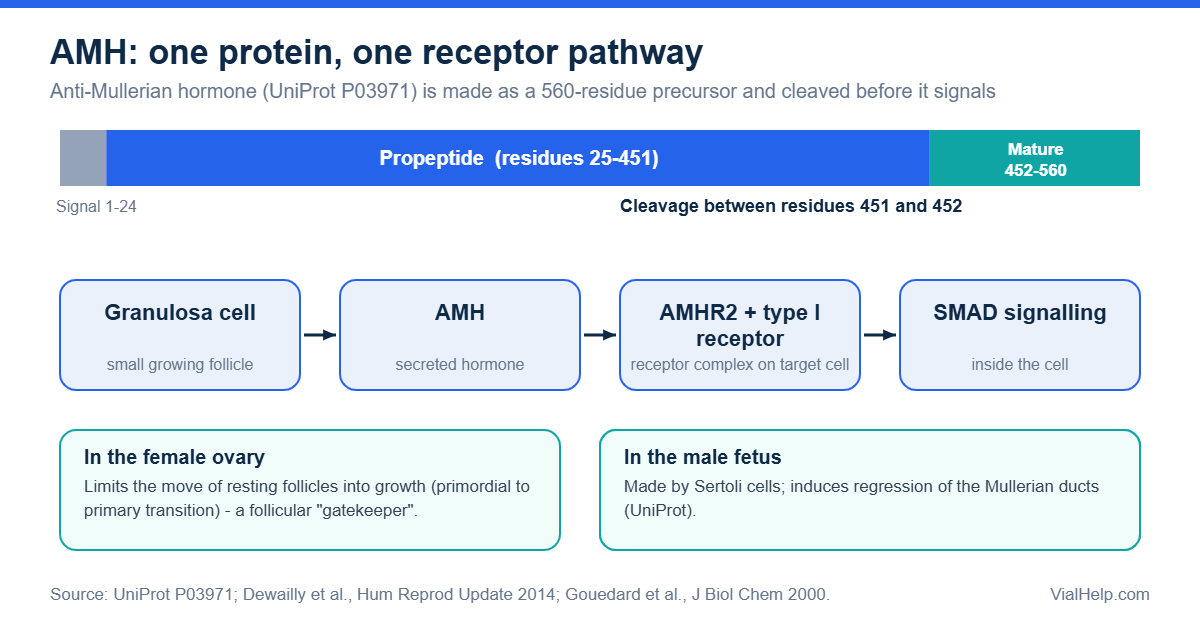
AMH (also called Müllerian-inhibiting factor) is encoded by the AMH gene. UniProt (entry P03971) describes a precursor of 560 amino acids and about 59 kDa that belongs to the TGF-beta family of growth and differentiation factors. The first 24 residues are a signal peptide, residues 25–451 form a propeptide, and the mature chain is residues 452–560 — about 109 amino acids. The precursor is cleaved between residues 451 and 452 before it signals. That makes AMH a much larger molecule than the short peptides most of this site covers, which is why it sits closer to the growth-factor and activin/myostatin end of the endocrine system.
How anti-Müllerian hormone works
According to UniProt, AMH binds a type II receptor, AMHR2, and activates SMAD proteins inside the cell. As with other TGF-beta-family ligands, a type I receptor partner is involved; a 2000 study in Journal of Biological Chemistry reported engagement of the BMP type IB receptor and Smad1 signalling by AMH and its type II receptor.
The hormone has two classically described roles. In the male fetus, Sertoli cells make AMH and it induces regression of the Müllerian ducts. In females, AMH is produced by granulosa cells of small growing follicles and acts as a follicular “gatekeeper”: a review of an ESHRE workshop concluded that AMH limits the initiation of follicle growth, and later restrains estradiol production from small antral follicles before selection. UniProt summarises this as negative regulation of the transition from primordial to primary follicle.
Why AMH is measured in blood
Because circulating AMH reflects the number of pre-antral and small antral follicles, it has been proposed as a marker of “ovarian reserve”. An early and frequently cited paper on the idea, by van Rooij and colleagues in Human Reproduction (2002), was titled “Serum anti-Müllerian hormone levels: a novel measure of ovarian reserve.” A 2014 review by Dewailly and co-authors summarised what has been learned since:
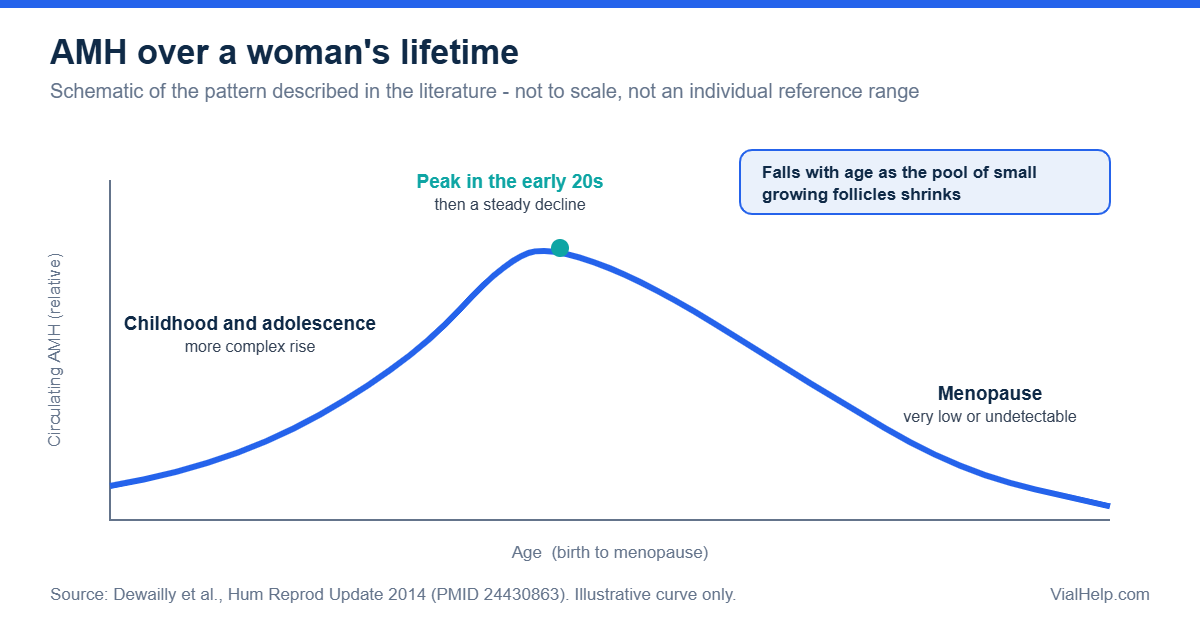
- AMH rises through childhood and adolescence, peaks in the early 20s, then declines toward menopause.
- It shows limited short-term variability, although states such as prolonged oral contraceptive use need to be considered when interpreting a result.
- There is a linear relationship between AMH and oocyte yield after ovarian stimulation, and AMH can identify “poor responders” — yet the authors judged it inappropriate to withhold IVF purely on that basis.
- Data linking AMH to natural fertility at different ages are very limited, and its relationship to age at menopause is highly variable.
- It may help assess the need for fertility preservation and detect damage to the ovarian reserve after chemotherapy or surgery.
AMH in PCOS and ovarian tumours
Women with polycystic ovary syndrome (PCOS) show markedly raised AMH. The Dewailly review attributes this to both the increased number of small antral follicles and intrinsic characteristics of the granulosa cells, and suggests the high AMH may contribute to anovulation. Whether AMH should be used to diagnose PCOS remained controversial, although it may replace antral follicle counting in future. Separately, AMH is secreted by granulosa cell tumours, and studies — for example Long and colleagues in 2000 and a 2020 diagnostic-value study in Eur J Obstet Gynecol Reprod Biol — have evaluated it as a tumour marker.
Testing and its limits
AMH is measured by immunoassay. Beckman Coulter announced FDA clearance of its Access AMH assay on 21 December 2017, stating that results can be used as an aid in assessing ovarian reserve in women presenting to fertility clinics alongside other clinical and laboratory findings; Roche has also announced a cleared Elecsys AMH test via the FDA de novo pathway. Both statements are company announcements. A practical limitation noted in the 2014 review is the absence of an international standard, so values from different assays are not always interchangeable.
Frequently asked questions
Is AMH a peptide?
Not in the usual short-peptide sense. The mature chain is roughly 109 amino acids and the active hormone is a larger glycoprotein signalling molecule in the TGF-beta family.
Can AMH predict fertility?
It reflects the number of small follicles, and it predicts the response to ovarian stimulation. The evidence linking it to natural fertility is limited, so it is one piece of information rather than a prediction.
Does birth control change AMH?
The 2014 review notes that prolonged oral contraceptive use is a state that needs to be considered when interpreting AMH.
Why do AMH numbers differ between labs?
Assays differ and no international standard existed at the time of the review, so the same sample can give different numbers on different platforms.
References
- UniProt P03971 — Anti-Müllerian hormone (AMH), human
- Dewailly D et al. The physiology and clinical utility of anti-Müllerian hormone in women. Hum Reprod Update 2014 (PMID 24430863)
- van Rooij IA et al. Serum anti-Müllerian hormone levels: a novel measure of ovarian reserve. Hum Reprod 2002 (PMID 12456604)
- Broer SL et al. Anti-Müllerian hormone: ovarian reserve testing and its potential clinical implications. Hum Reprod Update 2014 (PMID 24821925)
- Gouédard L et al. Engagement of bone morphogenetic protein type IB receptor and Smad1 signaling by anti-Müllerian hormone and its type II receptor. J Biol Chem 2000 (PMID 10854429)
- Chen S et al. Diagnostic value of anti-Müllerian hormone in ovarian granulosa cell tumor. Eur J Obstet Gynecol Reprod Biol 2020 (PMID 32898772)
- Beckman Coulter press release, 21 Dec 2017 — FDA clearance for Access AMH (company statement)
Informational only — not medical advice. This article is for educational purposes. It does not recommend, sell or instruct personal human use of any compound. Consult a qualified healthcare professional for any health decision. Content is intended for adults 21+. Verify scientific details against the primary sources cited.