
What Are Inhibins? Inhibin A and Inhibin B Explained
Reproductive endocrinology
Inhibins are hormones made by the ovary and testis that feed back on the pituitary to suppress follicle-stimulating hormone (FSH). They are dimeric proteins of the TGF-beta family, built from the same subunits as the activins but with the opposite effect on FSH, and two forms, inhibin A and inhibin B, are measured in clinical laboratories.
What are inhibins?
Inhibins are disulfide-linked heterodimers. Inhibin A pairs an alpha subunit (INHA) with a beta-A subunit (INHBA); inhibin B pairs the same alpha subunit with a beta-B subunit (INHBB). Activins are made from the beta subunits alone: activin A is a beta-A homodimer, activin B is a beta-B homodimer, and activin AB is a beta-A/beta-B heterodimer. According to UniProt, the mature alpha chain is 134 residues long, the beta-A chain 116 and the beta-B chain 115, and the alpha chain carries N-linked sugar groups. UniProt also records opposing roles for the two groups on the pituitary: inhibins suppress FSH secretion, while activins stimulate it.

Where inhibins are made
Inhibins were first characterised from ovarian granulosa cells and testicular Sertoli cells, although UniProt notes that expression is wider, including brain, placenta and adrenal tissue. In males the circulating form is inhibin B; females have both inhibin A and inhibin B. UniProt also describes inhibin B as the more potent FSH suppressor of the two.
How inhibins suppress FSH
Activin signals by binding type II activin receptors and then recruiting a type I receptor, ALK4. In a 2000 Nature paper, Lewis and colleagues showed that inhibin binds the type II activin receptors but cannot recruit ALK4. They also identified betaglycan, the type III TGF-beta receptor, as a high-affinity inhibin co-receptor: it increases inhibin binding in cells expressing the type II receptor and makes otherwise unresponsive cells sensitive to inhibin. In effect, inhibin sits on the receptor activin needs, without switching it on.
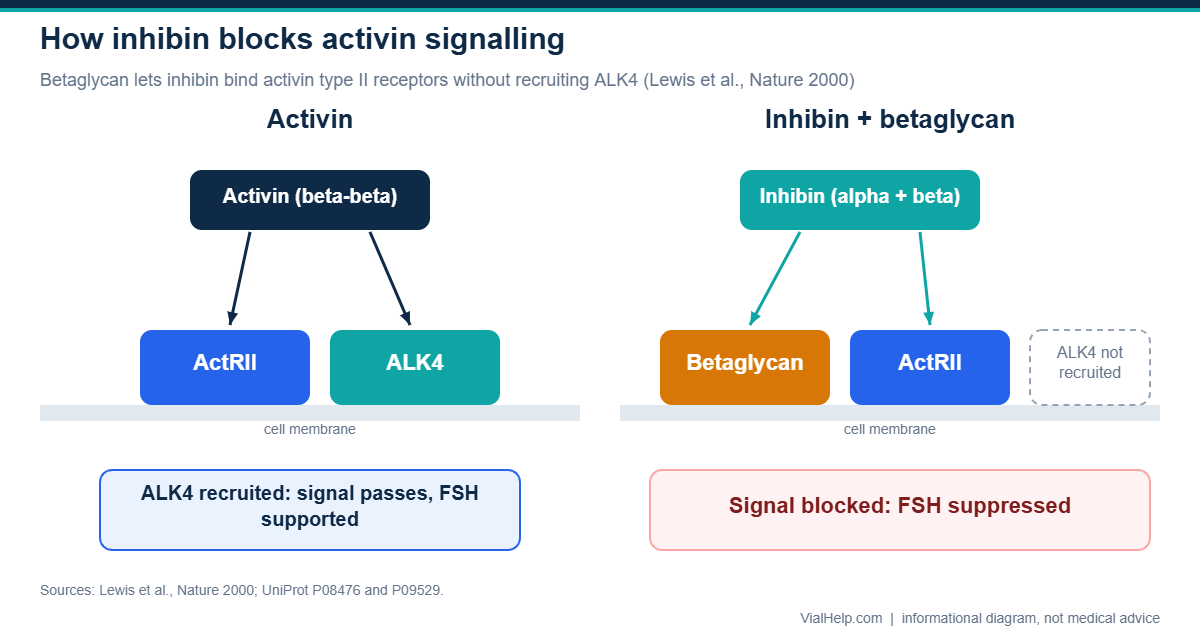
Together with GnRH from the hypothalamus and the sex steroids, this makes inhibin one part of the reproductive feedback network. Related control signals are covered in our kisspeptin guide and GnRH agonists vs antagonists, and the activin side of the story is in myostatin, activin and follistatin.
Inhibins in laboratory testing
Isoform-specific immunoassays allow inhibin A and inhibin B to be measured separately, and three uses are described in the literature.
Male reproductive function. A review of inhibins in normal male physiology reports that inhibin B is produced principally by Sertoli cells and, in adult men, tracks Sertoli cell function, sperm count and spermatogenic status, and is inversely related to FSH. That is an association, not a stand-alone diagnosis.
Granulosa cell tumours. Mayo Clinic Laboratories describes inhibin A and B as tumour markers, noting that a normal level does not exclude a granulosa or mucinous tumour, that levels fall after surgery and a later rise may signal recurrence, and that cycle-related fluctuation complicates interpretation in premenopausal women. Results need clinical correlation, and serial monitoring should use the same assay.
Prenatal screening. In a 1999 study of Asian women, second-trimester maternal serum inhibin A was higher in Down syndrome pregnancies (median 1.62 multiples of the median), with a detection rate of about 36 percent at a 5 percent false-positive rate. The authors found it correlated strongly with hCG and saw limited added benefit over hCG plus AFP. This was a single study; current screening protocols are set by obstetric guidelines.
Frequently asked questions
What is the difference between inhibin A and inhibin B?
They share an alpha subunit but differ in the beta subunit: beta-A for inhibin A, beta-B for inhibin B.
How are inhibins different from activins?
Activins are made of two beta subunits and stimulate FSH; inhibins pair one beta subunit with an alpha subunit and suppress FSH.
Do men make inhibin?
Yes. The circulating form in men is inhibin B, made mainly by Sertoli cells.
Is inhibin a peptide?
It is a dimeric glycoprotein hormone with chains of roughly 115 to 134 residues, larger than most compounds usually called peptides.
References
- UniProt P05111 — Inhibin alpha chain (INHA), human
- UniProt P08476 — Inhibin beta A chain (INHBA), human
- UniProt P09529 — Inhibin beta B chain (INHBB), human
- Lewis KA et al. Betaglycan binds inhibin and can mediate functional antagonism of activin signalling. Nature 2000
- Inhibins in normal male physiology (PubMed 15319820)
- Second-trimester maternal serum inhibin-A screening for fetal Down syndrome in Asian women (PubMed 10360516)
- Mayo Clinic Laboratories — Inhibin A and B tumor marker, serum
Informational only — not medical advice. This article is for educational purposes. It does not recommend, sell or instruct personal human use of any compound. Consult a qualified healthcare professional for any health decision. Content is intended for adults 21+. Verify scientific details against the primary sources cited.