
Hexarelin
Summary
Hexarelin (examorelin) is a synthetic growth hormone secretagogue (GHRP) studied for potent acute GH release via the ghrelin receptor and for a separate, GH-independent cardiac mechanism through CD36. It is a research compound and is not FDA-approved.
Quick facts
| Also known as | Examorelin, EP-23905 |
| Category | Growth hormone secretagogue (GHRP) / ghrelin-receptor agonist |
| Status | Research compound — not FDA-approved |
| CAS | 140703-51-1 |
| Formula | C47H58N12O6 |
| Molecular weight | 887.0 g/mol |
| Sequence | His-D-2-methyl-Trp-Ala-Trp-D-Phe-Lys-NH2 |
| Half-life | ~55–76 minutes (reported range) |
| Storage | Lyophilized: store frozen (-20°C) long-term, refrigerate short-term, protect from light. Reconstituted: refrigerate 2-8°C, use within a limited window, avoid freeze-thaw. |
In Plain English
Hexarelin is a small lab-made peptide that prompts a strong release of the body’s own growth hormone, and it may also act on the heart. Its development as a drug was eventually dropped. Researchers study it for growth-hormone and heart questions.
Hexarelin is a synthetic hexapeptide growth hormone secretagogue (GHRP) developed in the early 1990s as a more stable, more potent relative of GHRP-6. Also known as examorelin, it is studied for its ability to trigger a strong, rapid pulse of growth hormone (GH) from the pituitary — and, unusually, for a second mechanism in the heart that appears independent of GH. Hexarelin has never been approved as a medicine and exists today as a research compound only.
What is Hexarelin?
Hexarelin (aliases: examorelin, EP-23905) is a six-amino-acid peptide built by modifying the earlier secretagogue GHRP-6. A single D-2-methyl-tryptophan substitution increases its resistance to breakdown and its GH-releasing potency, making it one of the most potent acute GH releasers of the GHRP family. Chemically it carries the sequence His-D-2-methyl-Trp-Ala-Trp-D-Phe-Lys-NH₂ (C-terminal amide), with a molecular formula of C₄₇H₅₈N₁₂O₆ and a molecular weight near 887 g/mol. It belongs to the growth-hormone-secretagogue / ghrelin-mimetic class and, despite acting on the ghrelin receptor, shares essentially no sequence with the natural hormone ghrelin.
How Hexarelin is studied to work
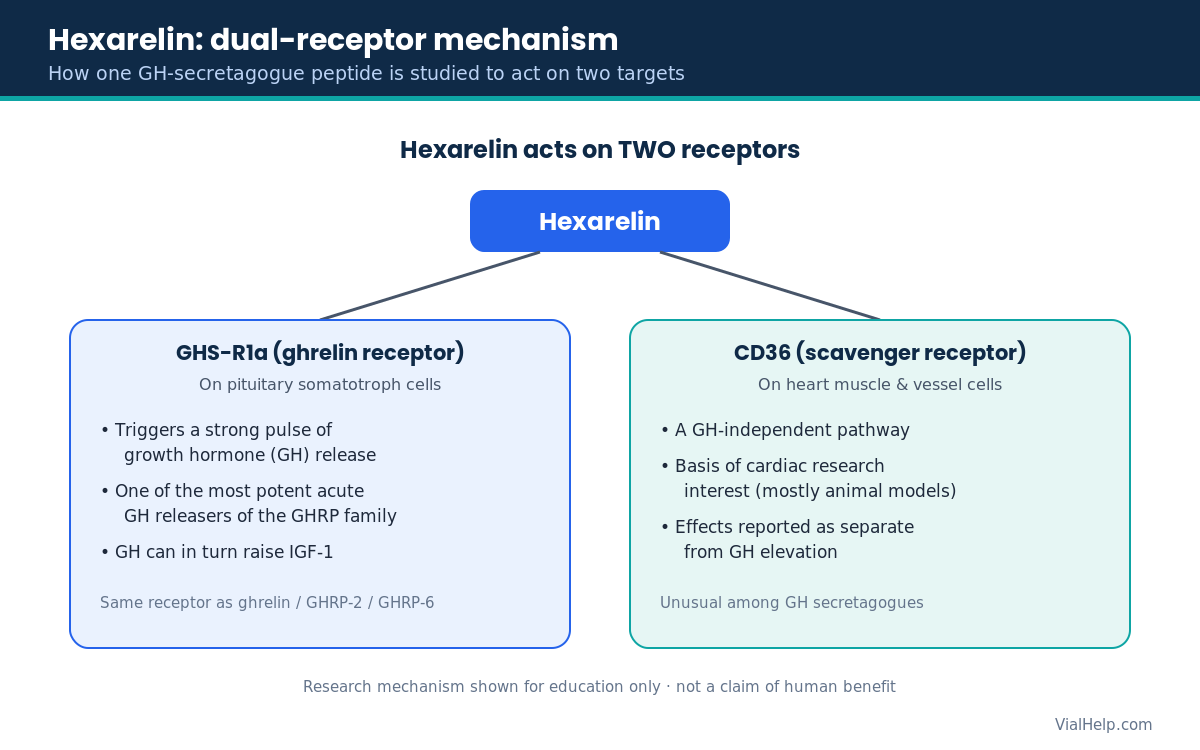
Hexarelin is notable because the research literature describes it acting on two distinct receptors — one driving growth hormone release, the other underlying its cardiac research interest.
- GHS-R1a (the ghrelin receptor): a potent agonist at the growth-hormone-secretagogue receptor on pituitary somatotroph cells, triggering a strong acute GH pulse.
- CD36 (a scavenger receptor): binds CD36 on heart-muscle and vascular cells — the GH-independent pathway behind its cardiac research signals.
- IGF-1: with repeated dosing, the GH that is released can in turn raise insulin-like growth factor 1 (IGF-1).
- Lineage: derived from GHRP-6; more potent and more metabolically stable than its parent.
Reported effects and benefits in the research literature
Across animal models and small, mostly decades-old human studies, researchers have reported:
- Acute GH elevation: reliably raises serum GH after a single dose; one of the strongest acute responses among GHRPs.
- IGF-1 increases with repeated administration in some studies.
- Cardiac / cardioprotective signals (animal models): improved left-ventricular function after experimental myocardial infarction and protection against ischemia-reperfusion injury, attributed largely to CD36 and reported as independent of GH.
- Tachyphylaxis (desensitization): a defining, well-documented finding — the GH response declines markedly with continued daily dosing.

What this does NOT mean: these are largely preclinical (rodent) or small, short, older human studies. None establish that Hexarelin is a safe or effective treatment for heart disease, growth disorders, body composition, or anti-aging in people. A benefit observed in a rat model is a research observation, not evidence of human therapeutic value — and the desensitization effect means acute responses are not sustained with ongoing use.
What the human evidence shows
Human work in the 1990s showed Hexarelin strongly stimulates GH in healthy adults, short-statured and obese children, and some growth-hormone-deficient subjects. A small study of intranasal Hexarelin in prepubertal short children reported increased growth velocity and IGF-1 over several months, but with partial desensitization developing over time. Cardiovascular evidence is dominated by animal data via the CD36 pathway; human cardiovascular efficacy was never established. Crucially, Hexarelin was never approved as a drug anywhere, its clinical development was largely abandoned, and there are no long-term human safety data. The honest summary: interesting mechanism and short-term effects, an unresolved tachyphylaxis problem, and no approved use.
Handling, storage and reconstitution (research context)
- Lyophilized (freeze-dried) powder: the most stable form — typically stored frozen (around −20 °C) for long-term storage, refrigerated for shorter periods, and protected from light, heat and moisture.
- Reconstituted solution: far less stable — kept refrigerated (2–8 °C), used within a limited window, with freeze-thaw cycles and vigorous shaking avoided.
- To work out concentration after adding bacteriostatic water, use the reconstitution calculator, and review why syringe “units” are a volume and not a dose in IU vs mL.
Cautions and considerations
- Hexarelin is a research compound, not a medicine; it is not approved by the FDA or other regulators.
- Purity and identity vary between sources; a current certificate of analysis (COA) matters — see how to read a COA.
- Tachyphylaxis means observed acute effects diminish with continued use.
- This page is informational only and not medical advice; it is intended for an audience 21 and older.
Frequently asked questions
Is Hexarelin the same as GHRP-6?
No, but they are closely related. Hexarelin is a modified, more stable and more potent derivative of GHRP-6; both act on the ghrelin receptor (GHS-R1a) to release growth hormone.
Why is Hexarelin associated with the heart?
Beyond the pituitary, Hexarelin binds CD36 on heart and vessel cells. Animal studies report cardioprotective effects through this pathway that appear independent of growth hormone — though human cardiovascular benefit has not been established.
Is Hexarelin approved for any use?
No. Hexarelin has never been approved as a drug, and its clinical development was largely halted. It exists only as a research chemical.
What is tachyphylaxis and why does it matter for Hexarelin?
Tachyphylaxis is a rapidly diminishing response to a repeated dose. Hexarelin’s strong GH response falls with continued daily dosing, which was a major obstacle to developing it as a long-term therapy.
Related compounds and further reading
- How to reconstitute peptides — step-by-step handling guide
- Sterile technique — clean handling basics
- GHRP-6 and GHRP-2 — the sibling GHRPs
- Ipamorelin, MK-677 and CJC-1295 — other GH-axis compounds
- Browse the full peptide library and the guides hub
Share this article
References
- Examorelin (Hexarelin)
- Hexarelin
- CD36 mediates the cardiovascular action of growth hormone-releasing peptides in the heart (Circulation Research)
- Hexarelin protects cardiomyocytes from ischemia/reperfusion injury (PMID 28321024)
- Kinetics and disposition of hexarelin in rats (PMID 10611139)
- Identification of the GHRP binding site in CD36 (PMC1133797)
For informational use only. Not medical advice; consult a qualified healthcare professional. 21+.
Hexarelin reconstitution calculator
Use the calculator below to find the concentration (mg/mL), draw volume and U-100 syringe units for Hexarelin once it is reconstituted with bacteriostatic water. Hexarelin has molecular formula C47H58N12O6 and a molecular weight of 887.0 g/mol. Enter your vial amount and the water volume to see the lab math — informational use only, not dosing advice.