
GHRP-6
Summary
GHRP-6 (Growth Hormone Releasing Peptide-6) is a synthetic ghrelin-mimetic hexapeptide studied as a growth hormone secretagogue. It binds the GHS-R1a receptor to trigger pulsatile GH release and also stimulates appetite. It is a research compound, not an approved medicine.
Quick facts
| Also known as | Growth Hormone Releasing Peptide-6; GHRP6; SKF-110679; Hexapeptide-2; His-D-Trp-Ala-Trp-D-Phe-Lys-NH2 |
| Category | Growth hormone secretagogue (ghrelin receptor agonist) |
| Status | Research compound — not FDA-approved; historically a GH-secretion probe |
| CAS | 87616-84-0 (free peptide; acetate salt 145177-42-0) |
| Formula | C46H56N12O6 |
| Molecular weight | 873.0 g/mol |
| Sequence | His-D-Trp-Ala-Trp-D-Phe-Lys-NH2 |
| Half-life | ~2.5 hours (elimination, IV); oral bioavailability under 1% |
| Storage | Lyophilized: -20C, protected from light/moisture. Reconstituted: 2-8C, use within a few weeks, avoid freeze-thaw. |
In Plain English
GHRP-6 is a small lab-made peptide that signals the body to release its own growth hormone and tends to boost appetite. It is one of the original peptides in this family. Researchers study it for growth-hormone release and recovery; it is a research compound.
GHRP-6 (Growth Hormone Releasing Peptide-6) is a synthetic six-amino-acid peptide first developed in the 1980s as a ghrelin-mimetic growth hormone secretagogue. Long before the natural hormone ghrelin was discovered, researchers found that this small peptide could provoke a sharp pulse of growth hormone (GH) from the pituitary, making it an important early tool for studying the GH axis.
What is GHRP-6?
GHRP-6 is a synthetic hexapeptide with the sequence His-D-Trp-Ala-Trp-D-Phe-Lys-NH2. It belongs to the growth hormone secretagogue (GHS) class and acts as an agonist at the ghrelin receptor (GHS-R1a). It is sometimes catalogued under the development code SKF-110679. The two D-amino acids and the C-terminal amide make it more resistant to enzymatic breakdown than an ordinary peptide of its size. GHRP-6 is a research compound and is not an approved medicine; it is widely sold for laboratory research use only.
How GHRP-6 is studied to work
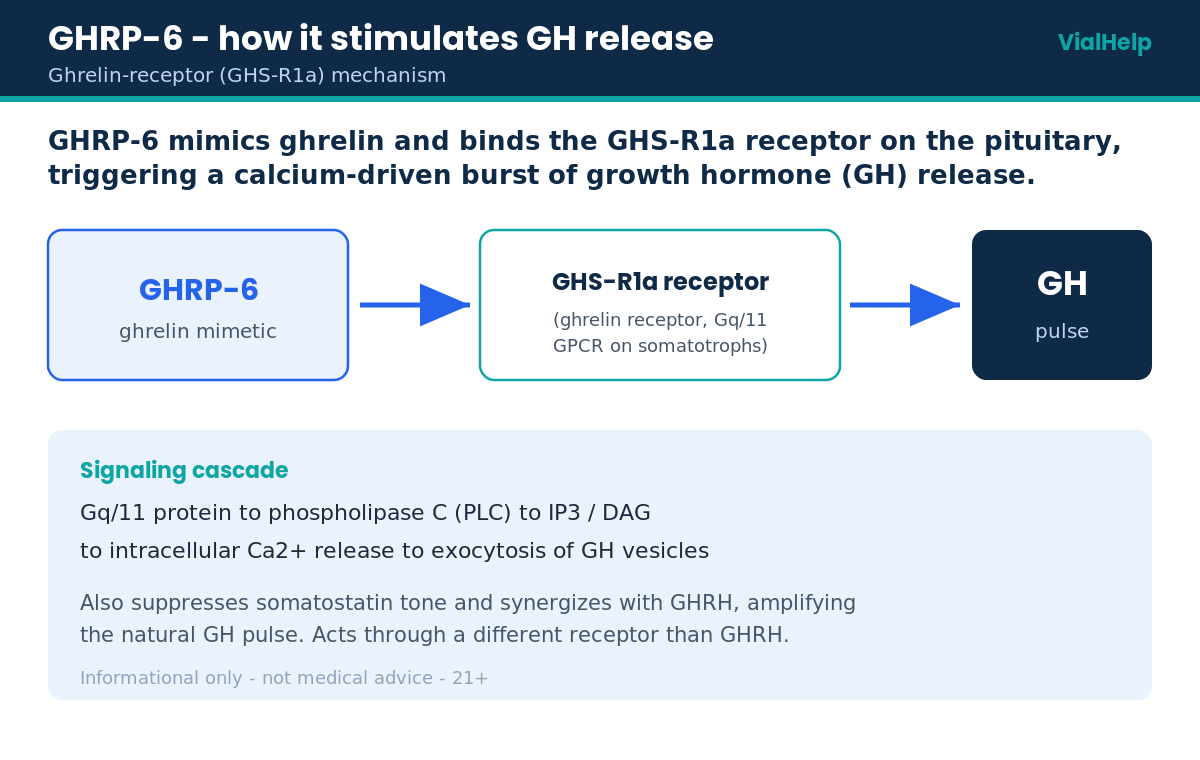
GHRP-6 mimics ghrelin, the body’s natural hunger-and-GH hormone. It binds the ghrelin receptor (GHS-R1a) on the growth-hormone-producing cells of the anterior pituitary, triggering a calcium-driven release of stored GH. Because it works through a different receptor than growth-hormone-releasing hormone (GHRH), the two are often studied together and act synergistically.
- GHS-R1a (ghrelin receptor): the primary target, a Gq/11-coupled receptor on pituitary somatotrophs and in the hypothalamus.
- Gq/11 → PLC → IP3/DAG → intracellular calcium: the signaling cascade that drives exocytosis of GH-containing vesicles.
- Somatostatin suppression: GHRP-6 is thought to blunt somatostatin tone, the brake on GH release.
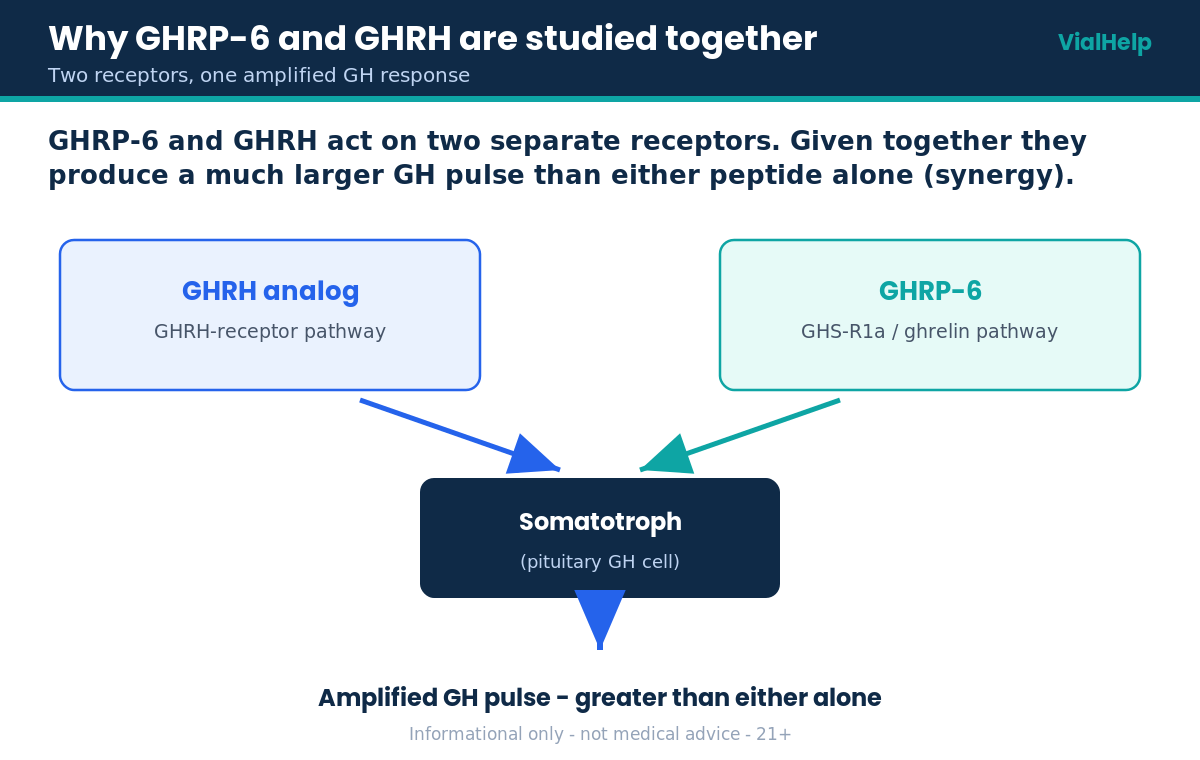
- GHRH synergy: combined GHRH + GHRP-6 produces a markedly larger GH pulse than either alone.
- Appetite signaling: as a ghrelin-receptor agonist it also stimulates food intake.
Reported effects and benefits in the research literature
Across decades of research, GHRP-6 has been characterised mainly as a GH-releasing probe. Reported findings include:
- GH and IGF-1 elevation: potent, pulsatile GH release in normal men after oral or intravenous dosing (Hartman 1992).
- Appetite stimulation: increased food intake, consistent with ghrelin-receptor activation (Korbonits 2004).
- Cytoprotective / cardiac signals: in animal models GHRP-6 showed anti-apoptotic and cardioprotective effects, e.g. limiting doxorubicin-induced myocardial damage in rodents (2024).
- GHRH synergy: a much larger combined GH pulse, which is why it was studied as a diagnostic stimulus.
What this does not mean: most of these findings come from animal models or small, short-term human GH-response studies. Acutely raising GH or IGF-1 is not proven to deliver muscle-building, anti-aging, fat-loss, or cardiac-therapy benefits in people over the long term, and the cardioprotective data are preclinical. There are no large controlled trials demonstrating therapeutic benefit.
What the human evidence shows
Human data on GHRP-6 are limited and mostly older. Small studies established that it acutely stimulates GH secretion (Hartman 1992; Penalva 1993), and a modern pharmacokinetic study in nine healthy men characterised intravenous dosing, bi-exponential clearance, and an elimination half-life of roughly 2.5 hours (Cabrales 2013). Historically it was explored as a probe of pituitary GH-secretory capacity in the assessment of GH deficiency. GHRP-6 is not FDA-approved as a therapeutic, has no assigned therapeutic indication, and is prohibited in sport as a growth hormone secretagogue.
Handling, storage and reconstitution (research context)
- Lyophilized powder: most stable; typically stored at -20°C, protected from light and moisture. Brief room-temperature exposure during shipping is usually tolerated.
- Reconstituted solution: refrigerate at 2-8°C, use within a few weeks, and avoid repeated freeze-thaw cycles.
- Concentration math: work out milligrams per millilitre before reconstituting with the reconstitution calculator, and review why a syringe “unit” is a volume, not a dose, in IU vs mL.
Cautions and considerations
- GHRP-6 is a research compound, not an approved drug, and is not intended for human or veterinary use.
- It is not FDA-approved and is banned in competitive sport (WADA category S2).
- Purity and identity vary between suppliers; a Certificate of Analysis should accompany any research material.
- This page is informational only and is not medical advice.
Frequently asked questions
Is GHRP-6 the same as GHRP-2?
No. Both are ghrelin-mimetic hexapeptide secretagogues, but they have different sequences and potencies. GHRP-6 tends to stimulate appetite more strongly, while GHRP-2 is often described as a more selective GH releaser.
Why is GHRP-6 often combined with a GHRH analog?
Because GHRP-6 and GHRH act on two different receptors, giving both together produces a larger GH pulse than either alone. This is why it is frequently discussed alongside CJC-1295 in the research literature.
Does GHRP-6 raise IGF-1?
In research settings GHRP-6 raises GH, which in turn can raise IGF-1. The magnitude depends on dose and on whether it is combined with a GHRH analog.
Is GHRP-6 approved for any medical use?
No. It has been used as a research and diagnostic probe but is not an approved therapeutic in the United States.
Related compounds and further reading
- How to reconstitute peptides
- Sterile technique
- GHRP-2 (Pralmorelin)
- Ipamorelin
- MK-677 (Ibutamoren)
- CJC-1295 (with DAC)
- Browse the full peptide library
- VialHelp guides
Share this article
References
- PubChem — GHRP-6 (CID 4345065)
- Wikipedia — GHRP-6
- Cabrales A, et al. Pharmacokinetic study of GHRP-6 in healthy volunteers. Eur J Pharm Sci 2013 (PMID 23099431)
- Hartman ML, et al. Oral GH-releasing peptide stimulates GH secretion in normal men. JCEM 1992 (PMID 1592884)
- Korbonits M, et al. Ghrelin — a hormone with multiple functions. Front Neuroendocrinol 2004 (PMID 15183037)
- GHRP-6 prevents doxorubicin-induced myocardial damage (PMC11169835, 2024)
For informational use only. Not medical advice; consult a qualified healthcare professional. 21+.
GHRP-6 reconstitution calculator
Use the calculator below to find the concentration (mg/mL), draw volume and U-100 syringe units for GHRP-6 once it is reconstituted with bacteriostatic water. GHRP-6 has molecular formula C46H56N12O6 and a molecular weight of 873.0 g/mol. Enter your vial amount and the water volume to see the lab math — informational use only, not dosing advice.