
What Is GLP-1? Incretin Hormones Explained
PEPTIDE SCIENCE
If you have wondered what is GLP-1 and why it suddenly seems to be everywhere, the short answer is that it is a natural gut hormone your body makes after you eat. GLP-1 (glucagon-like peptide-1) is a small peptide that helps control blood sugar and appetite, and understanding it explains how an entire generation of metabolic medicines works.
What is GLP-1?
GLP-1 stands for glucagon-like peptide-1. It is a peptide hormone about 30 to 31 amino acids long, cut from a larger precursor protein called proglucagon. It is released mainly by specialized cells in the gut wall, the enteroendocrine L-cells, which sit in the lower small intestine and colon and fire after you eat. A smaller amount is produced by neurons in the brainstem. The biologically active forms circulating in your blood are known as GLP-1(7-36) amide and GLP-1(7-37); both switch on the same target, the GLP-1 receptor, found on the pancreas, gut, brain and elsewhere.
The incretin effect: why oral glucose beats an IV drip
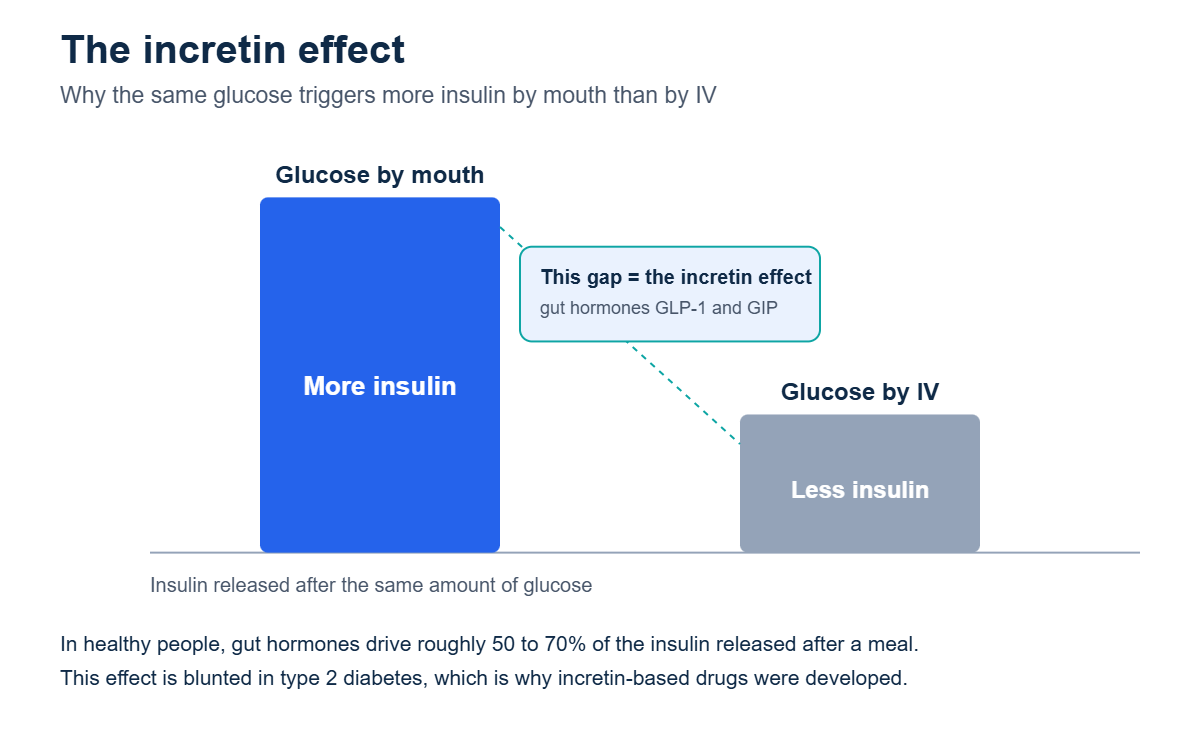
Here is a classic experiment. Give someone the same amount of glucose two ways, swallowed versus dripped straight into a vein, and the swallowed glucose triggers far more insulin. That extra insulin response to eating is called the incretin effect, and it happens because the act of digesting food releases gut hormones that amplify the pancreas response. The two main incretin hormones are GLP-1 and GIP (glucose-dependent insulinotropic polypeptide).
In healthy people, this gut-hormone boost is responsible for roughly 50 to 70 percent of all the insulin released after a meal. In type 2 diabetes the incretin effect is blunted, which is a large part of why incretin-based drugs were developed in the first place.
What GLP-1 does in the body
GLP-1 has several coordinated jobs, and most of them push in the direction of steadier blood sugar and feeling full:
- Glucose-dependent insulin release. It tells the pancreas to release insulin, but chiefly when blood sugar is already elevated. Because it eases off when glucose is normal, it carries a low intrinsic risk of driving sugar too low.
- Suppresses glucagon. It quiets the hormone that tells the liver to pour out more glucose, further limiting blood-sugar spikes.
- Slows gastric emptying. It relaxes the stomach so food and nutrients enter the bloodstream more gradually.
- Promotes satiety. It acts on appetite centers in the brain to increase fullness and reduce how much you eat.
The catch: a half-life measured in minutes
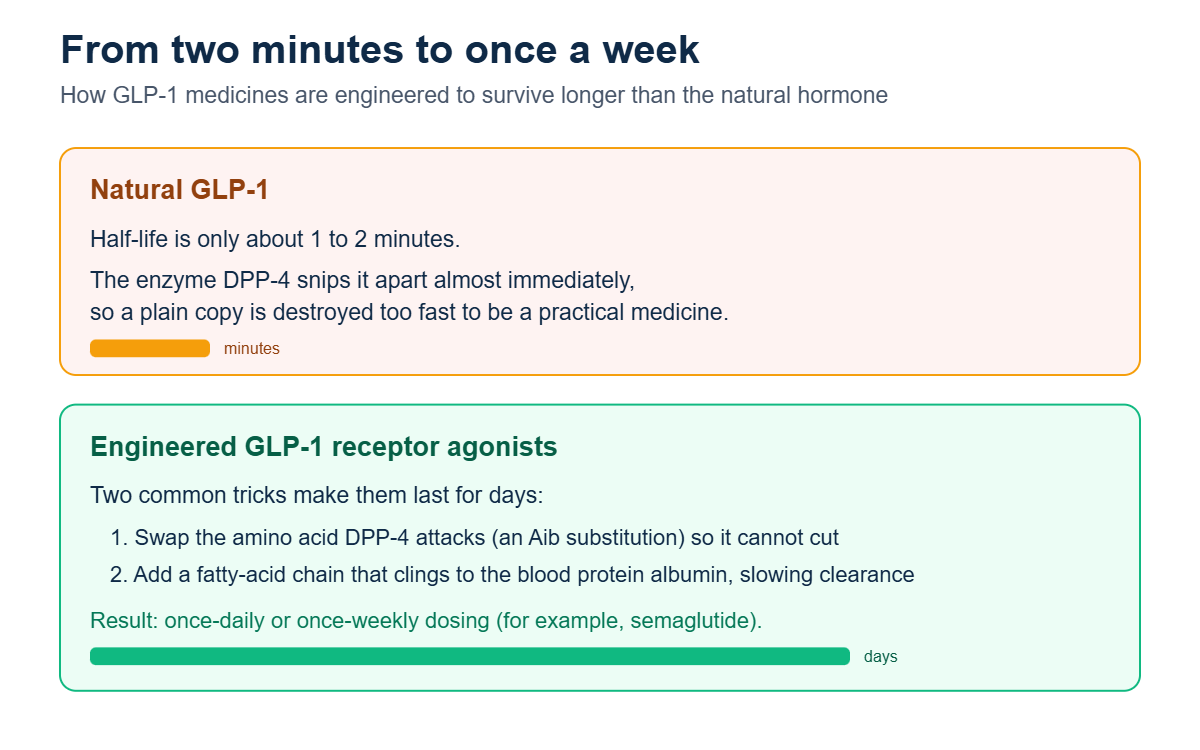
Natural GLP-1 is remarkably short-lived. Its half-life in the bloodstream is only about 1 to 2 minutes. The main reason is an enzyme called DPP-4 (dipeptidyl peptidase-4), which snips GLP-1 apart almost as fast as it appears, turning it into a largely inactive fragment; the kidneys clear the rest. That is fine for a fleeting after-meal signal, but it makes a plain copy of GLP-1 useless as a once-daily or once-weekly medicine. Defeating DPP-4 became the central challenge of GLP-1 drug design.
From lizard venom to once-weekly drugs
The first breakthrough came from an unlikely place. In 1992, a peptide called exendin-4 was identified in the saliva of the Gila monster, a venomous lizard. Exendin-4 activates the human GLP-1 receptor, shares roughly half of its sequence with human GLP-1, and, crucially, naturally resists DPP-4, so it lasts hours instead of minutes. A synthetic version became exenatide, the first FDA-approved GLP-1 receptor agonist, in 2005.
Later drugs were engineered even further using two main tricks. First, chemists swap the exact amino acid that DPP-4 attacks (for example, an Aib substitution near the start of the peptide) so the enzyme can no longer cut it. Second, they attach a fatty-acid chain that clings reversibly to albumin, a plentiful blood protein, which shields the drug and slows kidney clearance. Semaglutide, for instance, combines both approaches and can be dosed once weekly. The field has since moved toward molecules that hit more than one receptor at once, such as tirzepatide (a dual GIP and GLP-1 agonist) and the investigational retatrutide (a triple GLP-1, GIP and glucagon agonist that is not FDA-approved).
Where GLP-1 receptor agonists fit in medicine
GLP-1 receptor agonists are approved in two broad areas: managing blood sugar in type 2 diabetes, and chronic weight management, each used alongside diet and exercise. Familiar examples include semaglutide (marketed as Ozempic for diabetes and Wegovy for weight management) and tirzepatide (Mounjaro for diabetes and Zepbound for weight management). This page is a general reference, not a prescription: specific products, eligibility and dosing are decisions for a licensed clinician.
Why everyone is talking about GLP-1
The attention comes down to results plus demand. In clinical trials these drugs produced meaningful improvements in blood sugar and body weight that earlier options struggled to match, and the public interest has been enormous. It is worth keeping perspective: trial averages are not guarantees for any individual, side effects are real, and the underlying biology, native GLP-1 doing its quiet after-meal job, is the same whether or not anyone ever takes a medicine based on it.
Frequently asked questions
Is GLP-1 the same thing as Ozempic or Wegovy?
No. GLP-1 is the natural hormone your body makes. Ozempic and Wegovy are brand names for semaglutide, an engineered GLP-1 receptor agonist designed to mimic that hormone but last far longer.
Is GLP-1 a peptide or a hormone?
Both. It is a peptide (a short chain of amino acids) that functions as a hormone (a chemical messenger released into the blood).
Why does GLP-1 reduce appetite and body weight?
It slows how quickly the stomach empties and acts on appetite centers in the brain to increase fullness, so people tend to eat less.
Could you just use natural GLP-1 as a drug?
Not practically. Native GLP-1 is broken down within about 1 to 2 minutes, so useful medicines are engineered analogs that resist that breakdown.
References
- Holst JJ. The physiology of glucagon-like peptide 1. Physiol Rev 2007. PMID 17928588
- Glucagon-like peptide-1. Wikipedia overview
- The role of incretins on insulin function and glucose homeostasis. PMC8168943
- GLP-1 receptor: mechanisms and advances in therapy. Signal Transduct Target Ther 2024. Nature (STTT)
- Tirzepatide. StatPearls, NCBI Bookshelf. NBK585056
- FDA approves new medication for chronic weight management. FDA press release
Informational only — not medical advice · 21+. This article summarizes published science and does not endorse any use of these compounds. Consult a qualified healthcare professional before making health decisions.