
Insulin Syringe Anatomy: Parts and Unit Markings
Insulin syringe anatomy is worth understanding because every part of the tool affects how a volume is measured and read. A U-100 insulin syringe is a small, precisely molded device whose markings are calibrated to a single rule: 100 units equals 1 milliliter. Knowing the barrel, plunger, flange, needle, hub, and bevel, and how the unit scale maps to volume, helps anyone read measurements accurately. This article is informational only and is written for an audience aged 21 and over.
The parts of an insulin syringe
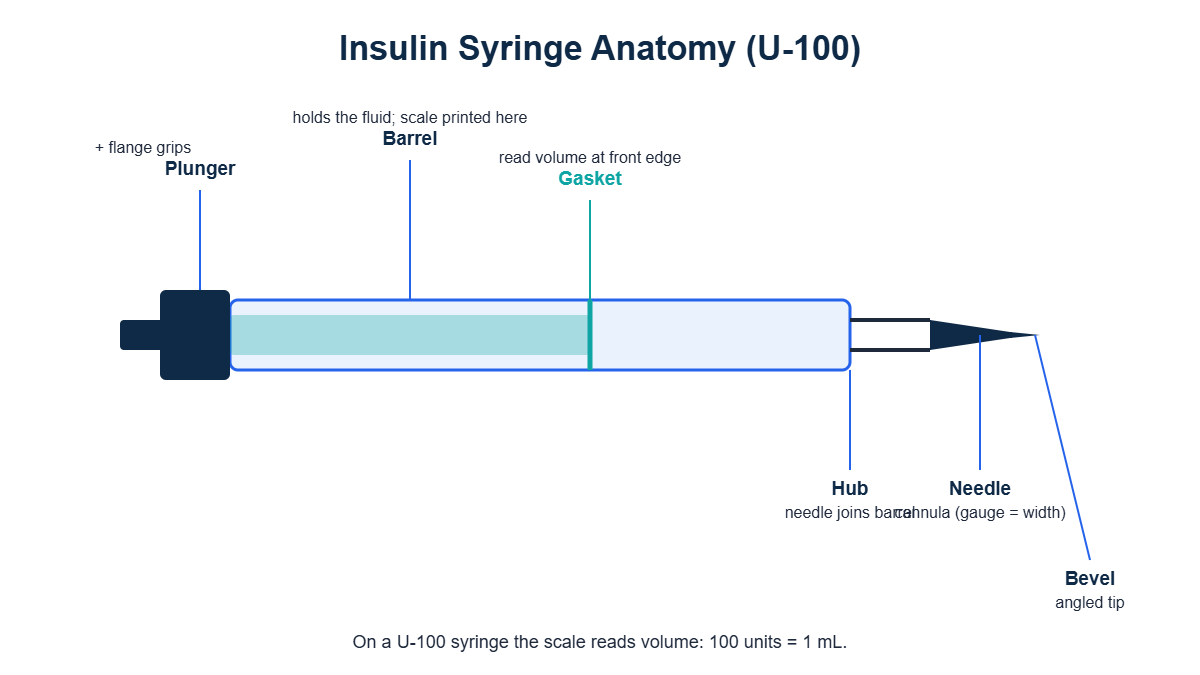
An insulin syringe looks simple, but it is built from several distinct components, each with a job. Manufacturer documentation describes the core assembly as the needle cap, needle, gasket, barrel, and plunger. Working from the body of the device outward, the parts are:
- Barrel – the clear cylindrical tube that holds the fluid. It is typically molded from polypropylene, with the unit scale permanently printed on the outside.
- Plunger – the rod that slides inside the barrel. Pulling it back draws fluid in; pushing it forward expels fluid out.
- Gasket – the rubber tip on the end of the plunger that seals against the barrel wall. The leading edge of this gasket is the line you read against the scale.
- Flange – the two finger grips at the open end of the barrel that let you brace the syringe while moving the plunger.
- Hub – the point where the needle joins the barrel. On most insulin syringes the needle is permanently fixed here rather than detachable.
- Needle – the thin hollow tube (cannula) that the fluid passes through.
- Bevel – the angled, sharpened tip at the end of the needle.
The U-100 scale: what the unit marks mean
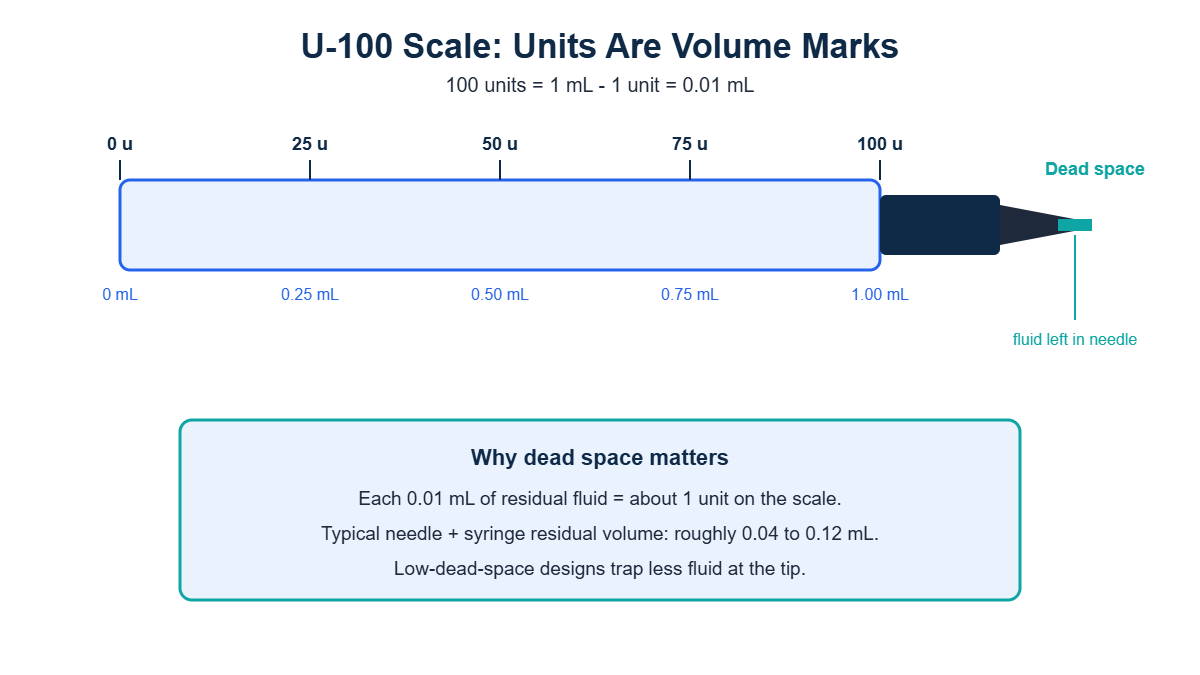
The most misunderstood feature of an insulin syringe is its scale. The marks labeled “units” are volume marks, not a dose. “U-100” is a concentration convention: a U-100 syringe is calibrated so that 100 units of fluid equal exactly 1 mL. That makes the conversion fixed and easy:
- 100 units = 1 mL
- 50 units = 0.5 mL
- 10 units = 0.1 mL
- 1 unit = 0.01 mL
Because a unit is simply one-hundredth of a milliliter on this scale, the same mark represents the same volume regardless of what fluid is in the barrel. A “unit” on the barrel tells you how much liquid you have measured, not how much active substance it contains. The amount of active substance depends entirely on the concentration of the fluid, which is a separate idea. For more on why a mark on the barrel is not the same thing as a dose, see the linked explainer on IU versus mL below.
Needle gauge versus length
Two needle dimensions are described separately and should not be confused. Gauge is the diameter of the needle, and the scale runs backward: a higher gauge number means a thinner needle. Common insulin needle gauges are 29, 30, and 31. Length is how far the needle extends from the hub, commonly ranging from about 4 mm to 12.7 mm. Gauge and length are independent: a needle can be both thin and short, or thicker and longer, in any combination the manufacturer offers.
Dead space and residual volume
Dead space (also called residual volume) is the small amount of fluid that remains inside the syringe and needle after the plunger is fully pushed in. It sits in the hub and the bore of the needle, beyond the reach of the gasket. This matters because that fluid is measured but not delivered.
On a U-100 scale the cost is easy to picture: since 1 mL spans 100 units, every 0.01 mL of dead space corresponds to 1 unit of fluid left behind. Reported needle-and-syringe residual volumes vary by design, roughly in the range of 0.04 mL to 0.12 mL. The insulin syringe is historically significant here: it was among the first low dead space designs, built with a permanently attached needle specifically to minimize the fluid trapped at the tip.
How to read the volume
Reading a syringe accurately comes down to a few consistent habits:
- Hold the barrel at eye level so the scale is not distorted by viewing angle.
- Read against the front edge of the rubber gasket – the side closest to the needle – not the back of the plunger.
- Confirm the syringe is a U-100 type and note its total capacity (0.3 mL = 30 units, 0.5 mL = 50 units, or 1.0 mL = 100 units). Smaller barrels often print finer increments.
- Account for dead space conceptually: the volume you measure on the scale is what enters the barrel, while a little remains in the needle afterward.
Frequently asked questions
Are syringe units the same as a dose?
No. Units on a U-100 syringe are volume marks where 100 units equal 1 mL. They tell you how much fluid is in the barrel, not how much active substance, which depends on concentration.
What does a higher gauge number mean?
A higher gauge number means a thinner needle. Gauge describes diameter, while length is a separate measurement of how far the needle extends from the hub.
Why does dead space matter?
Dead space is fluid left in the needle and hub after the plunger is pressed. On a U-100 scale, about 0.01 mL of dead space equals 1 unit of fluid, so low-dead-space designs reduce that leftover volume.
Related tools and reading
Informational only – not medical advice. 21+.