
What Is DPP-4? The Enzyme That Ends the Incretin Signal
Peptide science
DPP-4 (dipeptidyl peptidase-4) is the enzyme that switches off the incretin hormones — and understanding it explains why natural GLP-1 lasts barely two minutes while drugs like semaglutide last about a week. If you have ever wondered why some peptides are destroyed almost instantly in the body while their engineered cousins keep working for days, DPP-4 is a large part of the answer.
What is DPP-4?
DPP-4, short for dipeptidyl peptidase-4, is a serine protease (enzyme class EC 3.4.14.5) that trims short peptides. It is also known as CD26, and its gene is DPP4. The enzyme is a 766-amino-acid protein that sits mostly on the outer surface of cells throughout the body — on the lining of blood vessels, the gut, the kidney and lungs, and on activated immune (T) cells. A second, “soluble” form circulates freely in the blood, doing the same job away from any cell.
DPP-4 is active as a matched pair (a dimer), and each half carries the machinery to grab a peptide and snip it. What makes it special is where it cuts.
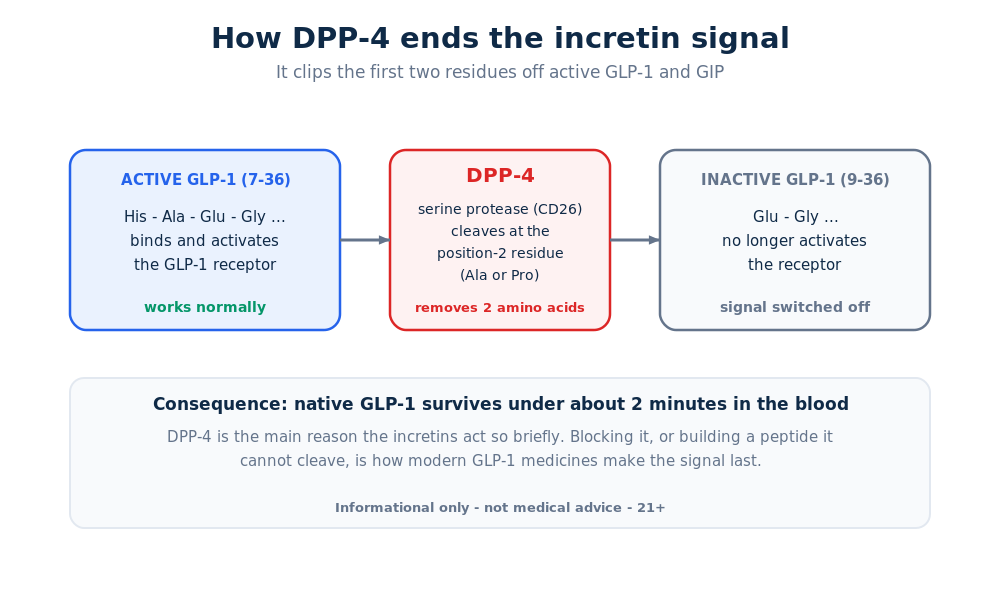
How DPP-4 works: it clips the position-2 residue
DPP-4 is an exopeptidase — it works from the end of a peptide, not the middle. It removes the first two amino acids (a dipeptide) from the N-terminal end, but only when the second amino acid is proline or alanine. Peptides that carry a different residue at position 2 are cut slowly, or not at all.
That narrow rule is the whole story. Two of the body’s most important metabolic signals — the incretin hormones — happen to have exactly the residue DPP-4 is looking for.
Why DPP-4 matters: it ends the incretin signal
The incretins are gut hormones released after you eat that tell the pancreas to release insulin. The two main ones are GLP-1 and GIP. Both begin with a residue DPP-4 can cleave, so within a minute or two of being released, DPP-4 converts active GLP-1(7-36) into inactive GLP-1(9-36), and active GIP(1-42) into inactive GIP(3-42). This degradation of the incretins in human serum was first attributed to DPP-4 by Mentlein and colleagues.
This is why native GLP-1 has a half-life of under about two minutes. The hormone is not “used up” by binding its receptor — it is chemically disarmed by DPP-4 almost as fast as the body makes it. DPP-4 can also trim other peptides that share the position-2 pattern, including several chemokines and neuropeptides shown to be substrates in the laboratory, but GLP-1 and GIP are the ones whose regulation by DPP-4 is best established in humans.
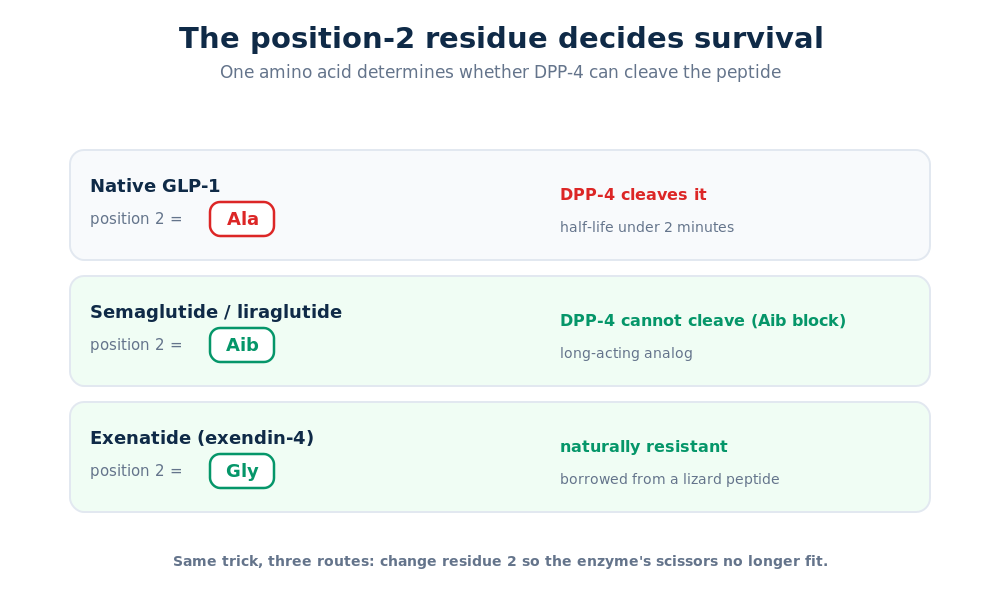
How GLP-1 drugs beat DPP-4
Once you understand the position-2 rule, the design of modern GLP-1 medicines makes sense. Native GLP-1 carries an alanine at the vulnerable spot, so engineers change that single residue so the enzyme’s scissors no longer fit:
- Semaglutide and liraglutide replace the alanine with a non-standard amino acid called Aib (α-aminoisobutyric acid), which blocks DPP-4 cleavage. They are also attached to a fatty-acid chain so they bind albumin and linger — semaglutide acts on roughly a weekly timescale.
- Exenatide takes a different route: it is based on exendin-4, a peptide from the Gila monster that naturally has glycine at position 2 and is therefore resistant to DPP-4 from the start.
The other approach: DPP-4 inhibitors
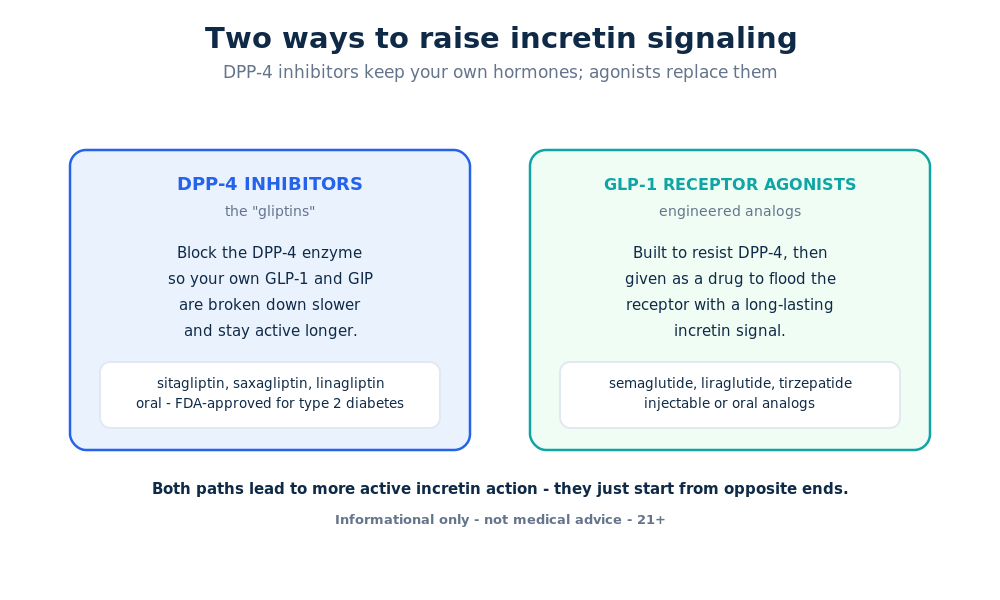
Instead of building a peptide DPP-4 cannot cut, you can block the enzyme itself. That is what the DPP-4 inhibitors — the oral “gliptins” — do. Drugs such as sitagliptin, saxagliptin, linagliptin and alogliptin inhibit DPP-4, which slows the breakdown of your own GLP-1 and GIP so they stay active longer. Higher active-incretin levels mean more glucose-dependent insulin release and less glucagon, improving blood-sugar control. Sitagliptin (Januvia) has been FDA-approved for type 2 diabetes since 2006.
Because the insulin boost is glucose-dependent, this class carries a low intrinsic risk of hypoglycemia: the incretin effect fades as blood sugar returns to normal.
DPP-4 beyond metabolism
DPP-4 is not only a metabolic enzyme. Under its other name, CD26, it acts as a marker and signaling molecule on T cells, where it contributes to immune activation, and it binds other partners such as adenosine deaminase. These immune roles are separate from its incretin-clipping job and remain an active area of research.
Frequently asked questions
What does DPP-4 do in simple terms?
It is a molecular scissor. It clips the first two amino acids off certain peptides, and its most important targets are the incretin hormones GLP-1 and GIP, which it switches off within a couple of minutes.
Is DPP-4 the same as CD26?
Yes. DPP-4 and CD26 are two names for the same protein — “DPP-4” emphasizes its enzyme activity, while “CD26” refers to its role as a cell-surface marker on immune cells.
Why doesn’t DPP-4 destroy semaglutide?
Because semaglutide was changed at the exact spot DPP-4 recognizes. Swapping the position-2 alanine for Aib means the enzyme can no longer cleave it, so it survives far longer than natural GLP-1.
Are DPP-4 inhibitors the same as GLP-1 drugs?
No. GLP-1 receptor agonists (like semaglutide) are peptides that mimic GLP-1. DPP-4 inhibitors are small oral pills that block the enzyme so your own incretins last longer. They work on the same pathway from opposite directions.
References
- UniProtKB P27487 — DPP4 (Homo sapiens)
- Baggio & Drucker. Biology of Incretins: GLP-1 and GIP. Gastroenterology 2007.
- Deacon CF. Physiology and Pharmacology of DPP-4. Front Endocrinol 2019.
- Mentlein R. DPP-IV in the degradation of incretins and neuropeptides. (PMC3567760)
- FDA JANUVIA (sitagliptin) Prescribing Information.
- DPP-4 structure and function review (PMC6733615).
Informational only — not medical advice · 21+. This article explains the biology of an enzyme and related research compounds for educational purposes. It is not a recommendation to use any drug, and DPP-4 inhibitors and GLP-1 medicines should only be used under the care of a qualified clinician.