How Peptides Are Analysed: HPLC, LC–MS/MS and Stability Testing
Peptide analysis methods are the reason a number on a certificate of analysis means anything at all. A review published in 2026 in Separation Science Plus surveys where those methods currently stand — and its framing is a useful reminder that “purity,” “identity” and “stability” are three separate questions answered by three different kinds of measurement.
What the review says
The article is “Rise of Peptide-Based Drugs: Recent Advancements in Analytical Strategies for Peptide Analysis” by K. Mannem and V. Harish, published in Separation Science Plus volume 9, issue 7 (2026), DOI 10.1002/sscp.70265. Summarising the authors’ own framing: peptide-based drugs have grown quickly as a therapeutic class, but their structural complexity, their susceptibility to degradation, and the very low concentrations at which they occur in biological samples create substantial analytical challenges. The review identifies liquid chromatography coupled with tandem mass spectrometry (LC–MS/MS) as the gold standard for peptide quantification, on the basis of its sensitivity and specificity, with particular attention to bioanalytical applications.
That is a statement about quantification in research and pharmaceutical settings. It is not a claim about any particular product, and the sections below are general analytical background rather than a summary of the paper.
Purity, identity and quantity are different questions
- Chromatography answers “how much of this sample is the main component?” Reversed-phase HPLC separates a mixture and reports the main peak as a percentage of total detected peak area. That is what a purity figure on a certificate of analysis usually is.
- Mass spectrometry answers “is the main component the molecule it is supposed to be?” It compares measured mass against expected mass. Tandem MS goes further, fragmenting the molecule so that sequence-level features can be confirmed.
- Quantification is its own exercise. Measuring how much peptide is present — especially in a biological matrix — generally requires LC–MS/MS run against a reference standard, which is the point the review emphasises.
The practical consequence is that a purity percentage on its own is an incomplete claim. A sample can be 99% one thing and still not be the thing on the label; chromatography alone cannot tell the difference.
Why a purity number depends on the method that produced it
Peak-area percentage is method-dependent. Column chemistry, gradient profile, run time and detection wavelength all affect which impurities separate from the main peak and which co-elute with it. Two competent laboratories can report different purity figures for the same material without either being wrong, because they measured under different conditions. This is why a certificate that names its method, column and detection conditions carries more information than one that reports only a number.
Detection has blind spots as well. UV detection at the wavelengths typically used for peptides responds to peptide bonds and aromatic residues, so substances that do not absorb there — residual solvents, counterions such as trifluoroacetate or acetate, and water — may not register as peaks at all. These are normally reported as separate line items rather than folded into the purity figure.
Stability is a question about time, not a snapshot
A certificate of analysis describes one lot at one moment. Peptides change afterwards, and they do so along identifiable routes — oxidation of susceptible residues, deamidation, hydrolysis of the backbone, aggregation, and racemisation. Each leaves a different analytical signature, which is why no single method detects all of them.
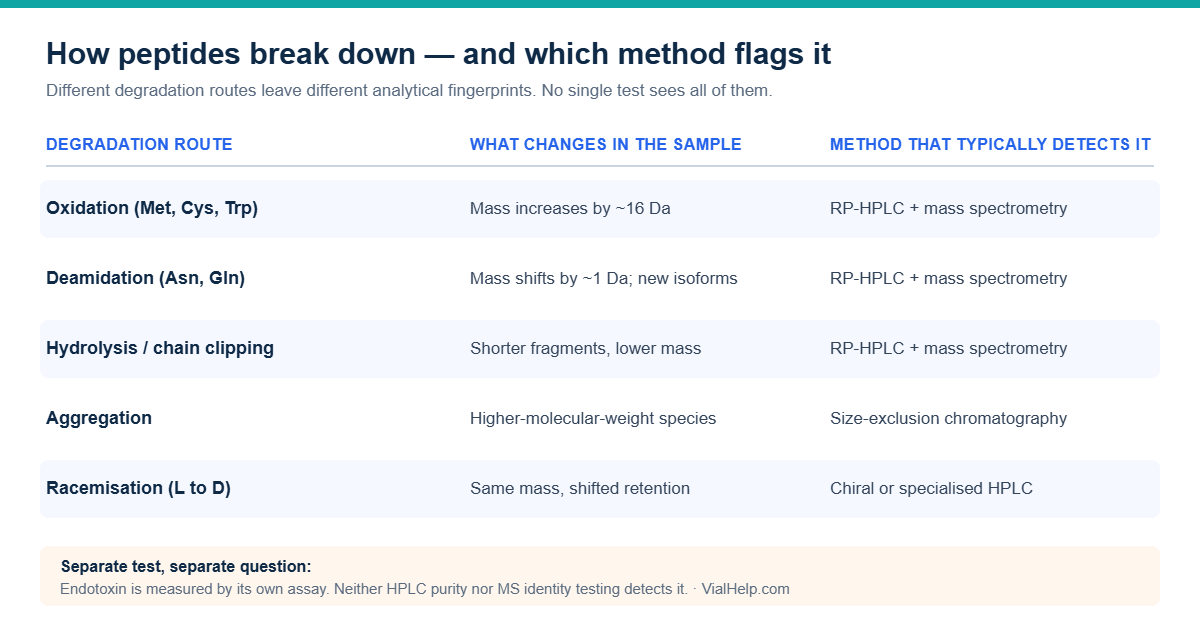
Stability programmes address this by testing material deliberately stressed with heat, light, oxidising agents or pH extremes. The purpose is twofold: to characterise how a given peptide degrades, and to confirm that the analytical method can actually resolve the degradation products from the intact molecule. A method that cannot separate a degradant from the main peak will keep reporting degraded material as pure — which is why “stability-indicating” is a specific property a method has to be shown to possess, not an assumption.
What to take from this when reading a certificate
- Look for the method, not only the number. A purity figure without its conditions cannot be compared against a figure from anywhere else.
- Purity and identity are separate claims. A complete document reports both, from different instruments.
- Endotoxin, water content and residual solvents are separate lines. Chromatographic purity does not cover them — endotoxin in particular has its own assay and its own evolving standards.
- A certificate is dated for a reason. It describes the lot tested, at the time it was tested, under the storage conditions that applied up to that point.
Our guide to reading a certificate of analysis walks through each section of a typical document, and the peptide reference library covers individual compounds in more detail.
Source
- Mannem K., Harish V. “Rise of Peptide-Based Drugs: Recent Advancements in Analytical Strategies for Peptide Analysis.” Separation Science Plus, 2026;9(7). DOI: 10.1002/sscp.70265.
More quality and regulatory coverage is collected on the VialHelp news page.