
Linaclotide and Plecanatide: Oral Peptides That Work in the Gut Without Being Absorbed
Oral peptide drugs
Linaclotide and plecanatide are oral peptides that activate the intestinal receptor guanylate cyclase-C and, according to their labels, are minimally absorbed into the bloodstream. That makes them a useful exception to the rule that peptides do not survive the gut, and this article explains how they work and what their labels report.
What are linaclotide and plecanatide?
Linaclotide is a 14-amino-acid cyclic peptide held in shape by three disulfide bonds; its label gives a molecular weight of 1526.8. A 2023 synthesis paper describes the disulfide pairing as Cys1-Cys6, Cys2-Cys10 and Cys5-Cys13 and notes that the structure resembles E. coli heat-stable enterotoxins. Plecanatide is a 16-amino-acid peptide described on its label as a structural analog of human uroguanylin, with a molecular weight of 1682. Both are agonists of guanylate cyclase-C (GC-C), a receptor on the lining of the intestine, and both are approved in the United States for chronic idiopathic constipation (CIC) and irritable bowel syndrome with constipation (IBS-C).
The natural ligands for that receptor are covered in guanylin and uroguanylin. What makes the two drugs unusual is where they work: they are swallowed peptides that do their job without entering the blood.
How linaclotide is studied to work
According to the Linzess label, linaclotide activates GC-C, raising intracellular cyclic GMP (cGMP). That stimulates secretion of chloride and bicarbonate into the intestinal lumen, mainly through the CFTR channel, which increases intestinal fluid and speeds transit. The label adds that in animal models linaclotide reduced visceral pain by decreasing the activity of pain-sensing nerves. The Trulance label describes the same chain of events for plecanatide, with cGMP rising both inside cells and outside them.

Why linaclotide is the exception to “peptides aren’t pills”
Oral peptides usually fail because of digestive enzymes and poor absorption, the barriers laid out in why peptides are not pills and oral peptide delivery. Linaclotide sidesteps the absorption problem by not needing to be absorbed. Its label says it is minimally absorbed with negligible systemic availability, with plasma levels of linaclotide and its active metabolite below the limit of quantitation at labeled doses; the Trulance label makes the same statement for plecanatide. The receptor sits on the luminal surface, so the drug can act where it is. It is reasonable to suggest that the disulfide-constrained ring helps it survive the gut, but that is an inference, not a statement from the labels.
What the labels report about effects and diarrhea
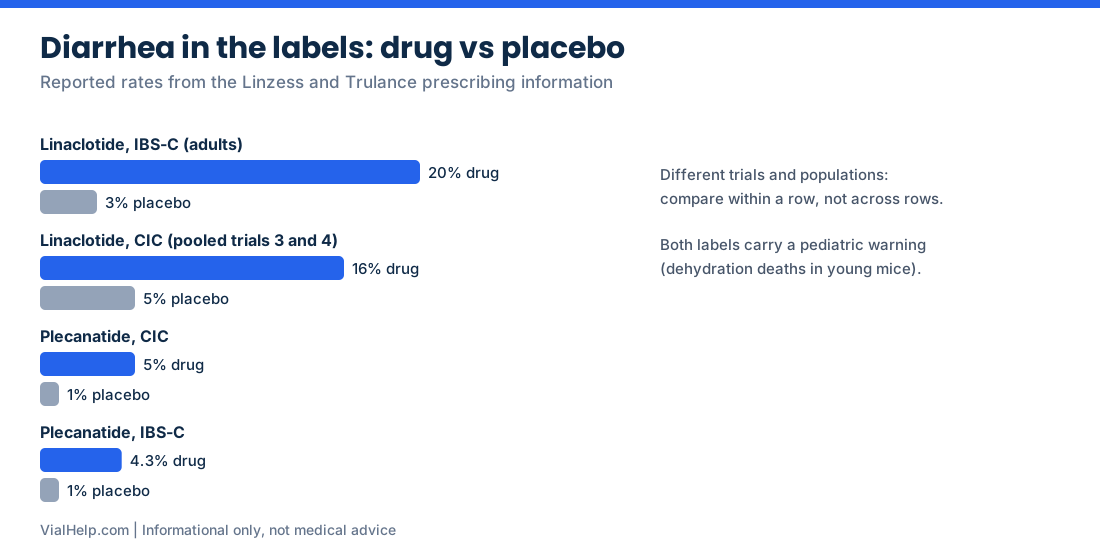
Both products were tested in randomized trials, including a 26-week IBS-C trial of linaclotide (Chey et al., 2012) and a 12-week CIC trial with a randomized withdrawal period (Rao et al., 2012). Because the labels pool and tabulate adverse reactions, the clearest numbers for educational use come from there. The labelled rate of diarrhea with linaclotide was 20 percent versus 3 percent with placebo in adults with IBS-C, and 16 percent versus 5 percent in pooled CIC trials; severe diarrhea was 2 percent versus under 1 percent. For plecanatide, diarrhea was 5 percent versus 1 percent in CIC and 4.3 percent versus 1 percent in IBS-C.
Pediatric warnings
The Linzess label includes a boxed warning contraindicating use in children under 2 years: a single clinically relevant adult oral dose caused deaths from dehydration in neonatal mice. The Trulance label cites dehydration deaths in young juvenile mice and sets different limits: contraindicated under 6 years, avoid at 6 to under 18 years. The two cutoffs differ, which is a reminder to read each label rather than assume the class behaves identically.
Research handling and unit context
Both drugs are marketed as finished oral products, not research powders, so reconstitution does not apply. For general mg, mL and concentration arithmetic, see the reconstitution calculator and concentration converter; they are lab-math utilities and do not give medical dosing.
Frequently asked questions
Are linaclotide and plecanatide absorbed into the blood?
The labels describe them as minimally absorbed with negligible systemic availability; concentrations were below the limit of quantitation in the plasma samples the labels describe.
Are they the same drug?
No. They share a receptor, but they are different peptides (14 versus 16 amino acids) with separate labels, doses and pediatric restrictions.
Where did the structure come from?
Plecanatide is described as a uroguanylin analog, while a 2023 chemistry paper says linaclotide resembles E. coli heat-stable enterotoxins.
What is the main side effect?
Diarrhea, per both labels, with rates shown above.
References
- Linzess (linaclotide) prescribing information, AbbVie.
- Trulance (plecanatide) prescribing information (label text).
- Qiu et al. A New Regioselective Synthesis of the Cysteine-Rich Peptide Linaclotide. Molecules 2023;28(3):1007.
- Chey WD et al. Linaclotide for irritable bowel syndrome with constipation: a 26-week randomized, double-blind, placebo-controlled trial. Am J Gastroenterol 2012.
- Rao S et al. A 12-week randomized controlled trial with a 4-week randomized withdrawal period of linaclotide in chronic constipation. Am J Gastroenterol 2012.
Informational only — not medical advice. This article is for educational purposes. It does not recommend, sell or instruct personal human use of any compound. Consult a qualified healthcare professional for any health decision. Content is intended for adults 21+. Verify scientific details against the primary sources cited.