
Polymyxin B and colistin: the last-line polypeptide antibiotics
Peptide antibiotics
The polymyxins, mainly polymyxin B and colistin (polymyxin E), are naturally occurring cyclic lipopeptide antibiotics discovered more than 60 years ago and now used as last-line options against some multidrug-resistant Gram-negative bacteria. They are old drugs with a short, serious safety label, and they matter again because newer antibiotics have not kept pace with resistance.
What are the polymyxins?
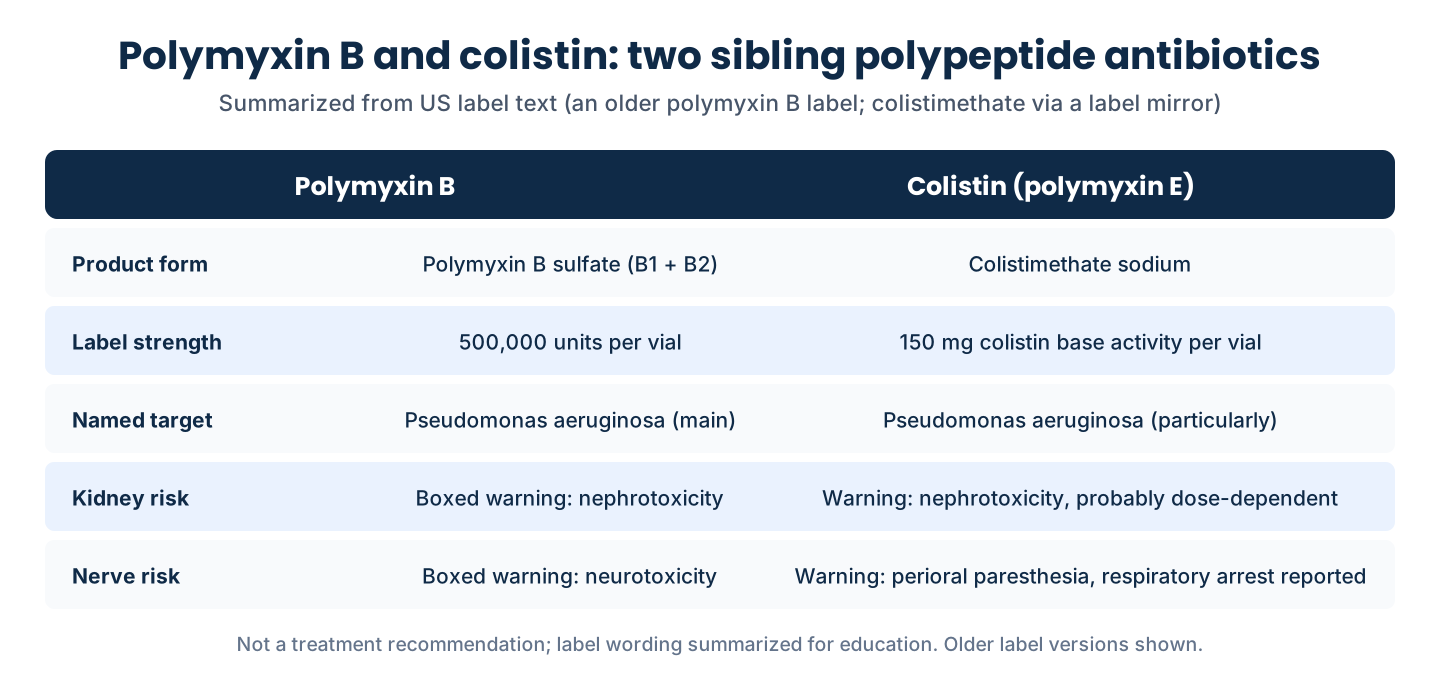
A 2019 review describes the polymyxins as naturally occurring cyclic lipopeptides with a narrow antibacterial spectrum that is mainly directed at Gram-negative pathogens. The older US polymyxin B label says the product is derived from Bacillus polymyxa and is a basic polypeptide antibiotic, supplied as the sulfate salt of polymyxins B1 and B2 with a potency of at least 6,000 units per mg and 500,000 units per vial. Colistin is marketed for injection as colistimethate sodium, labeled in terms of colistin base activity (150 mg per vial in the Coly-Mycin M label text).
The international consensus guidelines on the polymyxins point out that colistin and polymyxin B became available in the 1950s and so did not go through contemporary drug development procedures, and that significant confusion remains around their forms and labeling. If you want the broader picture of peptide-based antibiotics, see peptide antibiotics: vancomycin and daptomycin and antimicrobial peptides explained.
How polymyxins are studied to work
Polymyxins carry a positive charge and initially interact with lipid A, the negatively charged component of lipopolysaccharide (LPS) in the outer membrane of Gram-negative bacteria. That is why the drugs are so much more active against Gram-negative organisms than Gram-positive ones: the outer membrane and its LPS are the target. (Lipid A is the endotoxin portion of LPS, which is why the same molecule matters for peptide endotoxin testing.)
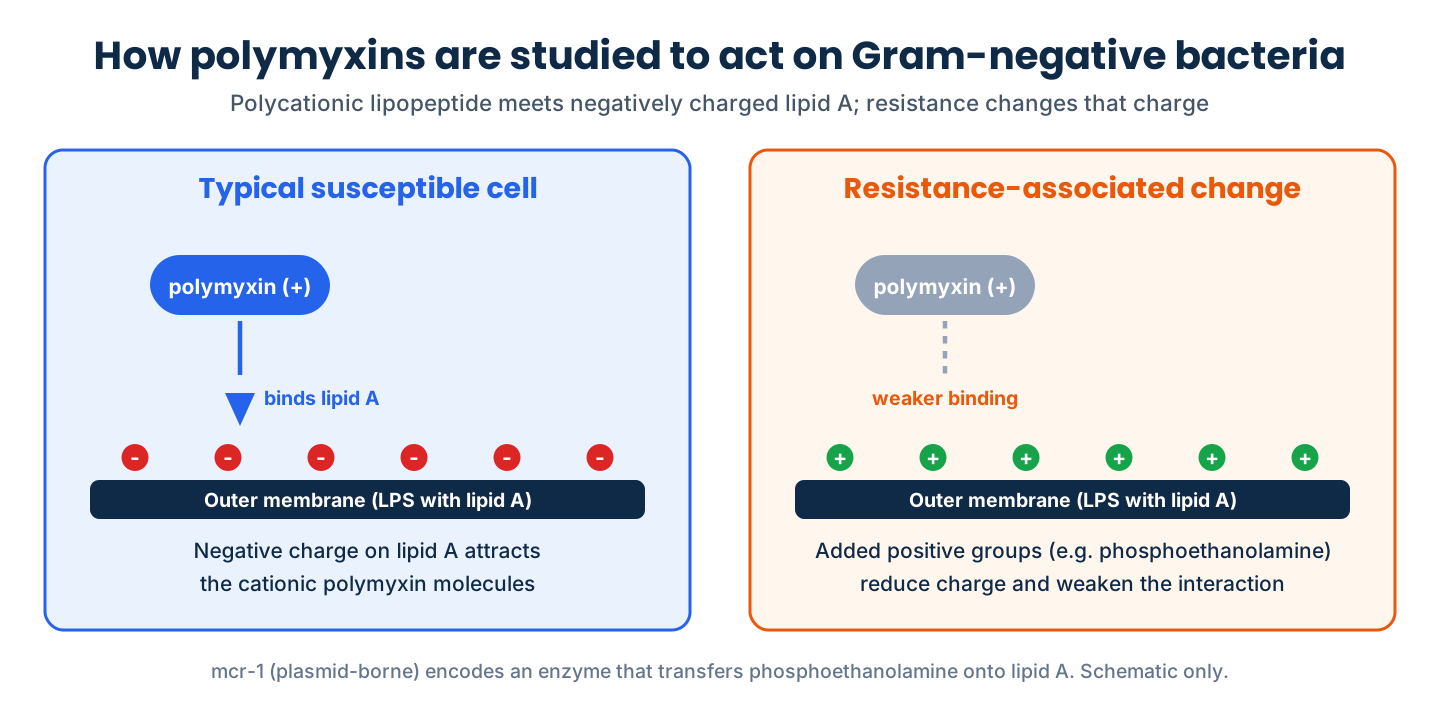
Some Gram-negative species, including Neisseria meningitidis, Proteus mirabilis and Burkholderia species, are intrinsically resistant to polymyxins. The cyclic structure that gives these molecules their stability is a theme covered in cyclic peptides and macrocyclization.
Where polymyxins fit in the literature
Reviews describe polymyxin B and colistin as last therapeutic options for infections caused by multidrug-resistant “superbugs” such as Pseudomonas aeruginosa and Acinetobacter baumannii. The labels themselves are more conservative: the polymyxin B label names Pseudomonas aeruginosa as the main target, along with Haemophilus influenzae, E. coli, Aerobacter aerogenes and Klebsiella pneumoniae, and the colistimethate label text is “particularly indicated” for susceptible P. aeruginosa. For context on why resistant Gram-negatives matter, the CDC’s 2019 antibiotic resistance threats report lists carbapenem-resistant Acinetobacter and carbapenem-resistant Enterobacterales among its urgent threats.
Why the labels carry serious warnings
The polymyxin B label opens with a boxed warning. It cautions that nephrotoxicity can occur, that dosage must be reduced in patients with kidney damage, and that falling urine output and a rising BUN are reasons to stop therapy. A second boxed warning covers neurotoxicity: irritability, weakness, drowsiness, ataxia, perioral paresthesia, numbness of the extremities and blurred vision, with respiratory paralysis from neuromuscular blockade possible, especially soon after anesthesia or muscle relaxants. The label advises avoiding other nephrotoxic or neurotoxic drugs, including colistin, and says intramuscular or intrathecal use is for hospitalized patients; safety in human pregnancy has not been established. The colistimethate label text similarly notes nephrotoxicity that is “probably dose-dependent,” perioral numbness and paresthesia, and respiratory arrest reported after intramuscular use.
Resistance and the mcr-1 gene
Most polymyxin resistance mechanisms involve changes to the LPS structure. Adding positively charged groups such as 4-amino-L-arabinose, phosphoethanolamine or galactosamine reduces the negative charge on the bacterial surface, which weakens the interaction with the drug. In 2015 Liu and colleagues reported mcr-1, a plasmid-mediated colistin resistance gene found in animals and humans in China, and concluded that it signaled a breach of the last group of antibiotics by plasmid-mediated resistance. The mcr-1 gene encodes a membrane-bound zinc metalloenzyme that transfers phosphoethanolamine onto lipid A. Because the gene sits on a plasmid, it can move between bacteria, which is why surveillance of mcr genes became a priority.
Units, milligrams and reading vial labels (research context)
Polymyxins are a classic case of why units, milligrams and “base activity” must not be confused: polymyxin B is labeled in units, while colistimethate is labeled as mg of colistin base activity. Concentration math that works for a peptide measured in mg does not transfer directly. If you work with any lyophilized material, the reconstitution calculator and concentration converter cover mg and mL arithmetic, this explainer on units versus volume covers the unit trap, and our guides to reconstituting peptides and sterile technique describe general handling.
Frequently asked questions
Are polymyxin B and colistin the same drug?
No. Colistin is polymyxin E. They are closely related, and the labels describe different product forms: polymyxin B sulfate versus colistimethate sodium.
Why are they called last-line antibiotics?
Because reviews describe them as the remaining option for some multidrug-resistant Gram-negative infections, and because their toxicity makes them a poor first choice when alternatives exist.
What is the polymyxin target?
Lipid A in the lipopolysaccharide of the Gram-negative outer membrane. Changes that reduce the negative charge of lipid A are the commonest route to resistance.
Are polymyxins related to antimicrobial peptides made by the body?
They share the general idea of positively charged molecules acting on bacterial membranes; for the human examples see cathelicidin LL-37 and defensins.
References
- Tsuji BT et al. International Consensus Guidelines for the Optimal Use of the Polymyxins. Pharmacotherapy 2019;39(1):10-39.
- Polymyxins: History, Chemistry and Antibacterial Spectrum. Adv Exp Med Biol 2019.
- Mechanisms of Polymyxin Resistance. Adv Exp Med Biol 2019.
- Liu YY et al. Emergence of plasmid-mediated colistin resistance mechanism MCR-1 in animals and human beings in China. Lancet Infect Dis 2016;16:161-8.
- Catalytic mechanism of the colistin resistance protein MCR-1. Org Biomol Chem 2021.
- Polymyxin B for Injection, FDA label (2012 version): description, boxed warnings, indications.
- Coly-Mycin M (colistimethate) label text as reproduced by MedLibrary.
- CDC. Antibiotic Resistance Threats in the United States, 2019.
Informational only — not medical advice. This article is for educational purposes. It does not recommend, sell or instruct personal human use of any compound. Consult a qualified healthcare professional for any health decision. Content is intended for adults 21+. Verify scientific details against the primary sources cited.