
mcg vs mg: Getting Peptide Units Right
Peptide Lab Math
mcg vs mg is one of the easiest places to make a costly mistake in peptide lab math — and one of the easiest to get right. A milligram (mg) and a microgram (mcg) differ by a factor of 1,000, so mixing them up changes a figure by a thousandfold. This guide explains what the units mean, how to convert between them, and how concentration in mg/mL ties everything together.
What mcg and mg mean
Both are metric units of mass built from the gram. The SI prefix “milli” means one-thousandth (10 to the -3), and “micro” means one-millionth (10 to the -6). So a milligram is 1,000 times larger than a microgram.
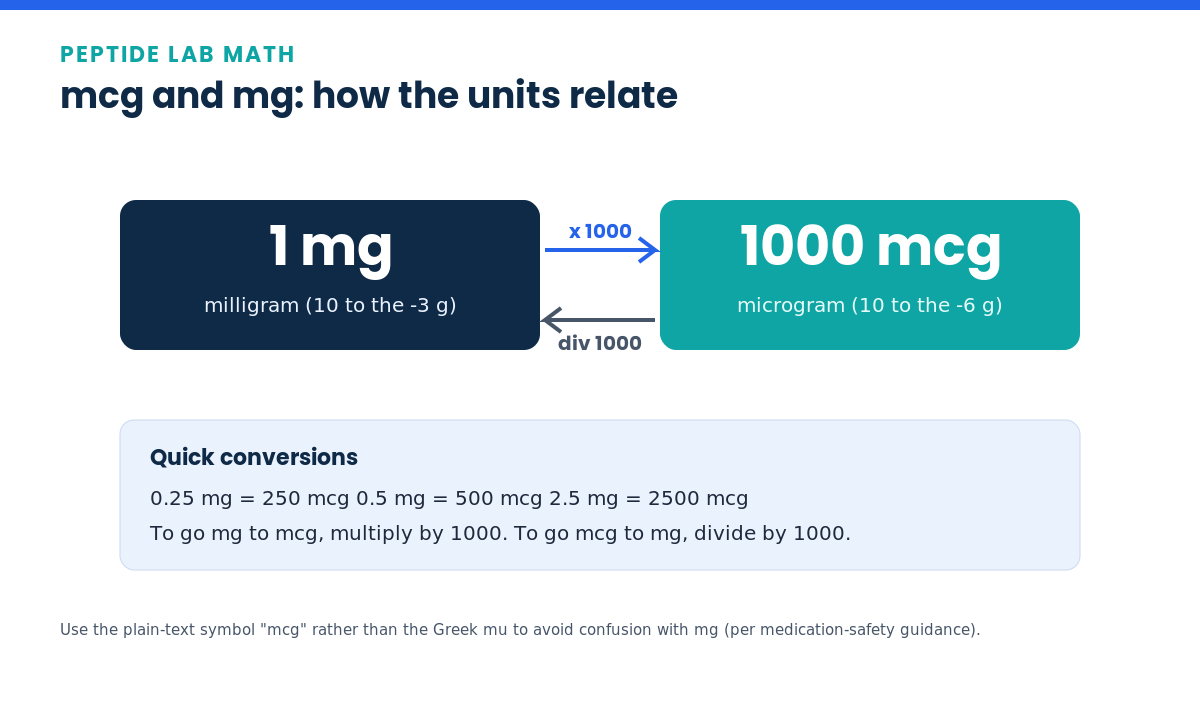
The official SI symbol for microgram is “µg” (with the Greek letter mu), but many labs, product labels and records use mcg instead. Medication-safety groups actually recommend “mcg” in plain text because the Greek mu can be misread as “mg,” which is exactly the error this article helps you avoid.
Converting between mcg and mg
- mg to mcg: multiply by 1,000. (0.5 mg = 500 mcg)
- mcg to mg: divide by 1,000. (250 mcg = 0.25 mg)
A few common values worth memorizing: 0.25 mg = 250 mcg, 0.5 mg = 500 mcg, 1 mg = 1,000 mcg, and 2.5 mg = 2,500 mcg. The decimal point simply moves three places.
Why the unit matters in peptide lab math
Research peptides span a huge range of masses. Some vials are labeled in milligrams (for example a 10 mg vial), while reported amounts for potent compounds are often written in micrograms. If you read “100 mcg” as “100 mg,” your figure is off by a factor of 1,000. Keeping units explicit — and converting deliberately — prevents that class of error.
Worked example: concentration, mg and mcg
Concentration is what makes the mcg vs mg conversion exact. Suppose you reconstitute a 10 mg vial with 2 mL of bacteriostatic water:
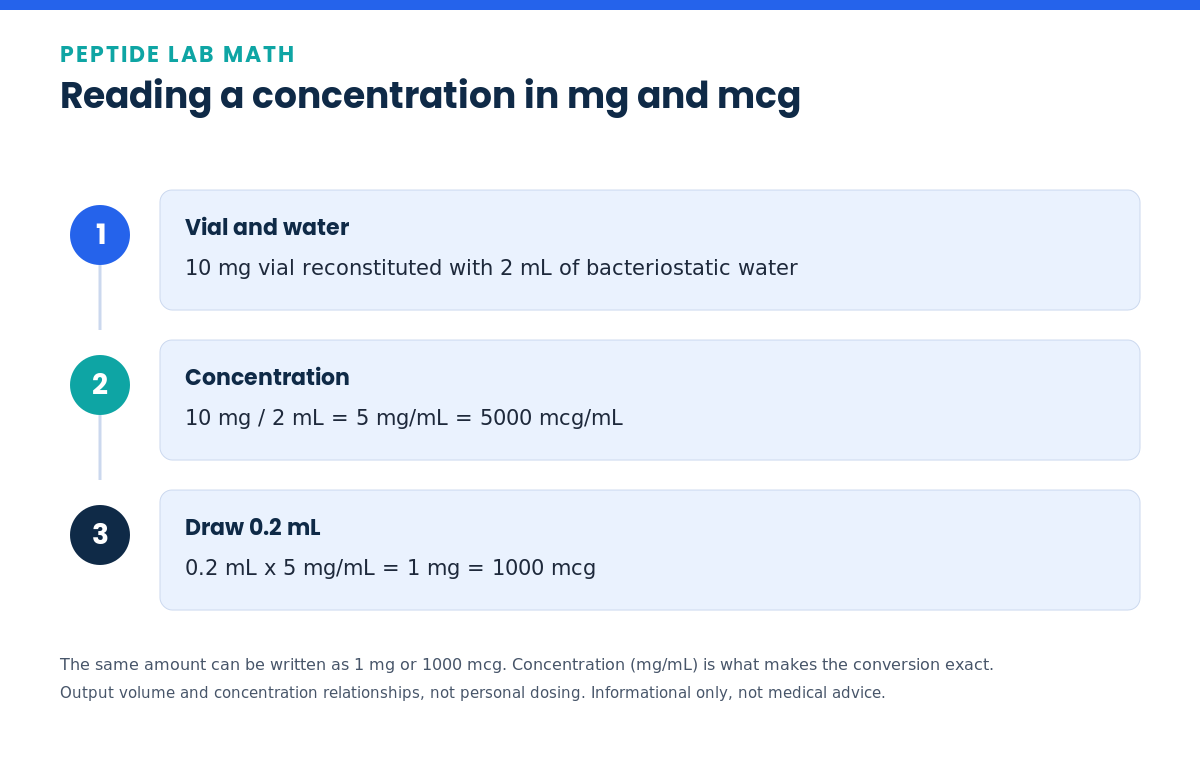
- Concentration = 10 mg / 2 mL = 5 mg/mL, which is the same as 5,000 mcg/mL.
- A 0.2 mL volume contains 0.2 mL x 5 mg/mL = 1 mg, which is identical to 1,000 mcg.
The amount didn’t change — only the unit it’s written in. You can run these figures instantly with the reconstitution calculator or the concentration and volume converter.
Frequently asked questions
How many mcg are in a mg?
1,000. One milligram equals 1,000 micrograms.
Is mcg the same as µg?
Yes. “mcg” and “µg” both mean microgram. “mcg” is preferred in plain text to avoid confusing the Greek mu with “mg.”
How do I convert 250 mcg to mg?
Divide by 1,000: 250 mcg = 0.25 mg.
Why does concentration matter for the conversion?
Concentration (mg/mL) links an amount of compound to a volume, so it lets you express the same quantity in mg or mcg and relate it to a measured volume.
References
Informational only — not medical advice. Output describes concentration and volume relationships, not personal dosing. Intended for those 21 and over.