
U-100 vs U-40 Syringes: Why the Scale Matters
U-100 vs U-40 syringes look almost identical, but the number stamped on the barrel changes what every unit mark actually means. The U-number tells you how concentrated the insulin a syringe is built for is, expressed as units per milliliter. A U-100 syringe assumes 100 units fit in 1 mL; a U-40 syringe assumes only 40 units fit in the same 1 mL. Reach for the wrong one and the unit marks lie to you, because the marks are really volume marks wearing a unit label.
This article is about measurement, not dosing. The goal is to explain why the scale printed on a barrel matters and how to read it correctly, so you can recognize the difference between two syringes that look the same but are not interchangeable.
What the U-number actually means
The “U” stands for units, and the number is a concentration: units of insulin per milliliter of liquid. It describes the fluid the syringe is calibrated for, not the syringe’s volume. A U-100 marking means the manufacturer expects 100 units to occupy 1 mL. A U-40 marking means 40 units occupy that same 1 mL.
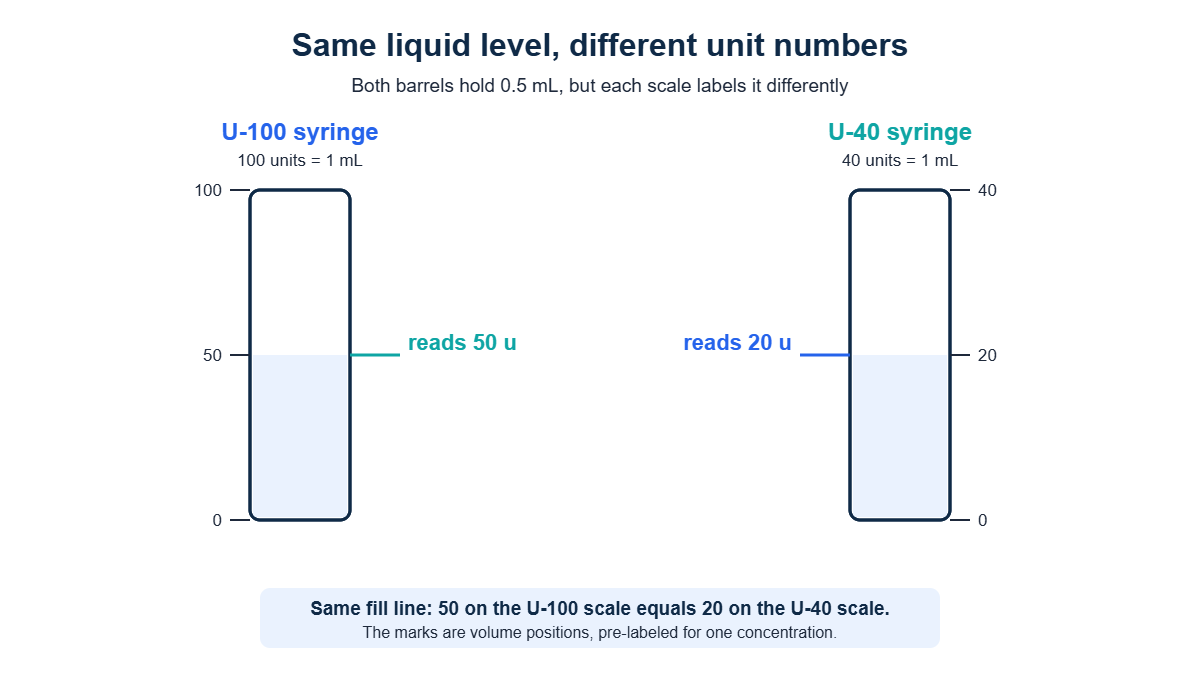
Because of that, the physical barrel of a 1 mL U-40 syringe and a 1 mL U-100 syringe can hold the same amount of liquid, yet the printed scales differ. The U-100 barrel counts up to 100; the U-40 barrel counts up to 40. Same tube, different ruler.
U-100 (100 units = 1 mL) vs U-40 (40 units = 1 mL)
U-100 is the standard concentration for human insulin across North America, which is why the orange-capped U-100 syringe is by far the most common one you will encounter. U-40, the red-capped scale, is older and now uncommon for people, but it persists in specific products.
- U-100: 100 units = 1 mL, so 1 unit = 0.01 mL.
- U-40: 40 units = 1 mL, so 1 unit = 0.025 mL.
Notice that a “unit” is a fixed quantity of insulin only when it sits on the matching scale. The same physical line on two different barrels can correspond to very different volumes.
The conversion math and a worked misread example
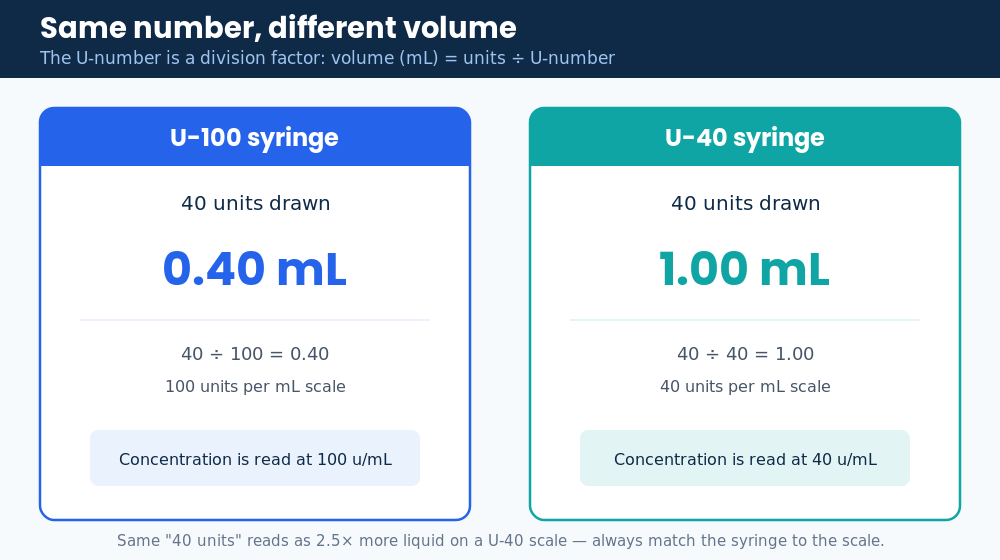
The conversion is simple division. To turn units into volume, divide by the syringe’s U-number:
- On a U-100 syringe: volume in mL = units divided by 100.
- On a U-40 syringe: volume in mL = units divided by 40.
Now the part that makes the scale matter. Suppose a liquid is a U-40 concentration and the intended measure is 5 units of it. On the correct U-40 syringe, the “5” mark sits at 5 divided by 40, or 0.125 mL.
Draw that same liquid to the “5” mark on a U-100 syringe instead, and the “5” line there sits at 5 divided by 100, or only 0.05 mL. You have pulled less than half the intended volume. Flip it the other way: take a U-100 concentration and measure it to a mark on a U-40 syringe, and you pull 100 divided by 40, or 2.5 times the volume you thought you were measuring. That is the 2.5x error in a single sentence: 100 divided by 40 equals 2.5. The ratio between the two scales is exactly two and a half, so a mismatch is never a small rounding slip.
Where U-40 still shows up
For people, almost all modern insulin is U-100, so most human-use syringes are U-100. U-40 has not disappeared, though. It remains the standard for several veterinary insulins. Vetsulin (porcine insulin zinc suspension), the FDA-approved insulin for diabetic dogs and cats from Merck Animal Health, is a U-40 product and its labeling states it must be used with U-40 syringes only. The University of Minnesota’s veterinary clinical skills reference similarly stresses matching the syringe scale to the insulin concentration to avoid the 2.5x mismatch.
This is why the two scales coexist at all: a household with a diabetic pet and a diabetic person could have both an orange-capped U-100 syringe and a red-capped U-40 syringe in the same drawer. The caps and the printed numbers are the only obvious difference.
Units are volume marks in disguise
This connects to a broader idea worth keeping straight: a unit is not a fixed thing you can see in a barrel. Every “unit” line on an insulin syringe is really a volume position that the manufacturer has pre-labeled for one specific concentration. The syringe does the unit-to-volume conversion for you, baked into where each line is printed, but only if the liquid matches the scale the lines were drawn for. That is the same point behind thinking in IU versus mL: the number of units is meaningless until you know the concentration that defines a unit.
How to check which scale you have
- Read the barrel print. The syringe is marked U-100 or U-40 (sometimes shown as 100 units or 40 units at the top mark). The printed number is the authority, not the cap color.
- Check the cap color as a secondary cue. U-100 syringes typically have an orange cap; U-40 syringes typically have a red cap. Treat color as a hint, then confirm with the print.
- Look at the top number. A 1 mL U-100 barrel counts to 100; a 1 mL U-40 barrel counts to 40.
- Match scale to concentration. The syringe’s U-number should match the U-number on the liquid’s label. If they do not match, the unit marks will not mean what you expect.
Is a unit the same amount on a U-40 and U-100 syringe?
No. A unit is a fixed amount of insulin only when the syringe scale matches the liquid’s concentration. The “5” mark on a U-40 syringe sits at a different volume than the “5” mark on a U-100 syringe, because the two barrels are calibrated for different units-per-mL.
Why is the error always 2.5x?
Because 100 divided by 40 equals 2.5. The two scales differ by exactly that ratio, so any mismatch shifts the measured volume by a factor of 2.5, either up or down depending on which way the syringe and concentration are swapped.
Why does U-40 still exist if U-100 is standard?
U-40 remains in use for certain veterinary insulins, such as the FDA-approved product Vetsulin, which is a 40 units per mL formulation labeled for U-40 syringes only. Human insulin in North America is essentially all U-100.
Related tools and reading
Informational only – not medical advice. 21+.