
Syringe Types & Gauges: U-100, Needle Gauge and Length
Informational guide
Choosing a syringe comes down to two numbers and one scale, and the syringe gauge is the one people misread most. This guide explains insulin syringe types, what gauge and needle length actually mean, why the U-100 scale measures volume rather than dose, and how dead space quietly affects small measurements — all in plain, research-handling terms.
The U-100 insulin syringe: the standard tool
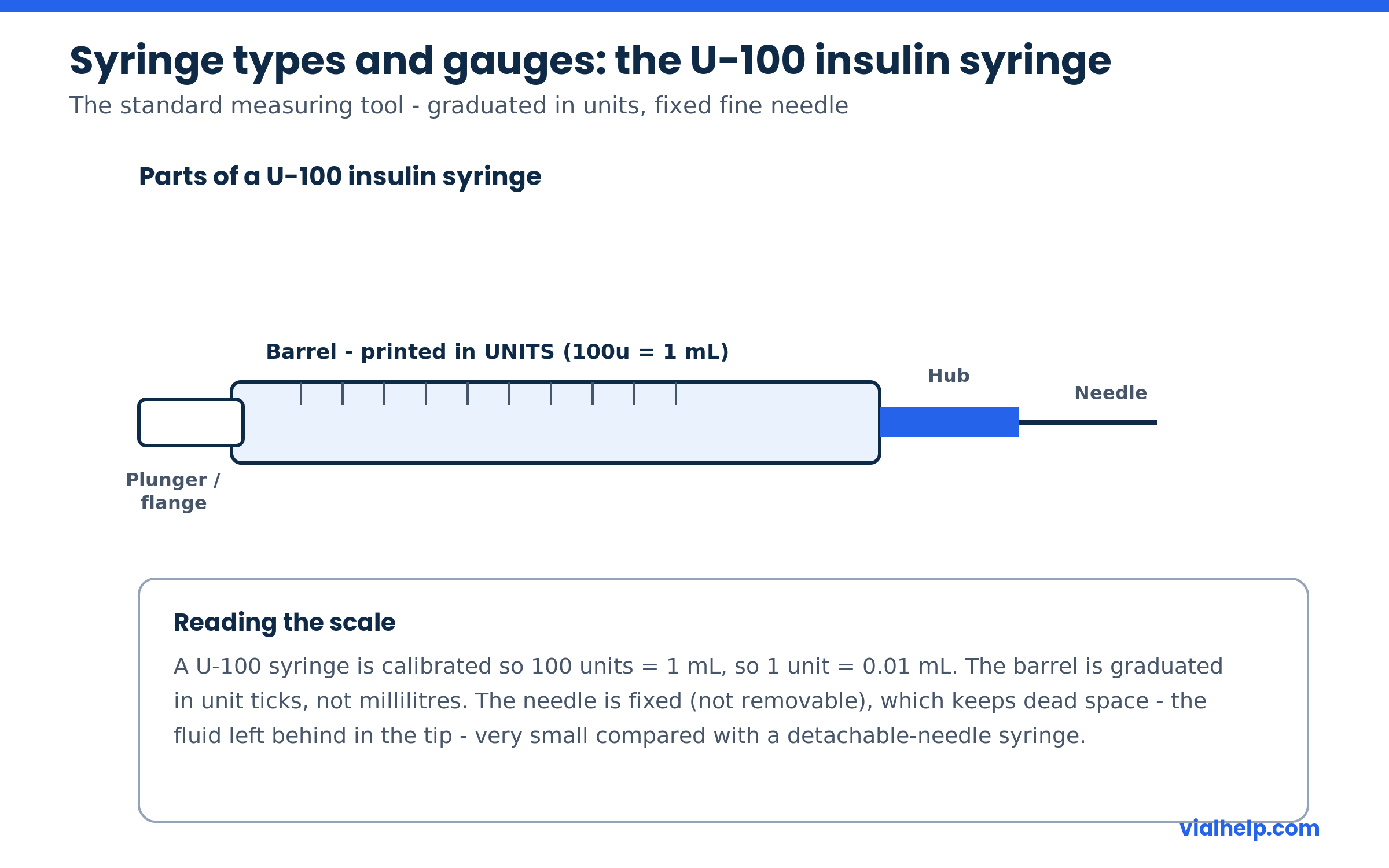
For small volumes, the U-100 insulin syringe is the usual measuring tool in research handling. “U-100” means the barrel is calibrated so that 100 units equals 1 mL — so one unit is 0.01 mL. Crucially, the barrel is printed in units, not millilitres, and the needle is permanently fixed rather than detachable. That fixed fine needle is what keeps dead space (the fluid left in the tip) very small.
Needle gauge: higher number, thinner needle
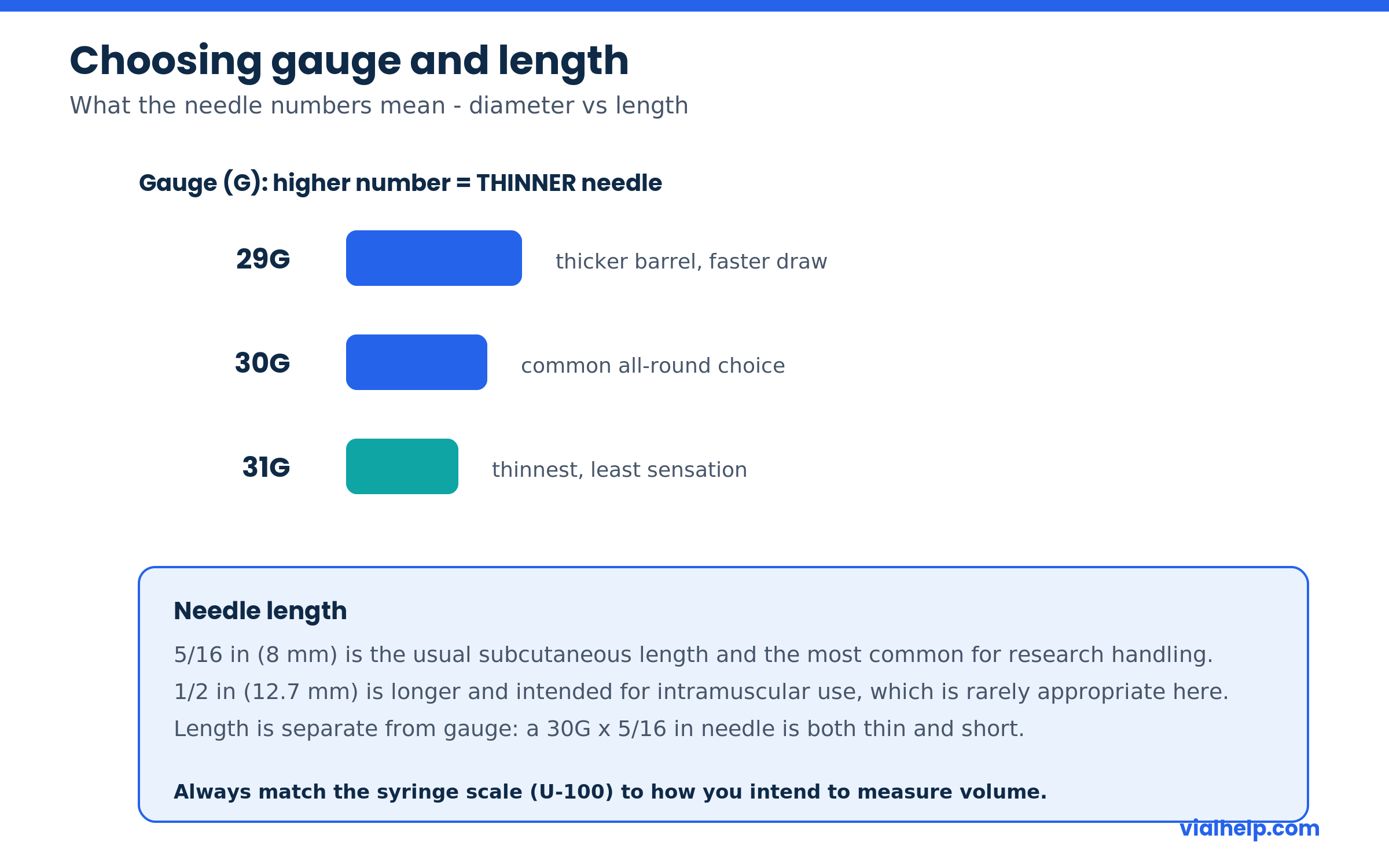
Gauge (written as a number followed by “G”) describes the needle’s outer diameter, and the scale runs backwards from intuition: a higher gauge number means a thinner needle. Insulin syringes typically come in 29G, 30G and 31G, all of them fine. Thinner needles (higher gauge) are generally felt less but draw thick fluid a little more slowly; slightly thicker needles (lower gauge) draw faster.
Needle length: a separate dimension
Length is independent of gauge. The most common subcutaneous length is 5/16 inch (8 mm), which is the typical choice for research handling. A longer 1/2 inch (12.7 mm) needle is intended for intramuscular delivery, which is rarely the appropriate route here. So a “30G × 5/16"” needle is both thin (30 gauge) and short (8 mm) — the two numbers describe different things.
Dead space: the volume you can’t see
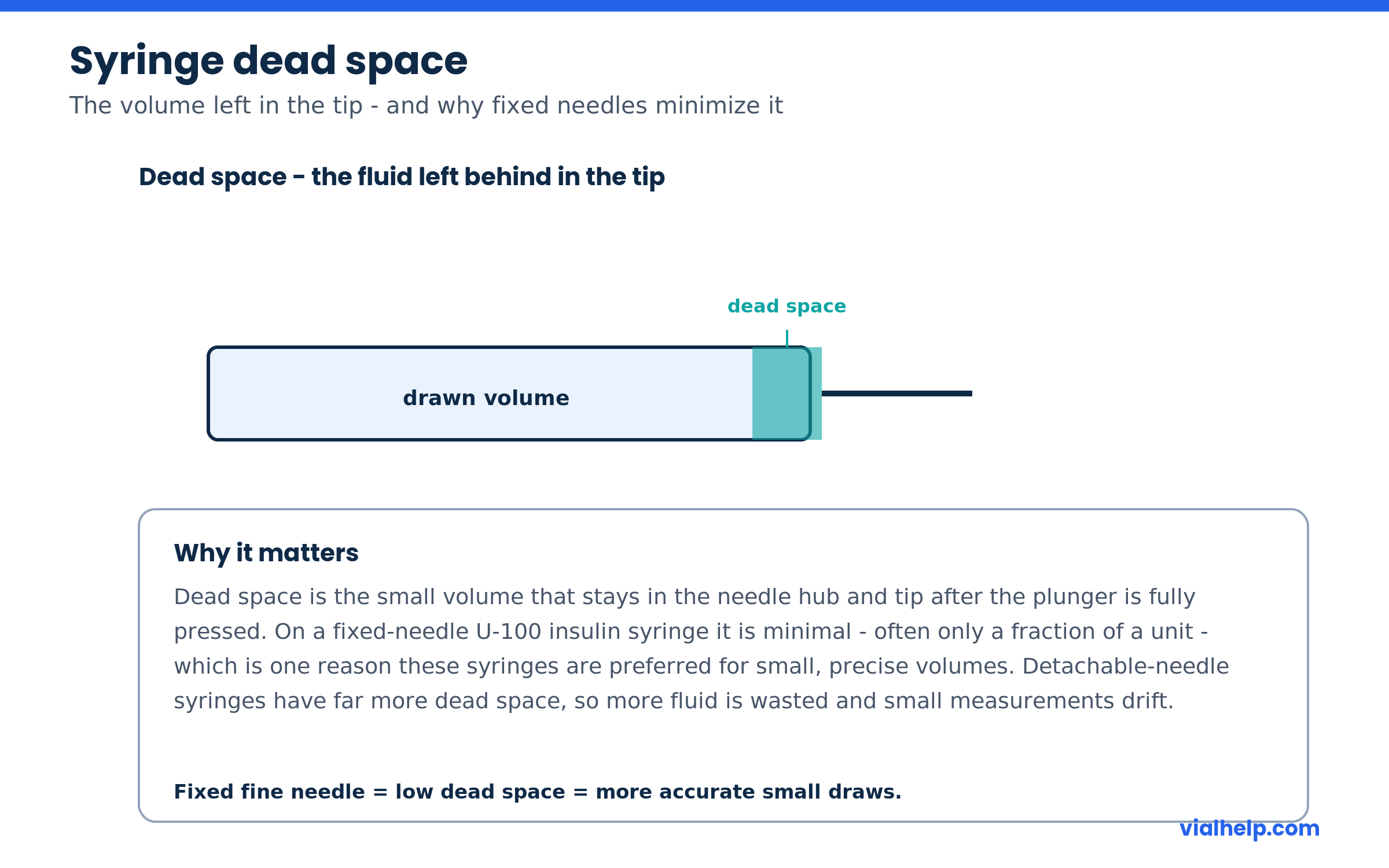
Dead space is the small amount of fluid that remains in the needle hub and tip after the plunger is fully depressed. On a fixed-needle insulin syringe it is minimal — often only a fraction of a unit — which is one of the main reasons these syringes are preferred for small, precise volumes. Detachable-needle syringes have considerably more dead space, so more fluid is left behind and small measurements drift.
Matching the syringe to the measurement
- Use a U-100 syringe when you are working in unit marks and small volumes — just remember units are volume, not dose.
- Pick a gauge (29–31G) that balances comfort against draw speed; 30G is a common all-round choice.
- Pick the right length — 5/16" (8 mm) for subcutaneous handling; reserve 1/2" for the rare intramuscular case.
- Mind dead space — fixed needles waste less and measure small volumes more reliably.
- Convert to mg/mL first. Use the reconstitution calculator so you know what each volume mark contains.
U-100 vs U-40 syringes — a quick caution
Not every insulin syringe uses the same scale. A U-40 syringe is calibrated to 40 units per mL, so its unit marks represent a different volume than a U-100 syringe. Mixing up the two scales is a classic measuring error. For consistency, U-100 is the standard reference, and the volume math on this site assumes it.
Frequently asked questions
Does a higher gauge mean a bigger needle?
No — it is the opposite. A higher gauge number means a thinner needle. 31G is thinner than 29G.
What gauge is best for research handling?
29G to 31G are all common and fine; 30G is a frequent all-round pick. The “best” choice trades comfort (thinner) against draw speed (thicker).
Is a syringe “unit” the same as a dose?
No. A unit is a volume mark (1 unit = 0.01 mL on a U-100 syringe). The amount of compound in that volume depends on concentration — see our IU vs mL explainer.
Why are insulin syringes preferred for small volumes?
Their fine, fixed needle and unit-scale barrel give very low dead space and fine resolution, which makes small measurements more accurate than a detachable-needle syringe.
References
CDC — Injection Safety (safe injection practices): link
FDA — Safely Using Sharps (Needles and Syringes): link
BD — Insulin syringes (U-100, gauge and length options): link
Informational only — not medical advice. This guide describes measurement and handling concepts for research contexts and does not provide personal dosing instructions. Consult a qualified healthcare professional for medical guidance. 21+.