
Freeze-Thaw Cycles and Aliquoting Peptides
Freeze-thaw cycles are one of the most common and most underestimated causes of peptide and protein degradation in the laboratory. Each time a frozen solution warms up and is refrozen, the molecules inside are exposed to physical and chemical stresses that can unfold, fragment, or clump them together. Aliquoting, the practice of dividing a stock into small single-use portions before freezing, is the standard handling technique used to keep those cycles to a minimum.
This article explains what actually happens to a peptide during freezing and thawing, why the damage is cumulative, and how a simple aliquoting workflow protects sample integrity. The framing here is laboratory handling and sample stability, not dosing or use guidance.
What happens during a freeze-thaw cycle
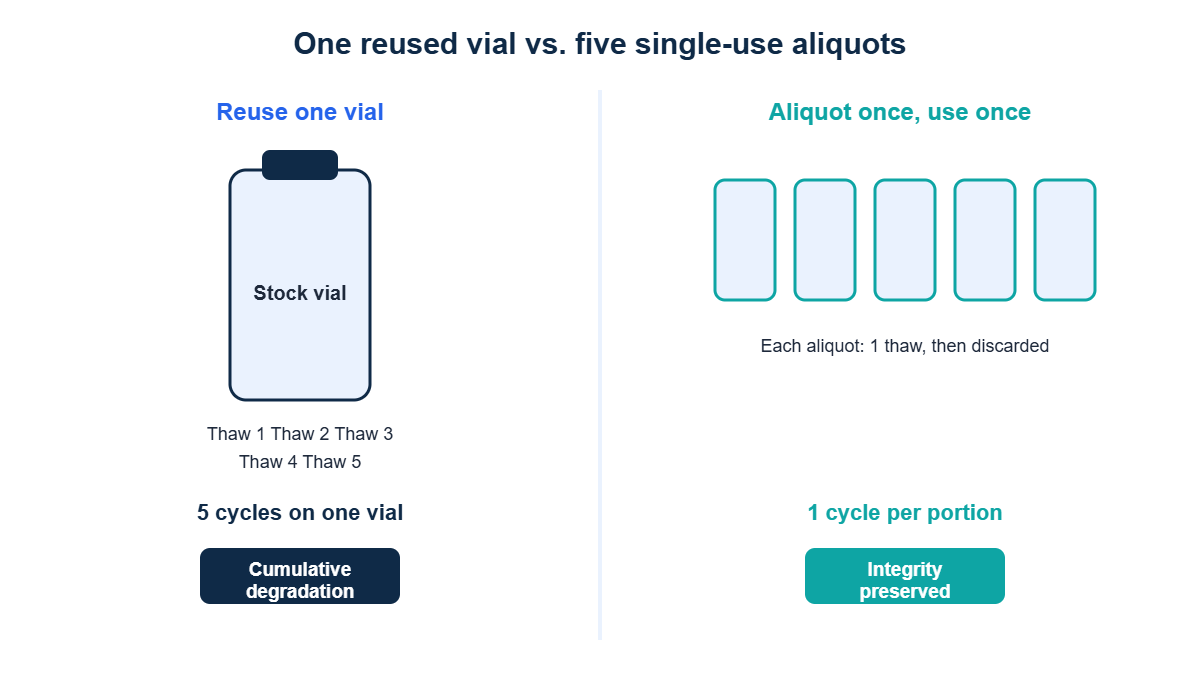
Freezing is not a gentle pause button. As a solution cools below its freezing point, pure water crystallizes into ice first, which sets off a chain of stresses on whatever is dissolved in the remaining liquid. Researchers studying protein therapeutics have characterized several overlapping mechanisms that act during each cycle:
- Ice crystal formation and the ice-water interface. Growing ice crystals create large surfaces where peptide molecules can adsorb and unfold. This interface is one of the principal drivers of aggregation.
- Freeze-concentration of solutes. As water leaves to form ice, everything else, peptide, salts, and buffer, is squeezed into a shrinking volume of liquid. Concentrations can rise dramatically, pushing molecules close enough to associate and aggregate.
- pH shifts. Buffer components do not always crystallize at the same rate. Preferential crystallization of one buffer salt can swing the pH of the unfrozen fraction by one or more units.
- Cold denaturation and mechanical stress. Low temperatures and the pressure of ice growth can partially unfold the molecule, and unfolded molecules readily link together into dimers and larger aggregates.
- Interfacial and air-bubble stress. Air pulled out of solution during freezing accumulates at ice boundaries, adding another interface where unfolding can occur.
The combined result is some fraction of the peptide unfolding, fragmenting, oxidizing, or aggregating into species that no longer behave like the intact molecule.
Why each additional cycle adds risk
The key point is that this damage is cumulative. A peptide does not reset to pristine condition after thawing; the molecules altered on the first cycle stay altered, and the next freeze-thaw acts on top of that. Manufacturer handling guidance is consistent on this: repeated freeze-thaw cycles should be avoided for both lyophilized material and solutions, because each cycle further degrades the sample. Even a single freeze-thaw can measurably reduce a sensitive peptide’s intact content, and aggregates, once formed, are often irreversible.
This is why “how many times has this vial been thawed?” is a genuine quality question, not just bookkeeping. A stock that has been opened and refrozen a dozen times is a different material from a freshly prepared one, even if it looks identical.
How aliquoting and freeze-thaw control work together
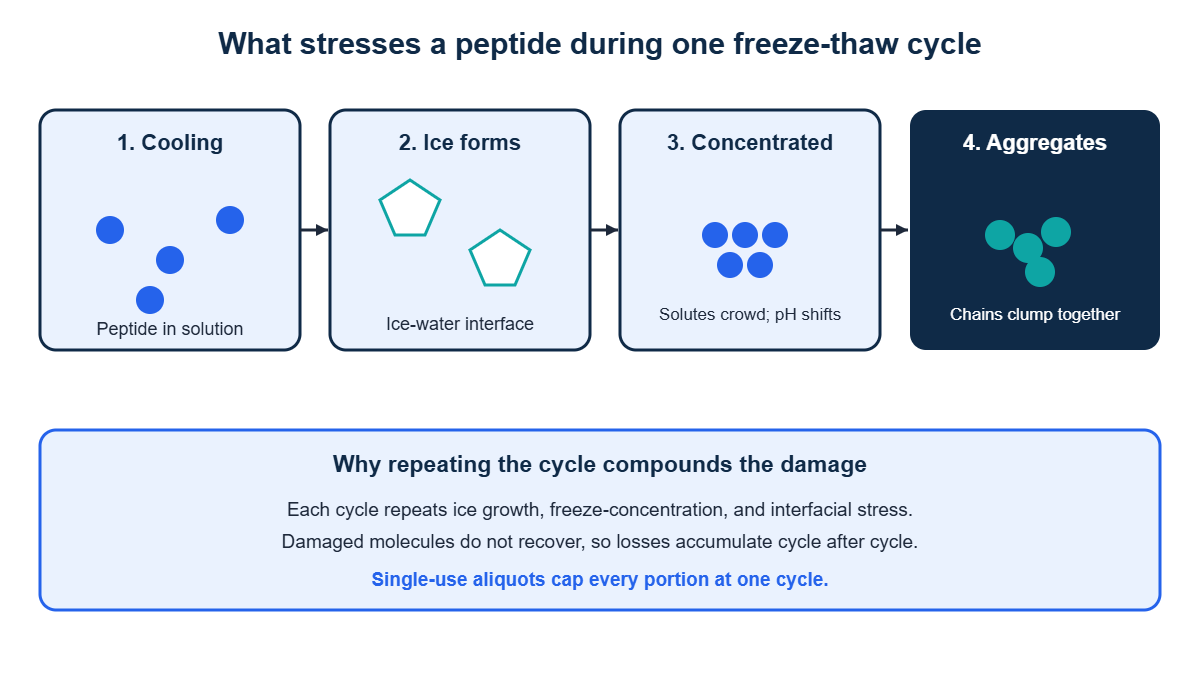
Aliquoting solves the problem by changing the geometry of access. Instead of returning to one master vial again and again, you divide the stock once into many small portions sized for a single use. Each portion is frozen one time and thawed one time, then discarded. The master stock experiences only the cycles needed to create the aliquots, and individual working portions never accumulate cycles at all.
Beyond limiting freeze-thaw, aliquoting also reduces how often the bulk material is exposed to air, moisture, and warming, all of which contribute to oxidation and hydrolysis over time. Best-practice laboratory storage guidance recommends creating multiple aliquots specifically so that repeated freeze-thaw of the whole sample is unnecessary.
A practical aliquoting workflow
A clean, repeatable aliquoting routine looks like this:
- Plan portion size first. Decide how much you need per use, then split the stock so each aliquot covers one use with little or no leftover.
- Work under sterile technique. Use sterile vials, tips, and a clean working surface so you are not trading freeze-thaw damage for contamination.
- Equilibrate before opening. Let a frozen vial reach room temperature before uncapping so condensation does not form inside and introduce water.
- Label and date every vial. Record contents, concentration, preparation date, and a freeze-thaw count that starts at zero.
- Freeze promptly and store cold. Get aliquots into the freezer without prolonged time at room temperature.
- One vial, one thaw. Pull a single aliquot, use it, and do not refreeze the remainder. Discard rather than recycle.
Storage temperatures and when freezing is not needed
For long-term storage, lyophilized peptides are typically held at around -20 C away from light, and peptide solutions are usually stored at -20 C or colder; many sensitive biologics are kept at -80 C. Lower temperatures slow the chemical reactions that degrade peptides over months and years.
Freezing is not always the right answer, though. If a reconstituted peptide will be used within a short window, refrigeration at roughly 2 to 8 C for a few days can be more appropriate than freezing, because it avoids freeze-thaw stress entirely. The general principle is to match storage to timeline: short-term in the fridge, long-term frozen in single-use aliquots. Always defer to the specific stability information for the exact compound and buffer you are handling.
Does one freeze-thaw cycle really matter?
It can. The effect depends on the peptide, the buffer, and conditions, but studies and handling guides note that even a single cycle can reduce intact content for sensitive molecules. The damage is also cumulative, so limiting cycles always helps.
Can I refreeze a thawed aliquot to save material?
The standard recommendation is no. Refreezing simply adds another cycle of ice, concentration, and interfacial stress. Aliquoting into single-use portions exists precisely so refreezing is never necessary.
How small should aliquots be?
Small enough that one aliquot equals one use, with minimal leftover. Slightly more, smaller vials is preferable to a few large ones that force repeated access.
Related tools and reading
- Peptide storage and stability
- Sterile technique
- How to reconstitute peptides
- Guides
- Reconstitution calculator — work out mg/mL and draw volume before you split a vial into aliquots.
- Vial splitting calculator — plan how much goes into each aliquot and what concentration each one holds.
Informational only – not medical advice. 21+.