
What Is a Peptide? Peptides vs. Proteins Explained
Peptide Basics
What is a peptide? In short, a peptide is a small chain of amino acids joined end to end by peptide bonds. That simple definition hides a few details worth knowing — how the bond actually forms, where peptides end and proteins begin, and why the numbers in names like “BPC-157” or “176-191” are so easily misread. This guide walks through the basics in plain language.
What is a peptide, exactly?
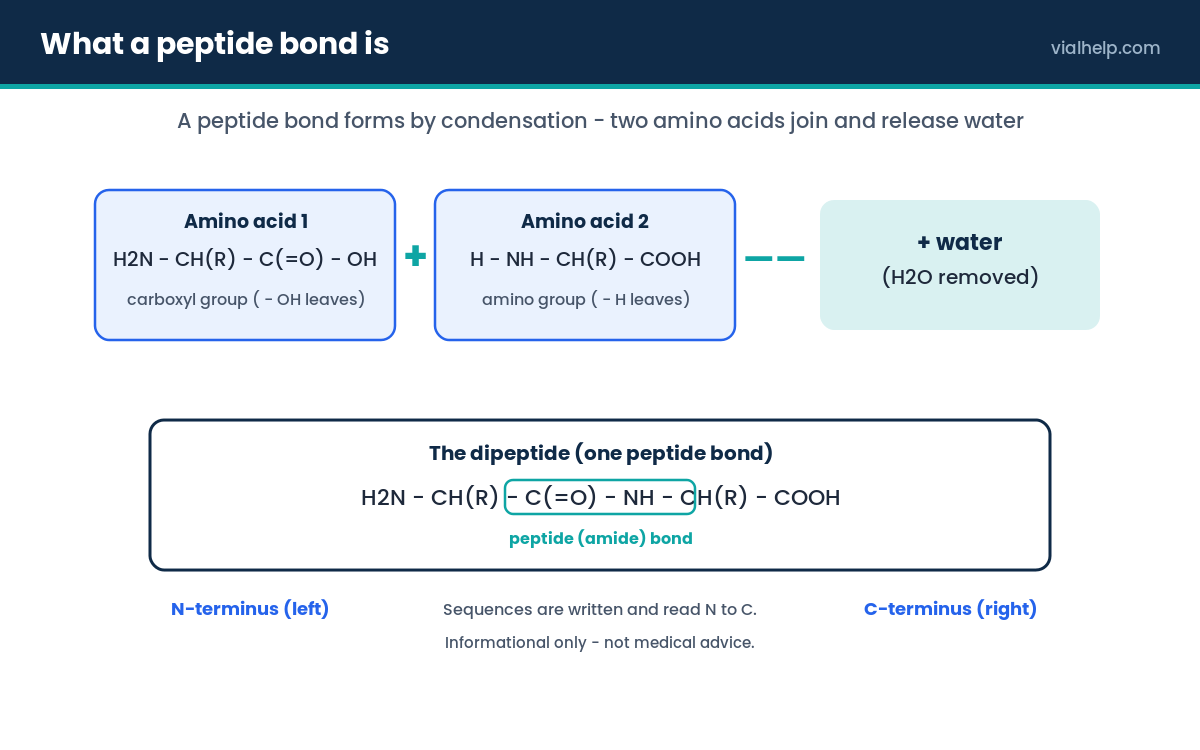
A peptide is a short polymer of amino acids linked by peptide bonds. A peptide bond is a type of amide bond: it forms by a condensation (dehydration) reaction, in which the carboxyl group (–COOH) of one amino acid reacts with the amino group (–NH2) of the next, and a molecule of water is released in the process.
Once an amino acid is built into the chain it is called a residue (it has lost the water of condensation, so it is no longer a whole free amino acid). The chain has direction and two distinct ends: the N-terminus (free amino group), drawn on the left, and the C-terminus (free carboxyl group), on the right. By convention, sequences are written and read from the N-terminus to the C-terminus — the same direction in which the ribosome builds them inside a cell.
Peptides vs. proteins: where is the line?
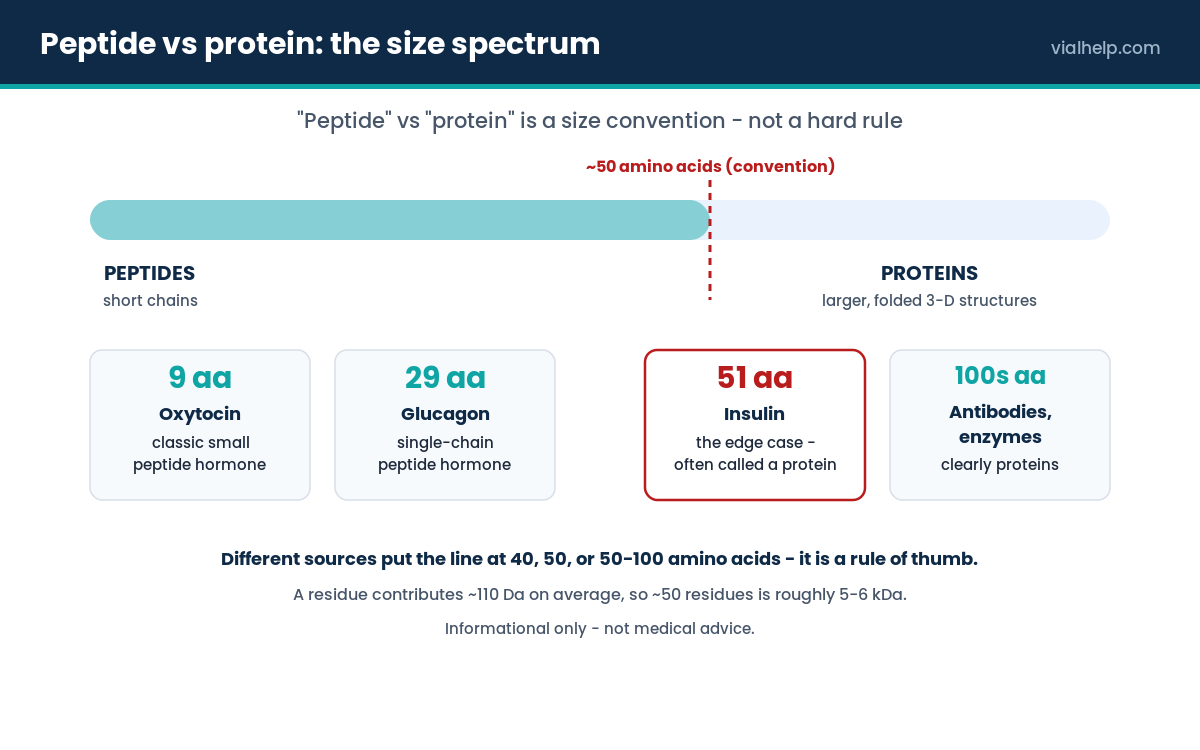
Here is the honest answer: there is no single hard cutoff. The peptide/protein distinction is partly a size convention and partly about structure, and sources genuinely disagree on the number.
- The most common textbook convention puts peptides at roughly 2–50 amino acids and proteins at about 50 or more — the ~50-residue mark corresponding to roughly 5–10 kDa.
- Many biochemists place the boundary anywhere in the 50–100 amino acid range.
- For regulatory purposes the US FDA adopted a 40 amino acid threshold (above 40 is treated as a protein/biologic), while noting literature support for 50.
Structure is often the more meaningful distinction: chains shorter than about 40–50 residues generally do not fold into a single, stable three-dimensional shape, whereas proteins fold into defined 3-D structures and are typically larger and more complex. Treat the number as a rule of thumb, not a law.
The vocabulary: dipeptide, oligopeptide, polypeptide
- Dipeptide — two residues (one peptide bond); tripeptide — three.
- Oligopeptide — a “few” residues (loosely up to ~10–20, no fixed line).
- Polypeptide — a long single chain of many residues; a protein is one or more folded polypeptides.
- Residue — an amino acid once it is part of the chain. An n-residue peptide has (n−1) peptide bonds.
Mass is measured in daltons (Da) or kilodaltons (kDa). As a rough rule, an average residue contributes about 110 Da, so a 50-residue chain lands near 5–6 kDa.
How peptides are named — and what the numbers mean
Each amino acid has a three-letter code (Gly, Ala, Leu) and a one-letter code (G, A, L), and sequences are written N→C. The trickiest part of peptide names is the numbers, because they are not all the same kind of number:
- Position ranges like “176-191” point to amino-acid positions within a larger parent protein. “HGH Fragment 176-191” is the stretch from residue 176 to 191 of human growth hormone.
- Series numbers like “GHRP-6” (growth hormone-releasing peptide 6) are identifiers within a named family.
- Catalog/code numbers like “BPC-157” are lab designations — BPC-157 is actually a 15-residue sequence, so the 157 is not an amino-acid count.
Why this matters for handling and measurement
Research peptides are typically supplied lyophilized (freeze-dried) and must be reconstituted in a suitable solvent such as bacteriostatic water before use. A peptide’s molecular weight drives the concentration math — converting between mass (mg), volume (mL) and the final mg/mL after mixing depends on it. (Our reconstitution calculator handles that arithmetic, and IU vs mL explains why a syringe “unit” is a volume mark, not an amount.)
Peptides are also fragile: peptide bonds and side chains are vulnerable to hydrolysis, oxidation and enzymatic or microbial degradation, and many sequences are sensitive to heat and light. That is exactly why storage matters — dry powder is far more stable than a solution, and reconstituted peptide is generally kept cold and protected from light.
Familiar peptides, from 9 to 51 amino acids
A few well-known examples show the size range and the blurry boundary:
- Oxytocin — 9 amino acids (a “nonapeptide”); a classic small peptide hormone.
- Glucagon — 29 amino acids; a single-chain peptide hormone.
- GLP-1 — about 30 amino acids; the basis for engineered analogs such as semaglutide.
- Insulin — 51 amino acids across two chains; the textbook edge case, often called a small protein because it is well-folded.
Frequently asked questions
Is a peptide just a small protein?
Effectively, yes — the difference is one of size and structural complexity, and the boundary (around 40–50 amino acids) is a convention rather than a strict rule.
What is the difference between an amino acid and a peptide?
An amino acid is a single building block; a peptide is two or more of them joined by peptide bonds. Each amino acid in the chain is then called a residue.
Does the number in a peptide’s name tell me its length?
Usually not. It may be a position range in a parent protein, a series number, or a catalog code — check the actual sequence rather than the name.
References
- StatPearls (NCBI Bookshelf), “Biochemistry, Peptide.” ncbi.nlm.nih.gov/books/NBK562260
- Encyclopaedia Britannica, “What Is the Difference Between a Peptide and a Protein?” britannica.com
- University of Queensland IMB, “Explainer: peptides vs proteins.” imb.uq.edu.au
- Chemistry LibreTexts, “The Peptide Bond.” chem.libretexts.org
- US FDA / Federal Register, “Definition of the Term ‘Biological Product'” (40-aa threshold). federalregister.gov
Informational only — not medical advice · 21+. This article explains peptide chemistry and terminology and is not guidance for personal use.