
Semaglutide vs Tirzepatide: What’s Actually Different?
Peptide science · Comparisons
Semaglutide vs tirzepatide is the most common question in the incretin space, and most of the difference comes down to a single design choice: how many gut hormones each molecule imitates. Both are once-weekly injectable peptides that lower blood glucose and body weight, both are engineered to ride along on blood albumin so they last about a week, and both are dominated by gastrointestinal side effects. Yet in the two trials that pitted them directly against each other, they did not perform identically. Here is what actually separates them — framed for education, not as medical or dosing advice.
What each one actually is
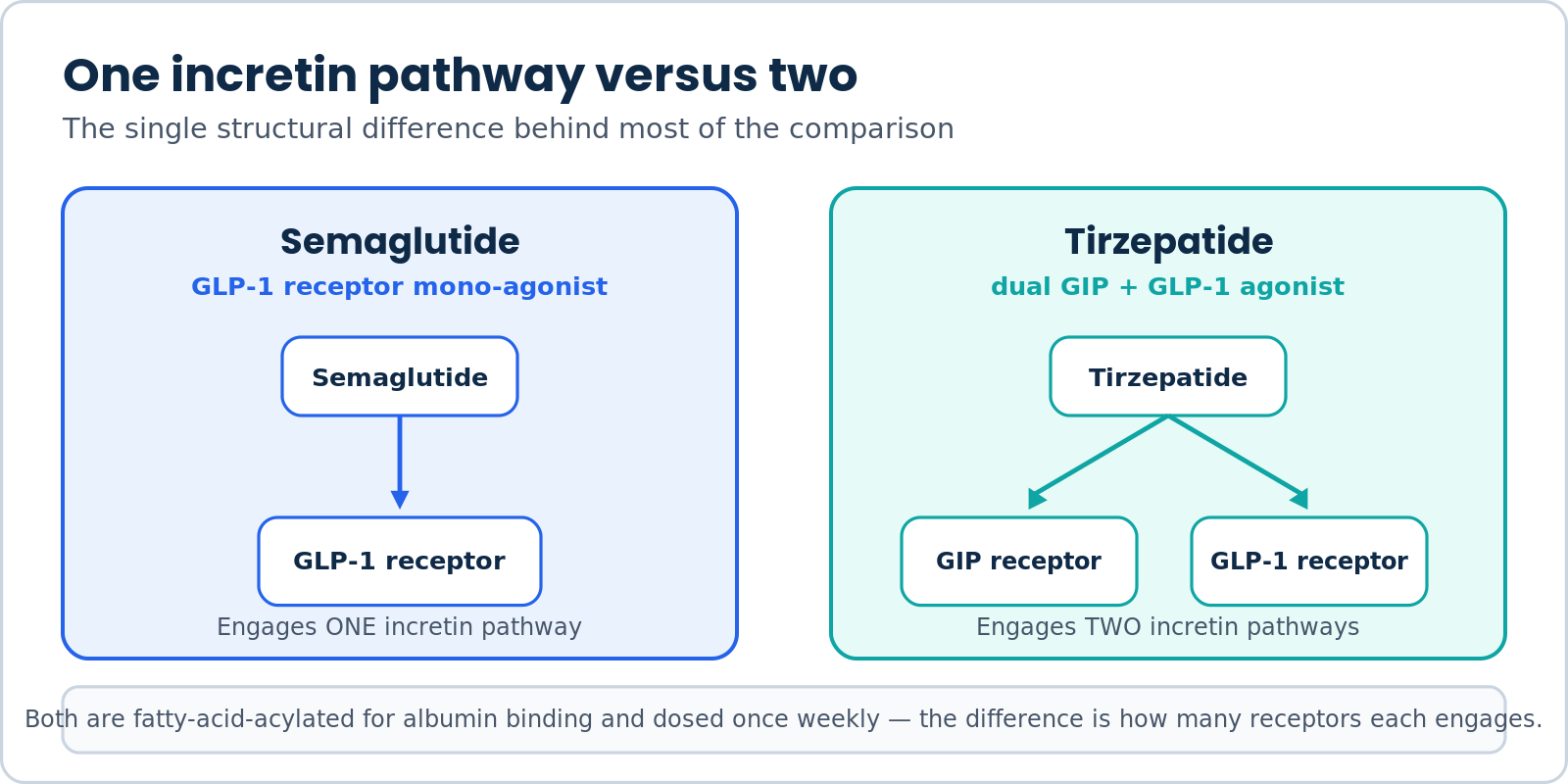
Semaglutide is a 31-amino-acid analog of the human incretin hormone GLP-1 (glucagon-like peptide-1). It is a GLP-1 receptor mono-agonist — it activates one receptor. A fatty-diacid chain attached to the peptide lets it bind reversibly to albumin, which slows clearance and gives it a half-life of roughly one week (about 7 days). It carries the molecular formula C187H291N45O59 and a molecular weight near 4,113 g/mol. To learn how GLP-1 works as a hormone, see our explainer on what GLP-1 is.
Tirzepatide is a 39-amino-acid synthetic peptide built on the backbone of a different incretin — GIP (glucose-dependent insulinotropic polypeptide) — and engineered so that the single molecule activates both the GIP receptor and the GLP-1 receptor. That is why it is often called a “twincretin” or dual agonist. It also carries a fatty-diacid for albumin binding, with an elimination half-life of about five days. Its formula is C225H348N48O68, molecular weight roughly 4,813 g/mol. Both peptides are examples of receptor agonists.
The one structural difference that matters
Strip away the branding and the difference is simple: semaglutide engages one incretin pathway; tirzepatide engages two. GLP-1 and GIP are the two major incretin hormones your gut releases after a meal, and both amplify glucose-dependent insulin release. Semaglutide leans entirely on the GLP-1 arm. Tirzepatide adds GIP-receptor activity on top of GLP-1-receptor activity, and the working hypothesis is that recruiting both incretin systems at once is what drives its larger effects. Almost every other comparison — approvals, dosing, side-effect profile — flows from that single design decision.
Head-to-head: what the direct trials show
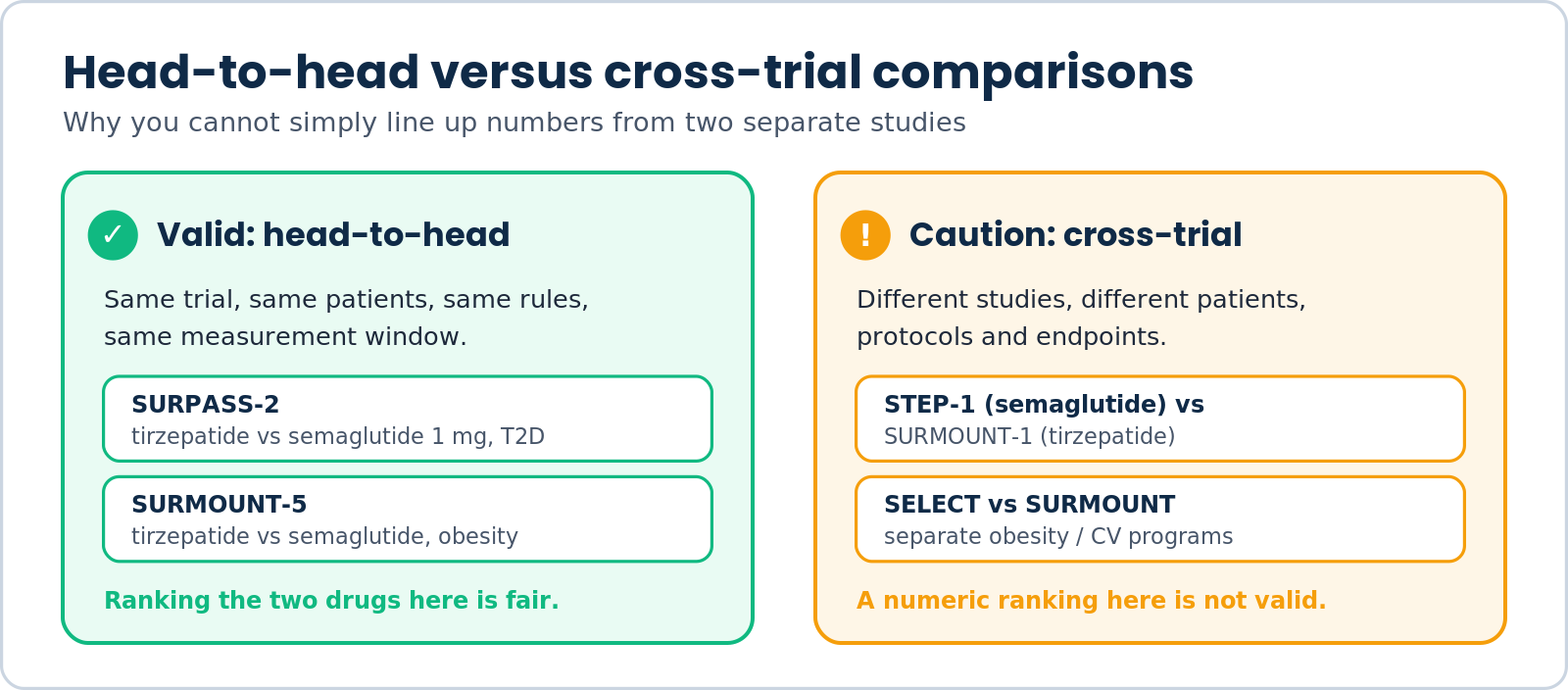
Two trials compared the drugs in the same patients under the same rules, so their numbers can be ranked fairly.
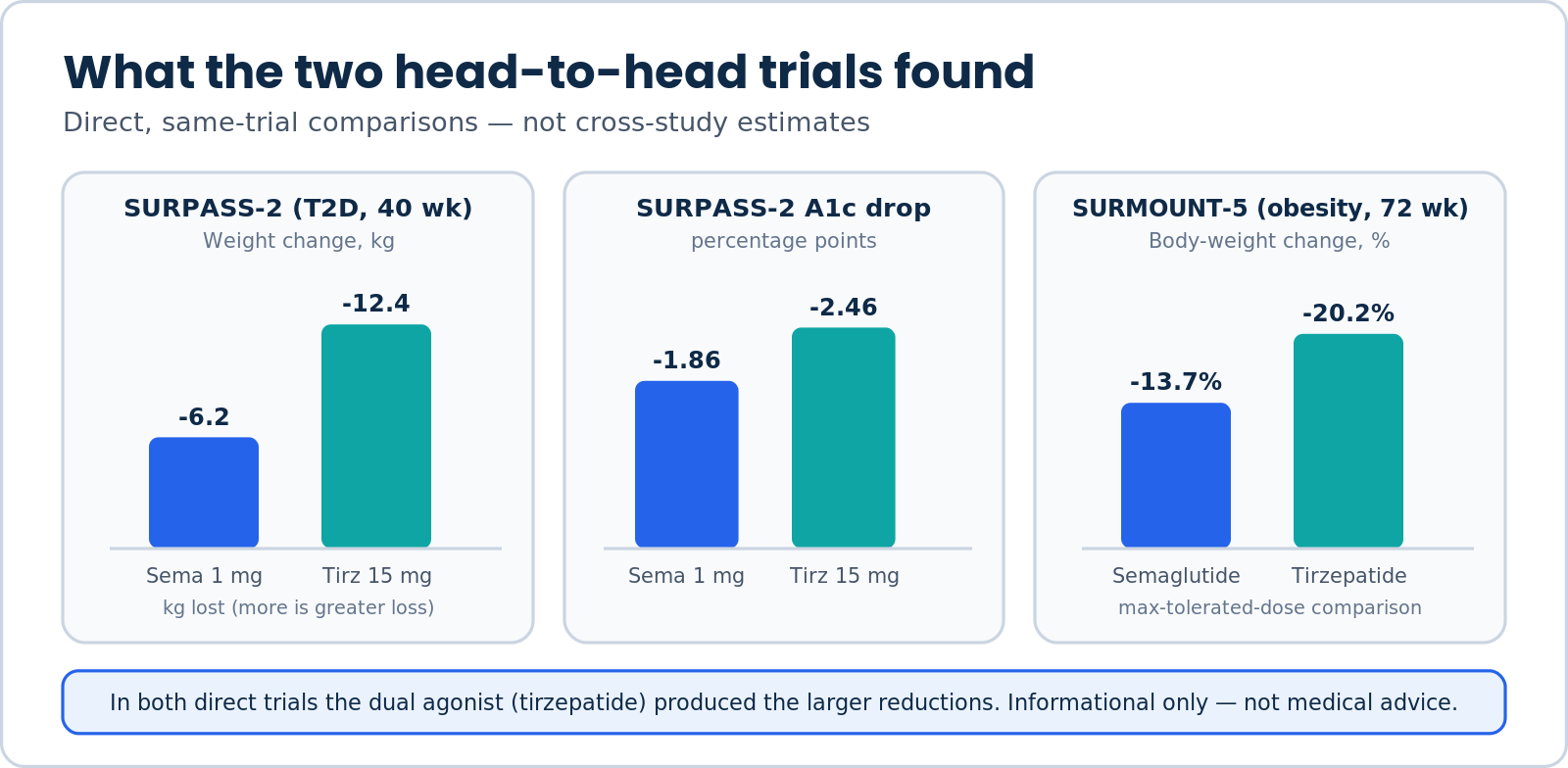
SURPASS-2 (type 2 diabetes, 40 weeks) compared tirzepatide against semaglutide 1 mg. Tirzepatide lowered HbA1c by up to about 2.46 percentage points versus 1.86 for semaglutide, and cut body weight by up to roughly 12.4 kg versus 6.2 kg. All three tirzepatide doses were statistically superior on both measures.
SURMOUNT-5 (obesity without diabetes, 72 weeks, published in 2025) compared the two at their maximum tolerated doses. Tirzepatide reduced body weight by about 20.2% versus 13.7% for semaglutide. Again the dual agonist came out ahead.
Approvals, brand names and indications
The same molecule appears under different brand names depending on the approved use. For semaglutide, Ozempic is the type 2 diabetes brand (first FDA approval December 2017) and Wegovy is the chronic-weight-management brand (2021). For tirzepatide, Mounjaro is the diabetes brand (2022) and Zepbound is the weight-management brand (2023), later also cleared for obstructive sleep apnea. Both molecules are also studied and discussed alongside newer agents such as retatrutide and cagrilintide; you can read the structured entries for semaglutide and tirzepatide in the library.
Tolerability at a high level
Both drugs are dominated by gastrointestinal effects — nausea, diarrhea, vomiting and constipation — that are usually mild to moderate and concentrated during dose escalation. This is informational context, not a safety comparison for any individual: tolerability depends on the person, the dose and the escalation schedule, which is a conversation for a qualified clinician. For a compound-agnostic overview of what drives these effects, see our note on GLP-1 side effects.
Frequently asked questions
Is tirzepatide simply “stronger” semaglutide?
Not exactly. It is a different molecule with an extra mechanism (GIP-receptor activity). In the two head-to-head trials it produced larger average reductions, but “more receptors engaged” is the reason, not a higher dose of the same drug.
Do they have the same half-life?
Close but not identical: semaglutide is about one week, tirzepatide about five days. Both support once-weekly dosing because both bind albumin through an attached fatty-diacid chain.
Why do the weight-loss percentages people quote vary so much?
Because they often come from different trials with different populations and durations. Only same-trial (head-to-head) comparisons can be ranked directly; cross-trial figures cannot.
Are these peptides or small-molecule drugs?
Both are peptides — chains of amino acids — not small molecules, which is why they are injected rather than taken as ordinary pills. See what a peptide is for the distinction.
- Frías JP, et al. Tirzepatide versus Semaglutide Once Weekly in Type 2 Diabetes (SURPASS-2). N Engl J Med 2021;385:503–515. pubmed.ncbi.nlm.nih.gov/34170647
- Aronne LJ, et al. Tirzepatide versus Semaglutide for Obesity (SURMOUNT-5). N Engl J Med 2025;393:26–36. pubmed.ncbi.nlm.nih.gov/40353578
- Wilding JPH, et al. Once-Weekly Semaglutide in Adults with Overweight or Obesity (STEP 1). N Engl J Med 2021;384:989–1002. nejm.org (NEJMoa2032183)
- Jastreboff AM, et al. Tirzepatide Once Weekly for the Treatment of Obesity (SURMOUNT-1). N Engl J Med 2022;387:205–216. nejm.org (NEJMoa2206038)
- National Center for Biotechnology Information. PubChem: Tirzepatide (CID 156588324) and Semaglutide (CID 56843331). pubchem.ncbi.nlm.nih.gov
- Eli Lilly. Mounjaro (tirzepatide) Prescribing Information. pi.lilly.com/us/mounjaro-uspi.pdf
Informational only — not medical advice · 21+