
The Kallikrein-Kinin System: Bradykinin Explained
Peptide systems
The kallikrein-kinin system is the peptide pathway that makes bradykinin — a short, powerful vasodilator. It is also the reason a familiar blood-pressure drug can cause a dry cough, because the enzyme that raises blood pressure is the same one that destroys bradykinin.
What is the kallikrein-kinin system?
The kallikrein-kinin system is a small cascade that releases active peptides called kinins. It starts with large precursor proteins, the kininogens (from the gene KNG1), circulating in the blood. Enzymes called kallikreins cut those precursors to release the kinins. Plasma kallikrein — generated from prekallikrein as part of the Factor XII “contact” system — releases bradykinin, a nine-amino-acid peptide with the sequence Arg-Pro-Pro-Gly-Phe-Ser-Pro-Phe-Arg. A closely related ten-amino-acid kinin, kallidin (Lys-bradykinin), is bradykinin with one extra lysine at the front.
The cascade, step by step
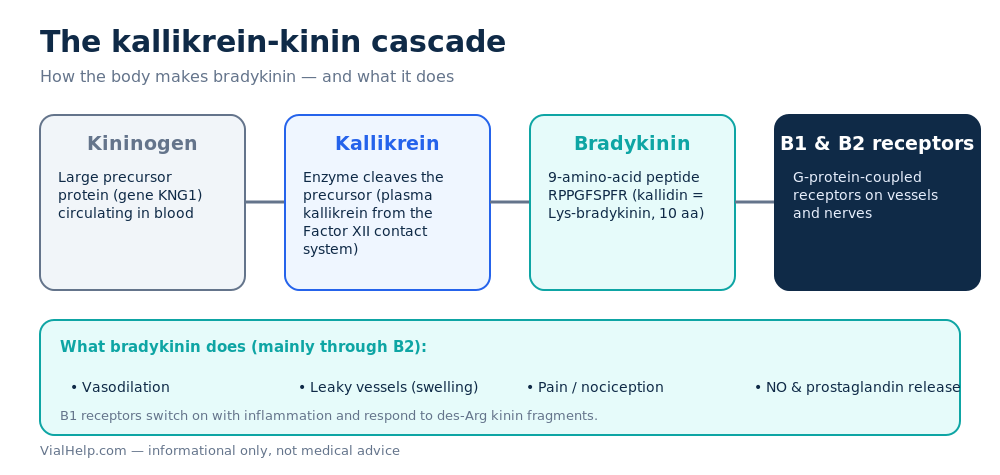
Kininogen is cleaved by kallikrein to release bradykinin (or kallidin), and those kinins act on two receptors — B1 and B2 — both of which are G-protein-coupled receptors. The B2 receptor is present all the time and carries most of bradykinin’s everyday effects. The B1 receptor is largely switched on by inflammation and injury, and it responds to the “des-Arg” kinin fragments that form when a carboxypeptidase trims the end residue.
Through these receptors, bradykinin produces vasodilation, makes small vessels leakier (contributing to tissue swelling), triggers pain, and prompts the release of nitric oxide and prostaglandins. It is a genuine double-edged mediator: helpful in normal tissue defence and blood-flow control, but capable of causing swelling and pain when it runs high.
The RAAS crossover: ACE is also “kininase II”
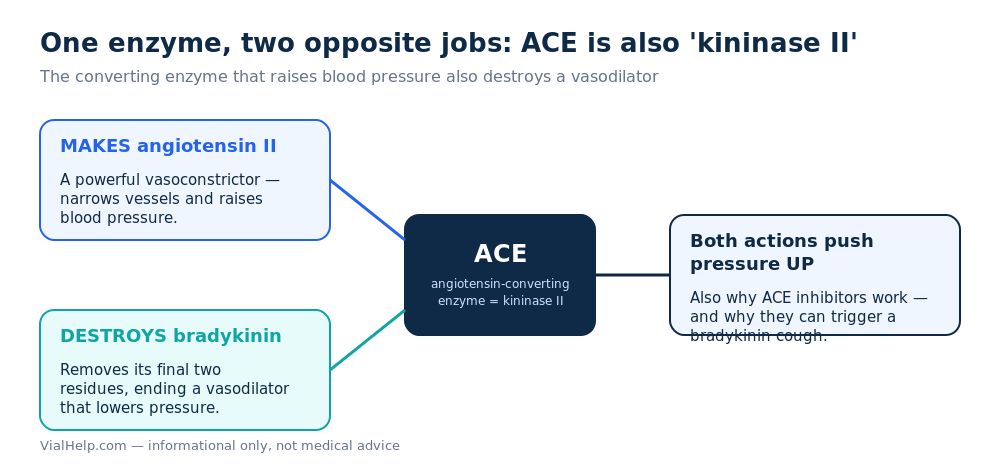
Here is the connection that ties this article to the renin-angiotensin-aldosterone system. The same angiotensin-converting enzyme (ACE) that builds the vasoconstrictor angiotensin II also destroys bradykinin — historically it was even called “kininase II.” One enzyme, two actions, both of which nudge blood pressure upward: more angiotensin II, and less of the vasodilator bradykinin.
Neprilysin degrades bradykinin too
ACE is not bradykinin’s only off-switch. Neprilysin also degrades bradykinin. That is why a neprilysin inhibitor is paired with an ARB rather than an ACE inhibitor — combining two bradykinin-raising mechanisms would stack the angioedema risk. The kallikrein-kinin system is the thread that runs through both stories.
When bradykinin runs unchecked
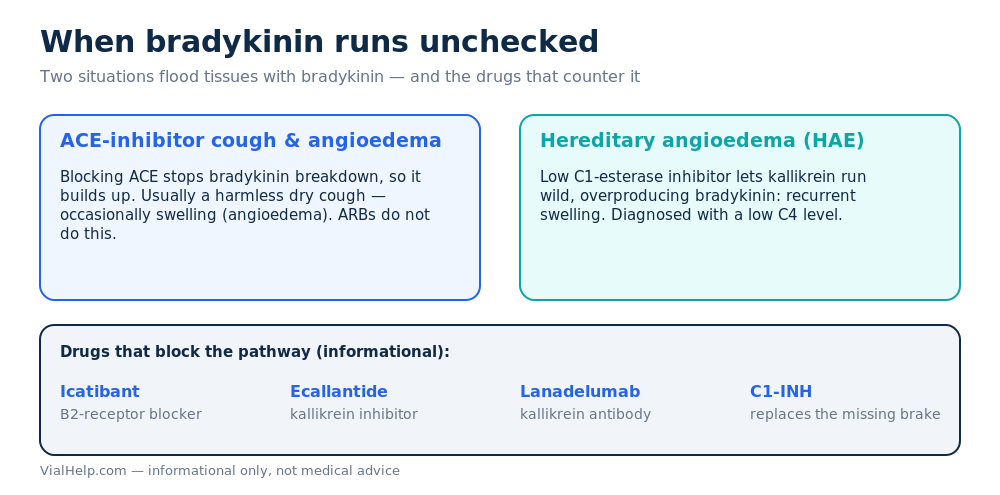
The clearest illustration of “too much bradykinin” is hereditary angioedema (HAE). In the common form, a shortage of C1-esterase inhibitor removes a brake on plasma kallikrein, so bradykinin is overproduced and patients get recurrent attacks of swelling — often not responsive to the antihistamines or epinephrine that help allergic swelling. A low complement C4 level is a classic clue. Because ACE inhibitors add to bradykinin, they are avoided in people prone to this kind of angioedema.
Several medicines target the pathway (informational only): icatibant blocks the B2 receptor; ecallantide and the antibody lanadelumab inhibit plasma kallikrein; and C1-esterase inhibitor concentrates replace the missing brake. Each interrupts bradykinin production or action at a different point.
Frequently asked questions
What is bradykinin in simple terms?
Bradykinin is a short peptide — nine amino acids — that widens blood vessels, makes them leaky, and causes pain. The body makes it from a larger precursor through the kallikrein-kinin system.
Why do some blood-pressure pills cause a cough?
ACE inhibitors block the enzyme that normally breaks bradykinin down, so bradykinin builds up and can irritate the airway into a dry cough. ARBs work differently and do not raise bradykinin, so they usually do not cause it.
How long does bradykinin last in the body?
Very briefly — on the order of seconds — because ACE and other enzymes degrade it almost immediately. That short life is part of why blocking its breakdown has such a noticeable effect.
Is the kallikrein-kinin system related to blood clotting?
It overlaps with it. Plasma kallikrein and high-molecular-weight kininogen are part of the Factor XII contact system, which sits at the intersection of the clotting cascade and kinin release.
- UniProt. Kininogen-1 (KNG1), human, P01042. uniprot.org/uniprotkb/P01042
- PubChem. Bradykinin, CID 439201. pubchem.ncbi.nlm.nih.gov/compound/439201
- Pirahanchi Y, Sharma S. Physiology, Bradykinin. StatPearls, NBK537187. ncbi.nlm.nih.gov/books/NBK537187
- IUPHAR/BPS Guide to Pharmacology. Bradykinin receptors. guidetopharmacology.org
- Yang HYT, Erdos EG, Levin Y. A dipeptidyl carboxypeptidase that converts angiotensin I and inactivates bradykinin (1970). PubMed 4322742
- Voors AA, et al. Sacubitril/valsartan review (neprilysin and bradykinin). PMC5013841
Informational only — not medical advice · 21+