
PTH Analogs: Teriparatide and Abaloparatide Explained
Peptide science
PTH analogs are engineered versions of parathyroid hormone and its relative PTHrP, and the two approved in the United States, teriparatide and abaloparatide, are each 34 amino acids long and act on the same receptor. They are unusual among osteoporosis drugs because the trial data describe them as building new bone rather than only slowing its loss.
What are PTH analogs?
Natural human parathyroid hormone (PTH) is an 84-residue hormone; in UniProt (P01270) the mature chain spans residues 32 to 115 of a 115-residue precursor. Its biology, and the glands that make it, are covered in what is parathyroid hormone and parathyroid glands and calcium homeostasis.
Teriparatide is the first 34 amino acids of PTH, with an identical sequence; the Forteo label gives its formula as C181H291N55O51S2 and its molecular weight as 4117.8 Da. Abaloparatide is a synthetic 34-residue analog of parathyroid hormone-related protein, PTHrP(1-34); the Tymlos label gives C174H300N56O49 and a weight of about 3961 Da, with 76% homology to human PTHrP(1-34) and 41% to human PTH(1-34).

How PTH analogs are studied to work
Both drugs act at the PTH1 receptor, a G-protein-coupled receptor (see what is a GPCR); the Tymlos label describes abaloparatide as a PTH1 receptor agonist acting through the cAMP pathway, and the Forteo label says teriparatide binds the same receptors as PTH with the same affinity. The Forteo label also states that once-daily administration favors osteoblast (bone-forming) over osteoclast (bone-resorbing) activity. That pattern is why these analogs are called anabolic agents, in contrast to antiresorptive drugs; hormone-level context is in what is calcitonin.
What the research literature reports
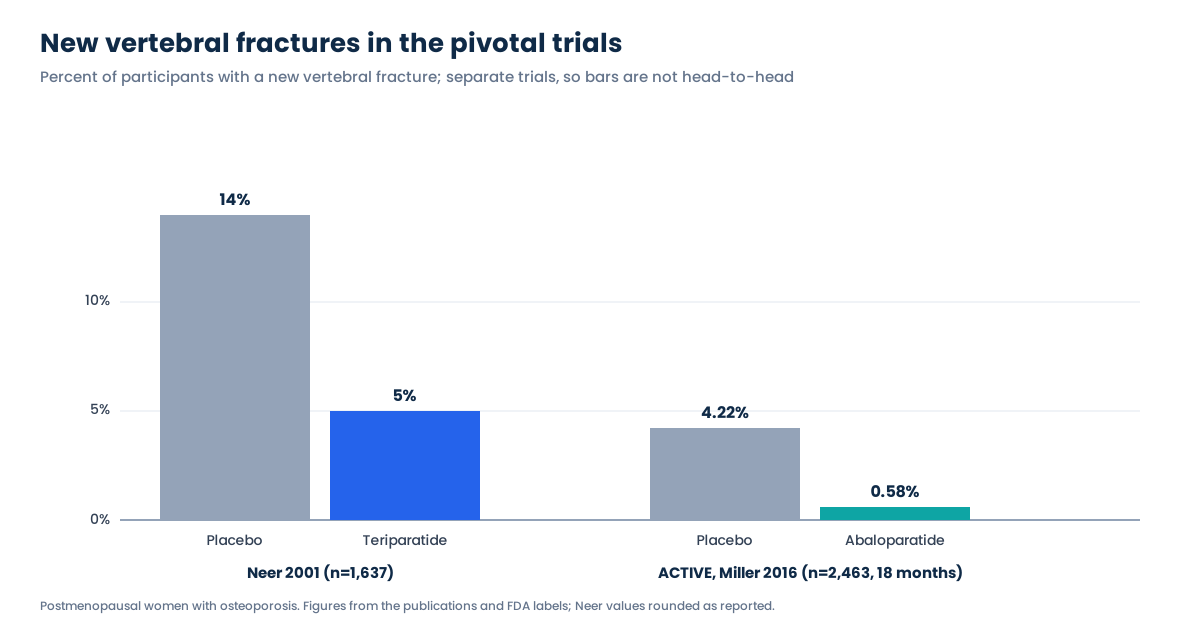
Teriparatide. In the 2001 New England Journal of Medicine trial by Neer and colleagues (1,637 postmenopausal women), new vertebral fractures occurred in 14% of placebo participants and 5% of those in the teriparatide arm studied at the lower dose; the relative risk was 0.35 (95% CI 0.22 to 0.55). The current Forteo label reports 14.3% versus 5.0%.
Abaloparatide. In the ACTIVE trial (Miller 2016, JAMA; 2,463 women, 18 months), new vertebral fractures occurred in 0.58% on abaloparatide versus 4.22% on placebo, and nonvertebral fractures in 2.7% versus 4.7% (hazard ratio 0.57). ACTIVE also included a teriparatide arm, in which hypercalcemia was reported in 6.4% versus 3.4% with abaloparatide.
What the human evidence shows
These are prescription drugs with FDA labels. Forteo is indicated for postmenopausal women with osteoporosis at high fracture risk, for men with primary or hypogonadal osteoporosis, and for glucocorticoid-induced osteoporosis, in patients at high risk of fracture who have failed or cannot tolerate other therapy. Tymlos is indicated for postmenopausal women with osteoporosis at high fracture risk and for men with osteoporosis at high fracture risk.
Osteosarcoma has been a central safety theme. Rodent studies led to a boxed warning on teriparatide; the Forteo label lists the boxed warning as removed in November 2020, and a review of that history is cited below. Radius announced a similar update for Tymlos in December 2021, and the current Tymlos label carries no boxed warning. Osteosarcoma remains discussed under Warnings and Precautions in both labels. On duration, the Forteo label says use beyond two years over a lifetime should be considered only if a patient remains at or has returned to high fracture risk, and the Tymlos label states that safety and efficacy have not been evaluated beyond two years.
Cautions and considerations
Label adverse-reaction tables give a sense of the profile. For Forteo, dizziness was 8.0% versus 5.4% on placebo and leg cramps 2.6% versus 1.3%; orthostatic hypotension, typically within about four hours of a dose, was seen in 5% of healthy volunteers. For Tymlos, the label table lists hypercalciuria (11% versus 9%), dizziness (10% versus 6%), nausea (8% versus 3%), headache (8% versus 6%), palpitations (5% versus 0.4%) and hypercalcemia (3% versus 0.1%). These are summaries of published labels, not predictions for any individual, and the drugs are used under medical supervision.
Because they are peptide pens, storage rules matter: both labels call for refrigeration before first use. General peptide stability concepts are in peptide half-life explained. Questions about how compounded peptides are regulated are covered in FDA 503A compounding categories. Lab-math background is in the reconstitution calculator and the IU vs mL explainer.
Frequently asked questions
Is teriparatide the same as PTH?
Not quite. Teriparatide is the first 34 amino acids of the 84-residue hormone, with an identical sequence in that region.
What makes abaloparatide different from teriparatide?
Abaloparatide is built on PTHrP(1-34) rather than PTH(1-34); its label reports 76% homology to PTHrP(1-34) and 41% to PTH(1-34). Both act at the PTH1 receptor.
Do these drugs still carry a boxed warning for osteosarcoma?
No. The boxed warning was removed from the Forteo label in 2020 and is absent from the current Tymlos label, but osteosarcoma remains in the Warnings and Precautions sections.
Are PTH analogs for long-term use?
The labels describe limited treatment duration; Tymlos states that use beyond two years has not been evaluated, and Forteo restricts use beyond two years to patients who remain at high risk.
References
- Neer RM et al. Effect of parathyroid hormone (1-34) on fractures and bone mineral density in postmenopausal women with osteoporosis. N Engl J Med 2001. PMID 11346808
- Miller PD et al. Effect of abaloparatide vs placebo on new vertebral fractures in postmenopausal women with osteoporosis (ACTIVE). JAMA 2016. PMID 27533157
- FDA. Forteo (teriparatide) prescribing information, NDA 021318 supplement 054
- FDA. Tymlos (abaloparatide) prescribing information, 2025
- UniProt P01270, PTH_HUMAN
- Teriparatide and osteosarcoma risk: history, science, elimination of boxed warning, and other label updates. PMC9465003
Informational only — not medical advice. This article is for educational purposes. It does not recommend, sell or instruct personal human use of any compound. Consult a qualified healthcare professional for any health decision. Content is intended for adults 21+. Verify scientific details against the primary sources cited.