
Anti-Drug Antibodies: Why Peptides Can Trigger an Immune Response
Guide
Anti-drug antibodies are one of the defining differences between peptide therapeutics and ordinary pills. Because a peptide is a piece of protein, the immune system can learn to recognise it as foreign and make antibodies against it. This guide explains what anti-drug antibodies are, why peptides trigger them, when they matter, and why product quality — not just the sequence — drives the risk.
What are anti-drug antibodies?
An anti-drug antibody (ADA) is an antibody the body makes against a therapeutic peptide or protein because the immune system treats the drug — or a fragment of it — as foreign. The property that makes a molecule capable of provoking this response is called its immunogenicity. Regulators and drug developers sort ADAs into two practical categories: binding antibodies, which attach to the drug anywhere, and neutralizing antibodies (NAbs), a subset that binds where it counts and blocks the drug from working.
Why peptides — and not pills — trigger them
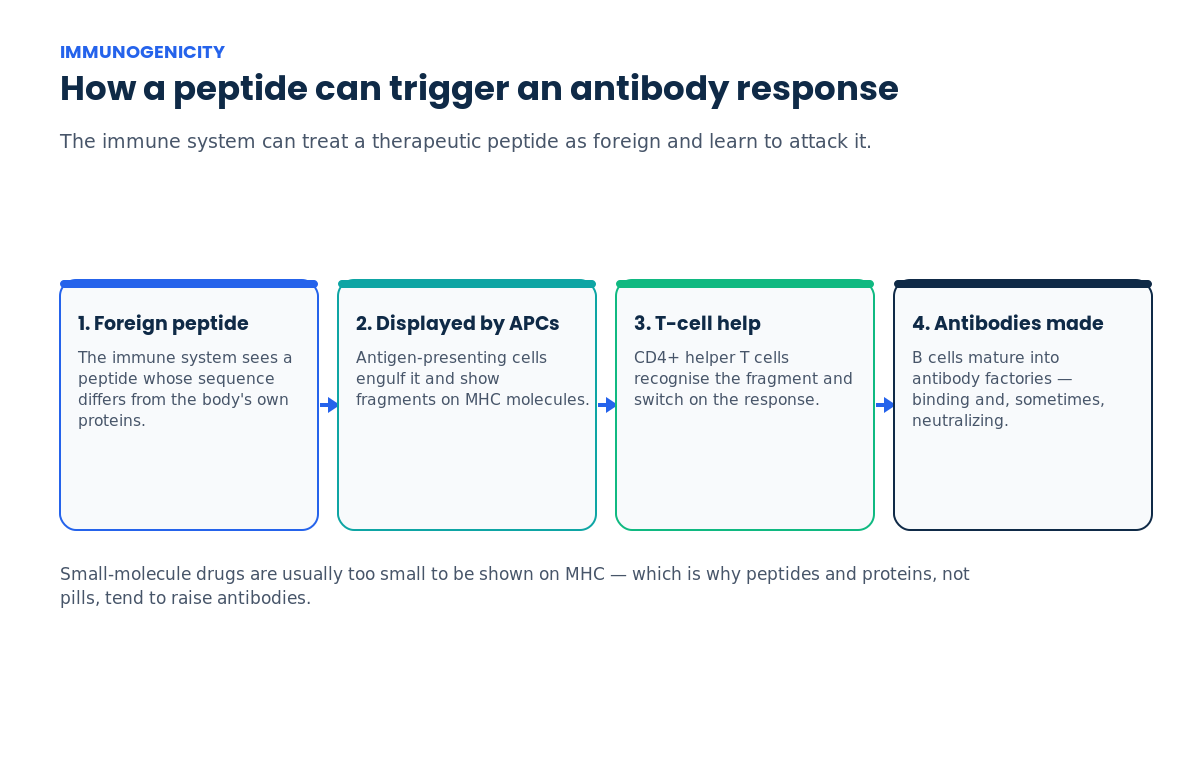
Antibody responses require the immune system to “see” a molecule as a foreign antigen. Proteins and peptides are large, structurally complex, and often differ in sequence from human proteins, so they carry the features the immune system recognises. The classic pathway works like this: an antigen-presenting cell engulfs the peptide, chops it into short fragments, and displays those fragments on its MHC (HLA) molecules. Helper CD4+ T cells that recognise a displayed fragment — a “T-cell epitope” — then help B cells mature into antibody-producing cells.
Small-molecule drugs generally escape this because they are too small to be processed and shown on MHC. (The exception: a very small molecule can occasionally become immunogenic as a hapten if it latches onto a carrier protein.) That size difference is why peptides and proteins, not tablets, are the drugs that tend to raise antibodies.
Binding vs. neutralizing antibodies

The distinction matters because most anti-drug antibodies are clinically silent. A binding antibody may simply stick to the drug and, at most, speed up its clearance so blood levels fall a little faster. A neutralizing antibody is the one to worry about: it binds the drug’s active region and can wipe out its effect. And in the worst case, a neutralizing antibody raised against a therapeutic can cross-react with the body’s own version of that hormone.
When it becomes dangerous: cross-reactivity
The textbook cautionary tale is recombinant erythropoietin (EPO). In a cluster of cases around 1998–2003, patients developed neutralizing antibodies that cross-reacted with their own erythropoietin, shutting down red-blood-cell production — a condition called pure red-cell aplasia. Because the antibodies neutralised every form of EPO, switching products did not help. The trigger was traced to a specific formulation and container change (a stabiliser plus uncoated rubber stoppers), not a new molecule — a stark demonstration that how a peptide is made and packaged can drive immunogenicity as much as the peptide itself.
What drives immunogenicity

Several factors raise the odds of an antibody response, and the most important ones are things you cannot see in a vial:
- Aggregation. Clumped peptide behaves like a repetitive, particulate antigen and pushes the immune system toward a stronger antibody response.
- Impurities and contaminants. Residual host-cell proteins, host-cell DNA, and especially endotoxin act as adjuvants — they switch on innate immune signalling and amplify the response to the drug.
- Sequence unlike human. The more a peptide differs from the body’s own proteins, the more T-cell epitopes it can present.
- Route and frequency. Under-the-skin and chronic, repeated dosing tend to be more immunogenic than a single IV dose.
How anti-drug antibodies are measured
Because antibodies are common but not always meaningful, regulators use a tiered testing strategy (spelled out in the FDA’s 2019 immunogenicity guidance): a sensitive screening assay flags any sample with drug-binding antibodies; a confirmatory assay proves those antibodies are really specific to the drug; a titration assay quantifies how much is present; and a neutralizing assay determines whether they actually block activity. One practical consequence: because assay sensitivity varies so much between products, raw antibody percentages are not directly comparable from one drug to another — the labels say so themselves.
Why this matters for research peptides
The literature is consistent that immunogenicity is driven heavily by product and formulation quality — aggregation, host-cell protein, and endotoxin — not the sequence alone. Those are exactly the attributes that pharmaceutical manufacturing controls with purity specs, aggregate limits, endotoxin limits, sterile fill, and validated packaging, and exactly what is not guaranteed in gray-market material. It is also a reason to read small “no adverse events” studies with caution — see why peptide trials are so small and the FDA 503A compounding categories, where immunogenicity is a recurring concern.
Frequently asked questions
What are anti-drug antibodies?
Antibodies the immune system makes against a therapeutic peptide or protein because it recognises the drug as foreign. Binding antibodies attach to the drug; neutralizing antibodies also block it from working.
Why do peptides cause antibodies when pills usually don’t?
Peptides are large enough to be processed and displayed on MHC molecules and recognised by T cells. Most small-molecule drugs are too small for that pathway.
Are anti-drug antibodies always harmful?
No. Many are binding-only and clinically silent. The concern is neutralizing antibodies, which can reduce or block efficacy, and the rare case where they cross-react with one of the body’s own hormones.
What makes a peptide more immunogenic?
Aggregation, contaminants like endotoxin and host-cell protein, a sequence unlike human proteins, and repeated under-the-skin dosing. Product quality is a major, often invisible, driver.
References
1. FDA. Immunogenicity Testing of Therapeutic Protein Products — Developing and Validating Assays for Anti-Drug Antibody Detection (2019). fda.gov/media/119788
2. EGRIFTA (tesamorelin) Prescribing Information, §6.2 Immunogenicity. FDA label PDF
3. What are clinically significant anti-drug antibodies? (review). PMC11682980
4. Pure Red-Cell Aplasia and Epoetin Therapy. N Engl J Med 2004. NEJMoa040528
5. Increased incidence of pure red cell aplasia with an Eprex formulation. Kidney International. ScienceDirect
6. Establishing endotoxin limits for in vitro immunogenicity risk assessment. PMC11792839
Informational only — not medical advice. Consult a qualified healthcare professional. For adults 21+.