
Nuclear Hormone Receptors Explained: Steroid & Thyroid Signaling
Endocrinology
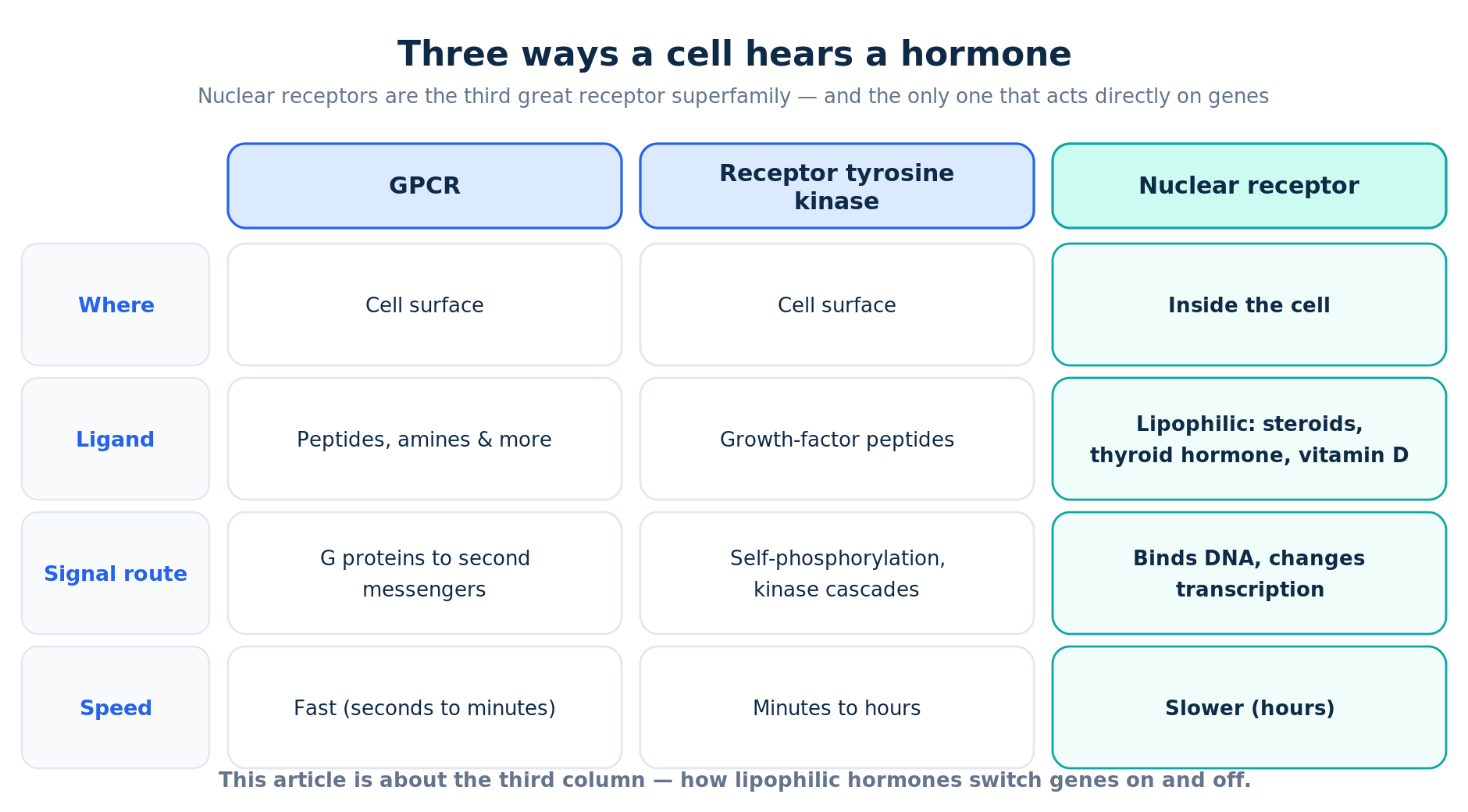
Nuclear hormone receptors are the proteins that let fat-soluble hormones act directly on a cell’s genes. Steroid hormones, thyroid hormone, vitamin D and retinoic acid can slip across the cell membrane, so instead of using a surface receptor they bind a receptor inside the cell that switches genes on or off. This makes nuclear receptors the third great receptor superfamily, alongside G-protein-coupled receptors and receptor tyrosine kinases — and the only one that reaches DNA directly.
The third receptor superfamily
Peptide hormones knock from the outside; lipophilic hormones walk in. Because molecules such as cortisol and thyroid hormone dissolve in fat, they pass through the membrane and bind an internal receptor that behaves as a hormone-controlled switch for transcription. Humans have about 48 of these receptors, grouped into six subfamilies. Not all of them have a known natural hormone — some are “orphan” receptors whose ligands are unknown or absent — but the classic members respond to steroids, thyroid hormone, vitamin D and vitamin-A derivatives.
One shared blueprint
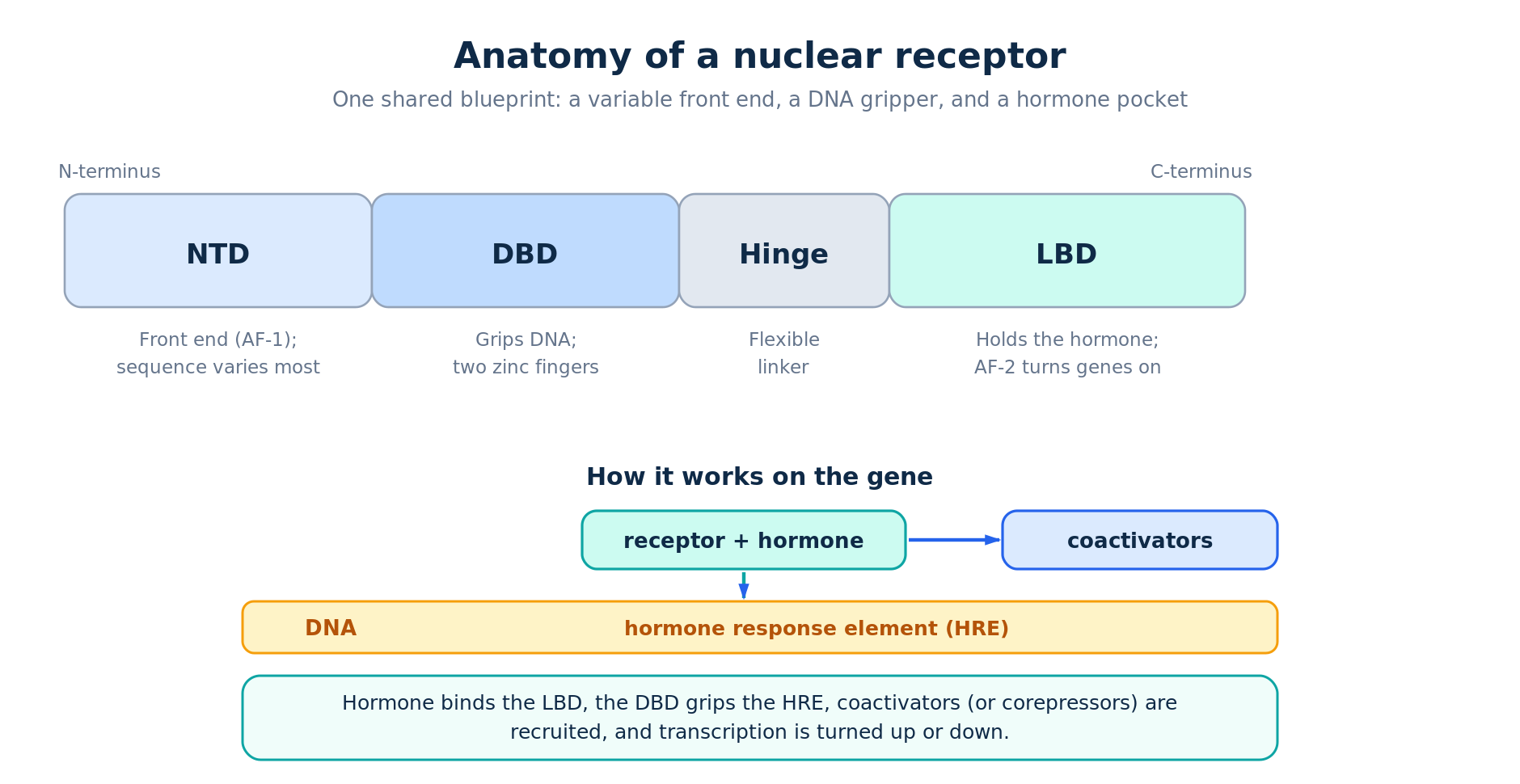
Despite their variety, nuclear receptors are built to a common plan. At the front is a variable region carrying one activation surface (AF-1). Next comes the DNA-binding domain, the most conserved part, which uses two small zinc-containing loops (“zinc fingers”) to grip specific DNA sequences. A flexible hinge links it to the ligand-binding domain at the far end, which holds the hormone and carries a second activation surface (AF-2) that shifts position when the hormone binds.
How they switch genes on and off
The mechanism is elegantly direct. The lipophilic hormone crosses the membrane and binds the receptor’s ligand pocket. The receptor’s DNA-binding domain then latches onto short DNA sequences called hormone response elements near target genes. Binding recruits helper proteins — coactivators to turn transcription up, or corepressors to turn it down — and the gene’s output changes accordingly. Because this works by making new messenger RNA and protein, these “genomic” effects unfold more slowly, over hours, than the second-messenger signalling used by peptide hormones. Importantly, nuclear receptors do not only switch genes on; they also actively repress them.
Two families, two mechanisms
Nuclear receptors split into two broad behaviours. Type I receptors are the classic steroid receptors — for cortisol (the glucocorticoid receptor), aldosterone, oestrogen, progesterone and androgens. These often wait in the cytoplasm bound to chaperone proteins; when the hormone arrives, they shed the chaperones, move into the nucleus, pair up with a copy of themselves, and bind their response elements. Type II receptors — for thyroid hormone, vitamin D and retinoids — behave differently: they usually sit in the nucleus already, on the DNA, partnered with a shared partner called RXR, even before their hormone shows up. Unliganded, they tend to keep the gene quiet; the hormone flips them from repressing to activating.
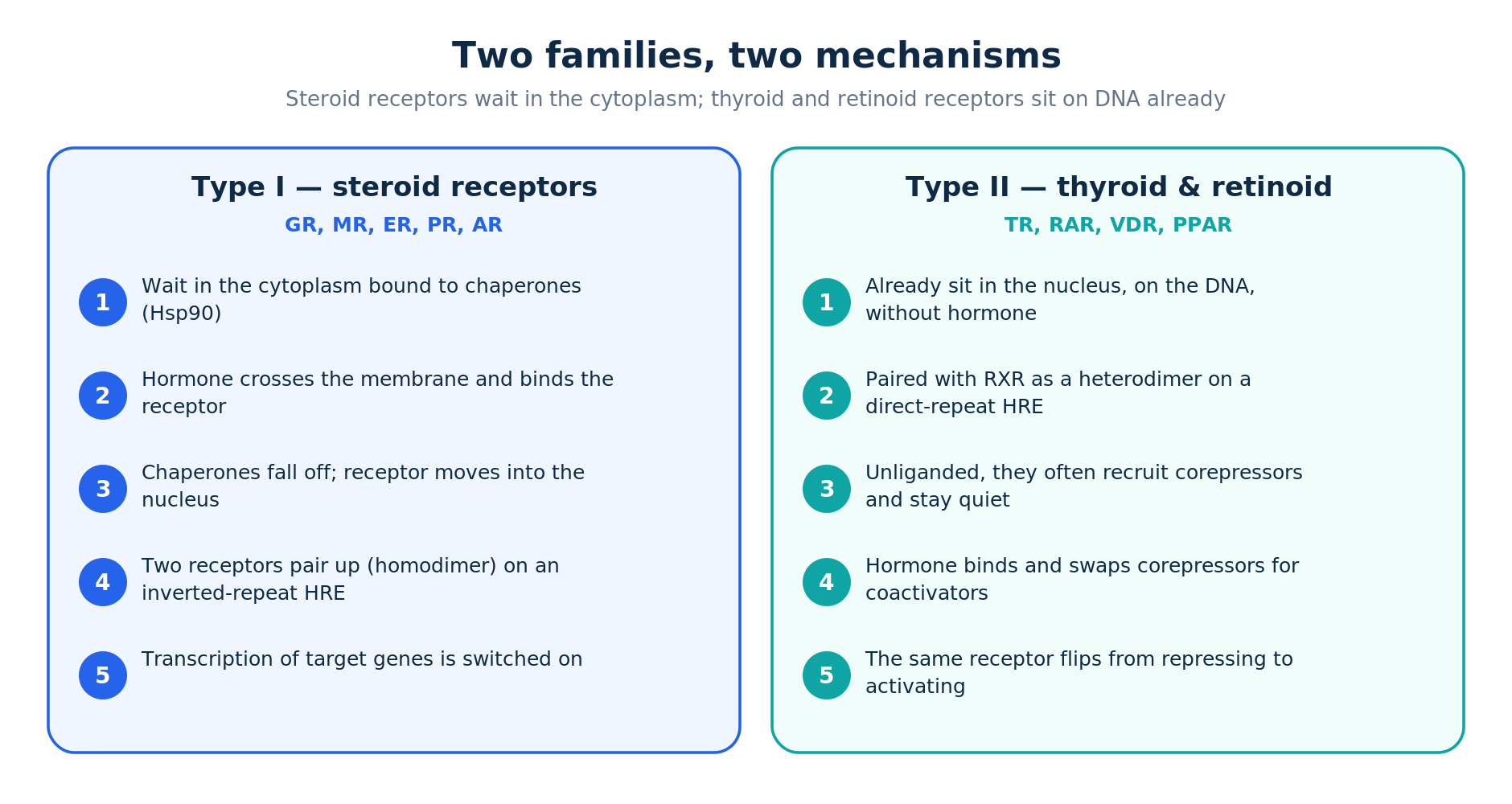
A common myth: it is often said that nuclear receptors all wait in the cytoplasm until a hormone binds. That is true mainly for the type I steroid receptors. Type II receptors are generally already in the nucleus and bound to DNA without their hormone. Some steroids also produce rapid, non-genomic effects that are too fast to involve transcription — an active area of research.
The bridge to the hormone axes
Nuclear receptors are where the body’s hormone axes actually take effect. The signals that release cortisol, thyroid hormone and the sex steroids are peptide-driven — ACTH, TSH, LH and FSH, themselves carved out by prohormone processing and often signalling through second messengers. But the end hormones do their work through nuclear receptors: cortisol through the glucocorticoid receptor, thyroid hormone through the thyroid receptor, and sex steroids through the oestrogen, androgen and progesterone receptors. The peptide axis controls supply; the nuclear receptor delivers the action.
Why steroids make useful drugs
Because these hormones are fat-soluble, they are membrane-permeant and can be taken up broadly, and because they reprogram gene expression their effects are durable. That is exactly why glucocorticoids are such powerful anti-inflammatory medicines — they harness the glucocorticoid receptor’s wide transcriptional reach. The same durability is why steroid effects take longer to appear and longer to fade than the quick on/off of peptide signalling. (This is general biology, not dosing guidance.)
Frequently asked questions
What is a nuclear hormone receptor?
It is a protein inside a cell that binds a fat-soluble hormone and then acts on DNA to turn specific genes up or down. It combines the jobs of receptor and transcription factor in one molecule.
How is this different from how peptide hormones work?
Peptide hormones cannot cross the membrane, so they use surface receptors and second messengers to act quickly and reversibly. Lipophilic hormones cross the membrane, bind nuclear receptors, and change gene activity — a slower, longer-lasting route.
Which hormones use nuclear receptors?
Steroid hormones (cortisol, aldosterone, oestrogen, progesterone, testosterone), thyroid hormone, vitamin D and retinoic acid are the main examples. Each acts on its own receptor.
Do nuclear receptors only turn genes on?
No. They can both activate and repress transcription, and some also produce rapid effects at the membrane that do not involve gene changes at all.
Related reading
Reconstitution calculator · Peptide library · Guides & how-tos
References
1. A unified nomenclature system for the nuclear receptor superfamily. Cell, 1999. pubmed.ncbi.nlm.nih.gov/10219237
2. Pawlak M, et al. Molecular mechanism of nuclear receptor action. PMC3637177. pmc.ncbi.nlm.nih.gov/articles/PMC3637177
3. IUPHAR/BPS Guide to Pharmacology — Nuclear hormone receptors. guidetopharmacology.org (nuclear receptors)
4. Endotext — Glucocorticoid Receptor (NCBI Bookshelf). ncbi.nlm.nih.gov/books/NBK279171
5. Endotext — Cellular Action of Thyroid Hormone (NCBI Bookshelf). ncbi.nlm.nih.gov/books/NBK285568
6. UniProt — NR3C1 / Glucocorticoid receptor (P04150). uniprot.org/uniprotkb/P04150
Informational only — not medical advice. For research and educational purposes; intended for audiences 21+. Always consult a qualified healthcare professional.