
BPC-157 and TB-500 Side Effects: What the Research Actually Shows
Peptide Side Effects Series
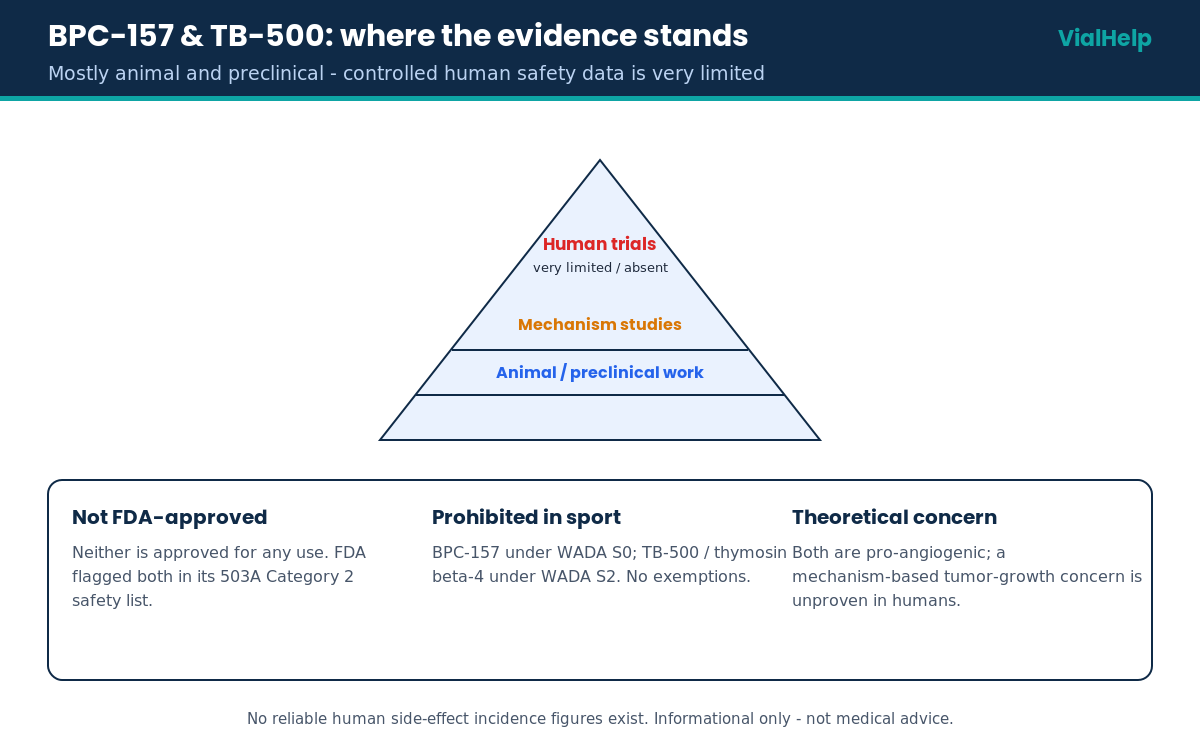
When people ask about BPC-157 and TB-500 side effects, the most honest answer is uncomfortable: there is very little reliable human safety data for either compound. Most of what is known comes from animals, theory, and anecdote — and that gap is itself the story.
BPC-157 and TB-500 are usually grouped together as “healing” or “recovery” peptides. BPC-157 (“Body Protection Compound-157”) is a synthetic 15-amino-acid peptide whose sequence is derived from a protein found in human gastric juice; it is studied in animals for tendon, ligament, muscle, gut, and bone repair, and it is pro-angiogenic (it promotes new blood-vessel growth). TB-500 is a synthetic fragment of Thymosin beta-4 (Tβ4), a naturally occurring protein involved in cell migration, wound healing, and angiogenesis. Both circulate on the gray market for tissue repair — and neither is approved by any regulator for that purpose.
BPC-157: what is and isn’t known about safety
On the reassuring side, preclinical toxicity studies in mice, rats, rabbits, and dogs — covering single-dose, repeated-dose, local tolerance, anaphylaxis, genotoxicity, and teratogenicity — have generally reported BPC-157 to be well tolerated, with no identified minimum toxic or lethal dose and only mild local irritation. The crucial caveat is that these are animal findings; reviews explicitly note that more extensive human-oriented studies of BPC-157’s therapeutic and toxic profile are still required.
The theoretical concerns to understand:
- Angiogenesis and tumor growth (theoretical): BPC-157 promotes new blood-vessel growth, partly via VEGFR2. Because tumors depend on angiogenesis, there is a plausible mechanism-based concern that a pro-angiogenic compound could support an existing or occult tumor. This has not been demonstrated in humans, and animal data show neither clear promotion nor reduction — it is an unresolved theoretical concern, not an established risk.
- Injection-site reactions: mild local irritation was seen in animal local-tolerance testing and is plausible in humans, though unquantified.
- Immunogenicity / impurity risk: the FDA has flagged this directly (below).
- Unknown long-term effects: no long-term human safety data exists.
On regulation, BPC-157 is not FDA-approved for any use. The FDA placed it in its 503A compounding Category 2 (“bulk drug substances that may present significant safety risks”), stating that compounded BPC-157 “may pose risk for immunogenicity for certain routes of administration,” may have peptide-impurity and characterization complexities, and that the agency “lacks sufficient information to know whether the drug would cause harm when administered to humans.” It is also prohibited in sport at all times under WADA’s S0 (Non-Approved Substances) category, with documented athlete sanctions.
TB-500 / Thymosin beta-4: a clinical-vs-gray-market distinction
Legitimate clinical trials have studied full-length Thymosin beta-4 — most notably the ophthalmic product RGN-259 for dry-eye and neurotrophic keratopathy, where a Phase 3 trial reported no significant adverse effects, and earlier work found Tβ4 well tolerated in healthy volunteers (one later European Phase 3 missed its efficacy endpoint). The key caveat: that human safety experience is largely for topical/ophthalmic and IV full-length Tβ4 in controlled trials — not for the injectable gray-market “TB-500” fragment, which is not always identical to clinical-grade Tβ4. Safety records do not automatically transfer.
Theoretical and anecdotal concerns mirror BPC-157: the same angiogenesis/tumor-growth theoretical concern (unproven in humans), plausible injection-site reactions, and immunogenicity/impurity risk that the FDA has flagged for the fragment specifically (it sits alongside BPC-157 in the Category 2 framework). Reports of “lethargy,” “head-rush,” or flushing circulate in user forums but are anecdotal and not documented in controlled studies. Tβ4 and its derivatives, including TB-500, are prohibited in sport under WADA’s S2 (Peptide Hormones, Growth Factors) category.
The most concrete real-world risk: supply quality
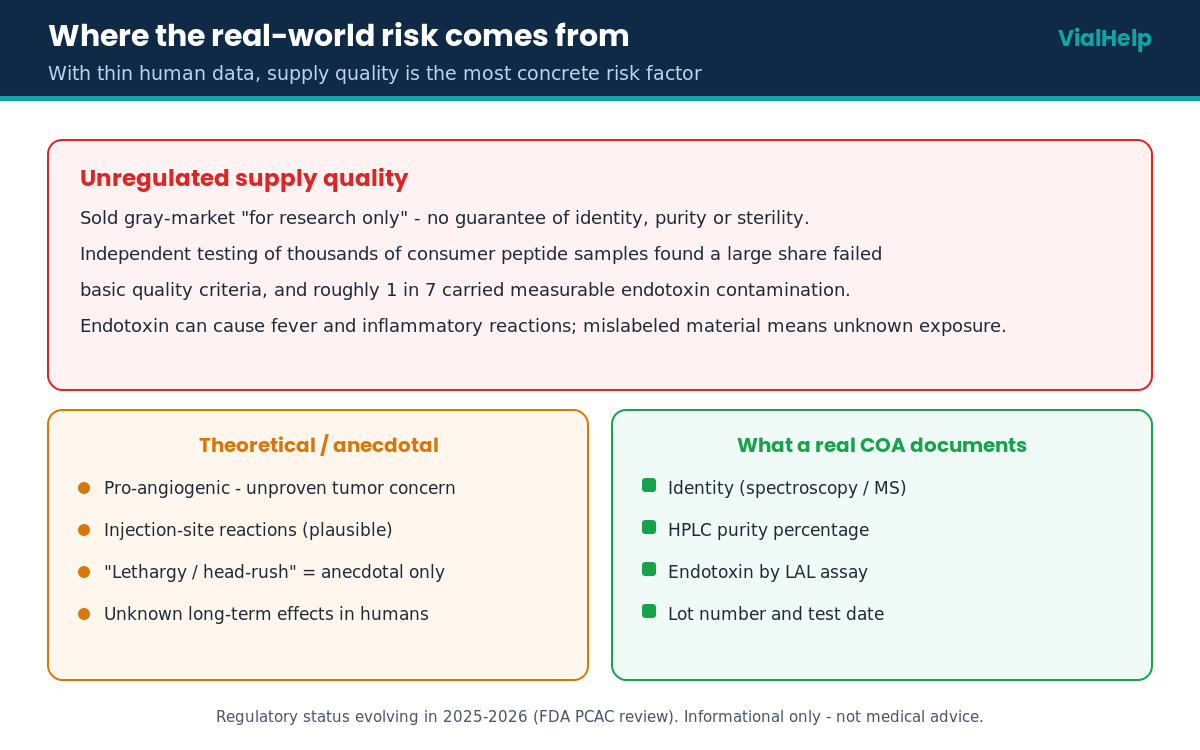
With human pharmacology so thin, the largest documented practical risk for both compounds is not their intrinsic biology — it is the quality of unregulated “research chemical” material. Because these are sold “for research use only,” there is no regulatory guarantee of identity, purity, or sterility. An independent analysis that tested thousands of consumer peptide samples across more than a dozen compounds — including BPC-157, TB-500, and thymosin beta-4 — found that a large share failed basic quality criteria, and roughly one in seven carried measurable endotoxin contamination. Endotoxin can cause fever and inflammatory reactions, and mislabeled or under-dosed material introduces unpredictable exposure. This is exactly why a meaningful Certificate of Analysis — documenting identity, HPLC purity, and endotoxin by LAL assay — matters.
Frequently asked questions
Are BPC-157 and TB-500 proven safe in humans?
No. Neither is FDA-approved, and controlled human safety data is very limited — for the injectable forms it is essentially absent. Animal studies suggest BPC-157 has low acute toxicity, but the FDA states it lacks sufficient information to know whether either would cause harm in humans.
Can these peptides cause cancer?
There is no human evidence that they cause cancer. There is a theoretical, mechanism-based concern because both promote angiogenesis and tumors rely on new blood vessels — but this has not been demonstrated in people, and animal data are not conclusive either way.
Are the side effects people report online reliable?
Generally no. Reports like lethargy, “head-rush,” or injection-site reactions are anecdotal and not established in controlled trials, and there are no reliable incidence figures. Some reactions, such as fever or inflammation, may actually stem from contamination or endotoxin in unregulated product rather than the peptide itself.
Are they legal or allowed in sport?
Both are prohibited in sport at all times — BPC-157 under WADA S0 and Tβ4/TB-500 under WADA S2 — with no Therapeutic Use Exemption and real athlete sanctions. Neither is FDA-approved; they circulate as unapproved research chemicals.
References
- FDA — Certain Bulk Drug Substances for Use in Compounding That May Present Significant Safety Risks (Category 2). fda.gov
- FDA — Bulk Drug Substances Used in Compounding Under Section 503A. fda.gov
- USADA — BPC-157: Experimental Peptide Creates Risk for Athletes (WADA S0). usada.org
- “Regeneration or Risk? A Narrative Review of BPC-157 for Musculoskeletal Healing.” PMC12446177
- Sosne et al. — 0.1% RGN-259 (Thymosin β4) Ophthalmic Solution, Phase 3 trial. PMC9820614
- Hsieh et al. — Pro-angiogenic BPC-157 and VEGFR2 activation. J Mol Med (2017)
Informational only — not medical advice; consult a qualified healthcare professional. No selling or recommendation of any product. Intended for an audience 21+.