
Endotoxins and the LAL Test: What “Endotoxin” on a COA Means
Quality & the COA
Endotoxin is one of the most important — and most misunderstood — lines on a peptide certificate of analysis (COA). It is a marker of how cleanly a peptide was made, and “sterile” does not mean “endotoxin-free.” This guide explains what an endotoxin is, how the LAL test measures it, what “EU/mg” actually means, and how to read the number alongside purity and identity.
What is an endotoxin?
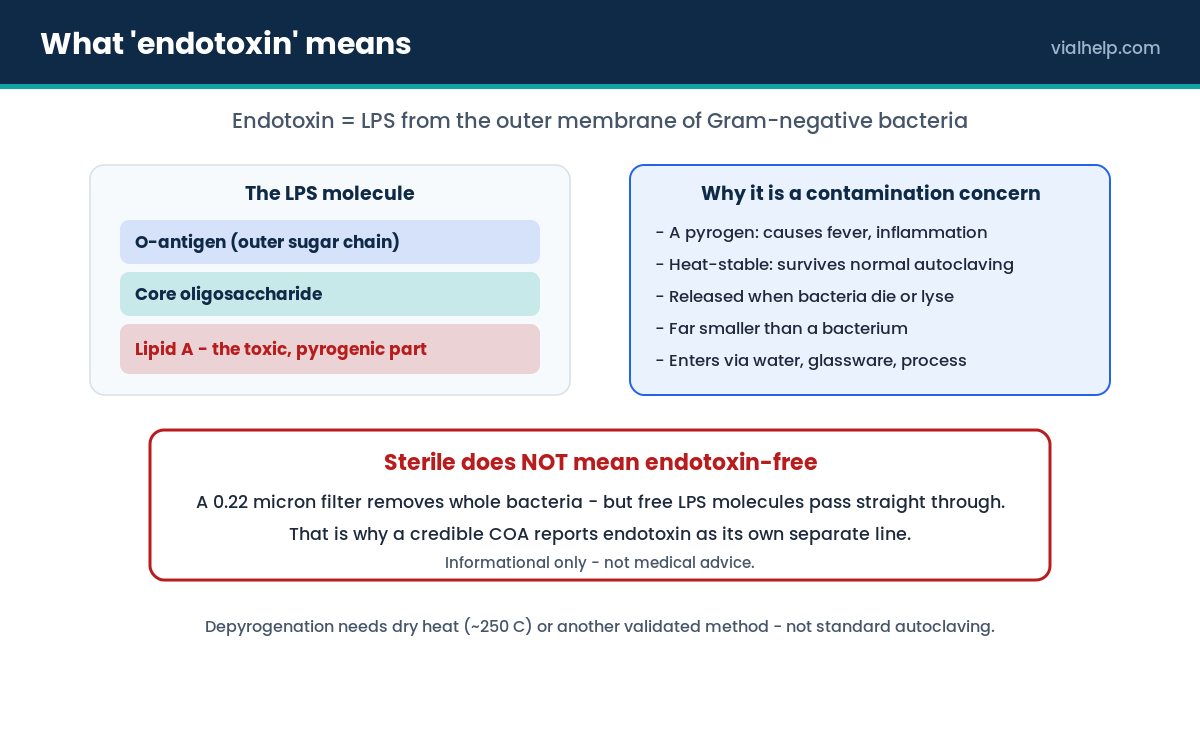
An endotoxin is lipopolysaccharide (LPS), a structural component of the outer membrane of Gram-negative bacteria (such as E. coli and Pseudomonas). Unlike a classic secreted toxin, it is released when bacterial cells die, lyse or divide. LPS has three regions — the O-antigen (outer sugar chain), the core oligosaccharide, and lipid A, which is the toxic, biologically active part.
Endotoxin is a pyrogen (it can cause fever) and, at higher exposures, inflammation and worse. Two properties make it a stubborn contaminant: it is heat-stable — ordinary autoclaving kills bacteria but does not reliably destroy endotoxin (depyrogenation needs dry heat near 250 °C or another validated method) — and it is tiny. A 0.22 micron sterilizing filter removes whole bacteria, but free LPS molecules pass straight through. That is why a product can be sterile yet still carry endotoxin, and why a credible COA reports it as its own separate line.
How endotoxin is measured: the LAL test
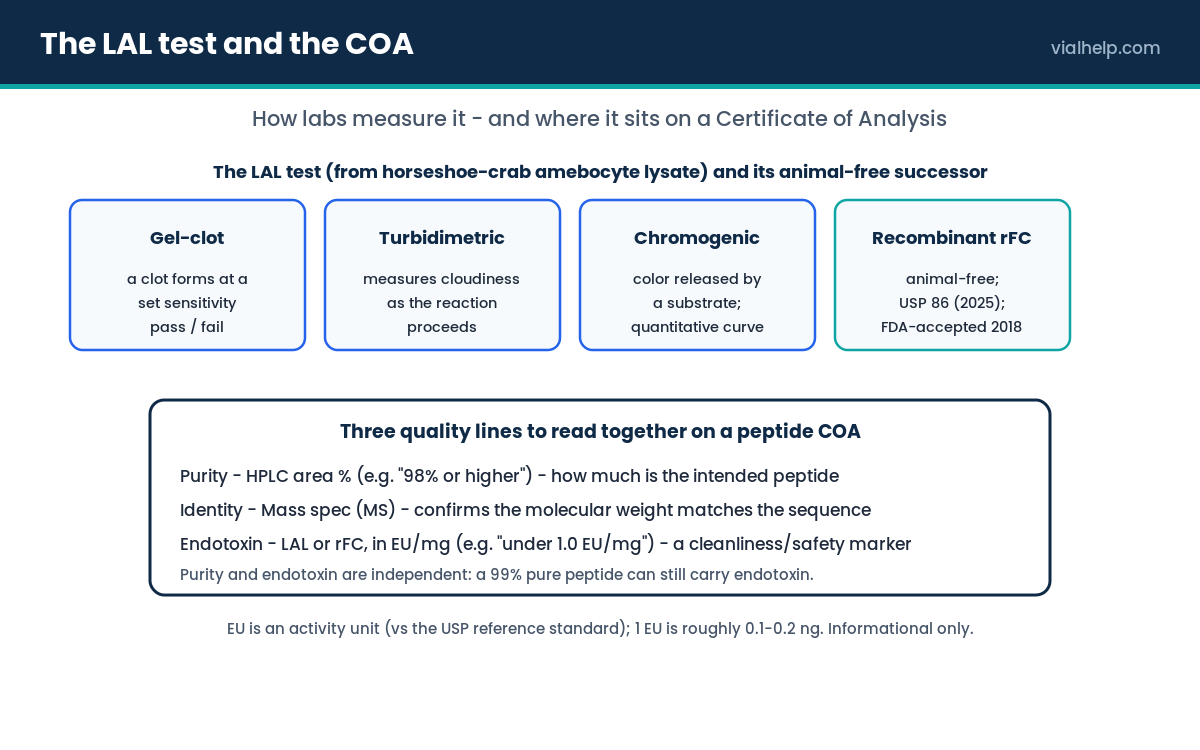
The standard method is the LAL test (Limulus Amebocyte Lysate), an extract from the blood of the horseshoe crab (Limulus polyphemus). The crab’s amebocytes contain a clotting cascade that is exquisitely sensitive to endotoxin: LPS activates Factor C, which sets off a chain of enzymes that ultimately forms a gel. Compendial chapter USP <85> covers three formats:
- Gel-clot — a clot does or does not form at a set sensitivity; essentially pass/fail.
- Turbidimetric — measures increasing cloudiness as the reaction proceeds.
- Chromogenic (kinetic) — a synthetic substrate releases color in proportion to endotoxin; quantitative, the most widely used format.
There is also an animal-free successor: recombinant Factor C (rFC), which uses only the first enzyme of the cascade made recombinantly and reads out by fluorescence — no horseshoe-crab blood required. The accurate compendial status: USP gave recombinant reagents their own chapter, USP <86> (official May 2025), rather than adding them to <85>, and the FDA accepted the first rFC-based drug test back in 2018.
Units: what “EU/mg” means on a COA
Endotoxin is reported in Endotoxin Units (EU) — a measure of biological activity, not mass. The EU is defined against the USP/FDA Reference Standard Endotoxin (RSE); lab working standards are calibrated to it. On a COA you will see endotoxin as a concentration or content: EU/mg for a powder, EU/mL for a solution. A typical line reads something like “Endotoxin: under 1.0 EU/mg (LAL).”
Endotoxin limits and why the number matters
For regulated parenteral products, the limit is derived from a threshold pyrogenic dose, K, and the maximum dose per kilogram per hour, M:
- Endotoxin Limit = K / M
- K = 5.0 EU/kg/hr for most parenteral routes; K = 0.2 EU/kg for intrathecal routes, which are far more sensitive.
Conceptually, the cleaner a product needs to be depends on how much of it could be administered: total endotoxin delivered = (EU/mg) × (mg given). A high-dose product must show a lower EU/mg than a low-dose one. For research buyers, a low endotoxin figure signals clean manufacturing (good water, depyrogenated glassware, controlled process); high endotoxin signals poor process control and, in cell or animal work, can confound results because LPS is itself a potent immune stimulant.
Why endotoxin shows up in peptides
Endotoxin generally does not come from the peptide chemistry itself but from the process environment: non-pyrogen-free water, glassware and containers, raw materials, and — for peptides expressed recombinantly in E. coli — carryover from the production organism. Because it can survive sterile filtration, a reputable peptide COA reports it explicitly.
Reading endotoxin alongside purity and identity
Endotoxin is one of three core quality lines on a peptide COA, and they answer different questions:
- Purity — HPLC (area %, e.g. “98% or higher”): how much of the sample is the intended peptide versus related impurities.
- Identity — mass spectrometry (MS): confirms the measured molecular weight matches the intended sequence.
- Endotoxin — LAL or rFC (EU/mg): a cleanliness and safety marker, independent of the other two.
Frequently asked questions
Does “sterile” mean endotoxin-free?
No. Sterilizing filtration removes living bacteria, but free endotoxin molecules are far smaller and pass through. Sterility and endotoxin are separate measurements.
Is a lower EU/mg always better?
Lower endotoxin reflects cleaner processing, which is generally desirable. What counts as acceptable depends on the intended use; the regulated framework scales the limit to the dose (the K/M formula).
What does the LAL test use?
Classic LAL uses an extract of horseshoe-crab blood. A modern, animal-free alternative, recombinant Factor C (rFC), is recognized under USP <86>.
References
- FDA, “Guidance for Industry: Pyrogen and Endotoxins Testing: Questions and Answers.” fda.gov
- USP, statement on Recombinant Factor C and bacterial endotoxin testing. usp.org
- Ding JL & Ho B, “Endotoxin detection — from Limulus Amebocyte Lysate to recombinant Factor C” (review). PubMed 20593268
- Thorne et al., comparison of LAL and rFC assays (open access). PMC2916455
- FDA Inspection Technical Guide, “Bacterial Endotoxins/Pyrogens.” fda.gov
Informational only — not medical advice · 21+. The limits described here are pharmaceutical quality-control concepts, not dosing guidance.