
Nootropic Peptide Side Effects: Semax, Selank & Dihexa
Nootropic peptide side effects are a common question, and the honest answer is that the human safety data are thin and uneven. This entry in our side-effects series looks at three “cognitive” research peptides — Semax, Selank and Dihexa — and what the literature does and does not tell us about their tolerability. The pattern is instructive: two have small human studies suggesting they are generally well tolerated, and one has no human data at all.
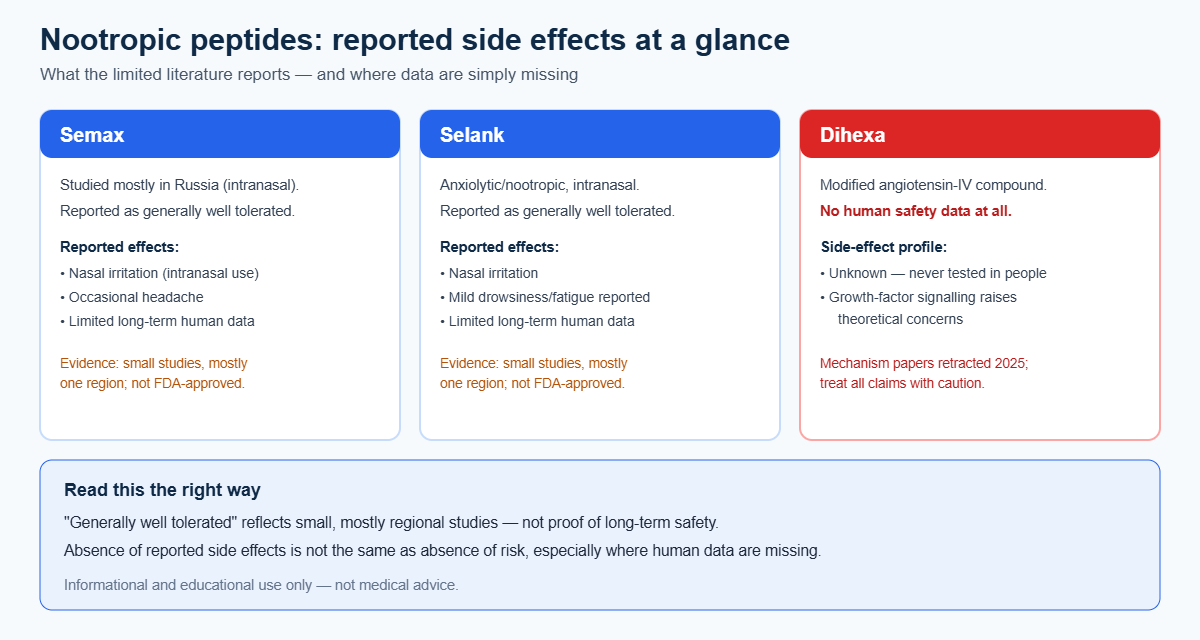
Semax: reported side effects
Semax is a short peptide studied mostly in Russia, typically given intranasally, where it has been described as generally well tolerated in small clinical studies. The most commonly reported issues are local and mild:
- Nasal or throat irritation from intranasal administration.
- Occasional headache.
- Little published long-term or high-dose human safety data.
Semax is not FDA-approved, and its safety record comes from a relatively small, regionally concentrated body of research. See the Semax compound page for background.
Selank: reported side effects
Selank, an anxiolytic and nootropic peptide also usually delivered intranasally, has a similar profile in the limited literature — generally well tolerated, with mostly mild reports:
- Nasal irritation from intranasal use.
- Mild drowsiness or fatigue in some reports.
- As with Semax, limited long-term human data.
Again, “well tolerated” here reflects small studies rather than large, long-term trials. Details are on the Selank compound page.
Dihexa: an honest blank
Dihexa is a different situation entirely. It is a modified angiotensin-IV compound with no human safety data whatsoever — it has never been tested in a human clinical trial. Its side-effect profile is therefore unknown. Two additional cautions apply: because it is designed to influence growth-factor (HGF) signalling, its interaction with abnormal cell growth is a theoretical concern that has not been studied in people; and the foundational papers describing its mechanism were retracted in 2025, so even the basic claims about how it works are uncertain. See the Dihexa compound page for the full picture.
Why the side-effect picture is incomplete
Across all three compounds, the same limitations recur, and they matter for how you interpret “generally well tolerated”:
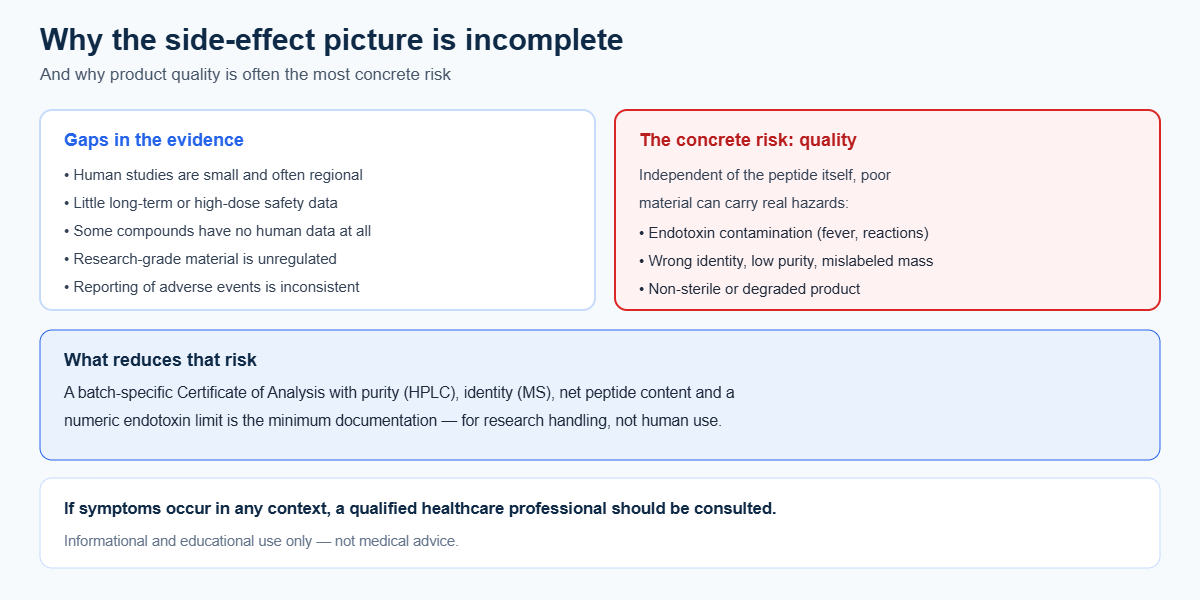
- Human studies are small and often regional, with inconsistent adverse-event reporting.
- There is little long-term or high-dose safety data, and in Dihexa’s case none at all.
- Research-grade material is unregulated, so what is in a given vial is not guaranteed.
- Absence of reported side effects is not the same as absence of risk — it often just reflects how little has been measured.
The most concrete risk is often product quality
Independent of any compound’s own pharmacology, poor-quality material carries real hazards: endotoxin contamination that can cause fevers and reactions, wrong identity, low purity, or non-sterile product. This is frequently the most tangible risk with research peptides. The practical safeguard is documentation — a batch-specific Certificate of Analysis showing purity (HPLC), identity (MS), net peptide content and a numeric endotoxin limit. See our guides on how to read a COA and endotoxins and the LAL test.
Frequently asked questions
Are Semax and Selank safe?
They are described as generally well tolerated in small studies, but that is not the same as proven long-term safety. They are not FDA-approved, and this article is informational only, not medical advice.
Does Dihexa have known side effects?
No side effects are documented in humans because Dihexa has never been tested in a human trial. Unknown is not the same as safe.
Why do nootropic peptides list so few side effects?
Largely because so little has been studied. Small trials with limited follow-up will report few adverse events; that reflects the size of the evidence base, not a guarantee of safety.
What should I check to reduce risk?
For research handling, the minimum is a batch-specific COA with purity, identity, net peptide content and a numeric endotoxin limit. Symptoms in any context warrant a qualified healthcare professional.
Related reading
- Semax · Selank · Dihexa compound pages.
- How to read a COA · Endotoxins and the LAL test.
- Reconstitution calculator · Peptide reference library.