
FDA 503A Categories 1, 2, and 3 Explained (and Why Peptides Are Category 2)
Regulation explainer
If you follow research peptides, you have probably run into the phrase FDA 503A categories — usually attached to a warning that some compound is “Category 2.” This guide explains what those categories actually are, why so many peptides ended up in Category 2, and what a surprising round of 2026 changes means for the months ahead. It is informational, not legal or medical advice.
First, what is a 503A compounding pharmacy?
Section 503A of the Federal Food, Drug, and Cosmetic Act is the part of federal law that lets a traditional pharmacy compound — custom-prepare — a medication for an individual patient without meeting three requirements that normally apply to drug manufacturers: FDA premarket approval, standard “adequate directions for use” labeling, and current good manufacturing practice (cGMP). Those exemptions only apply when all of 503A’s conditions are met.
One condition matters most here: a 503A drug can be compounded only from a bulk drug substance that (1) has an applicable USP or NF monograph, (2) is a component of an FDA-approved drug, or (3) appears on FDA’s 503A bulks list. A separate, more industrial pathway — 503B outsourcing facilities — registers with FDA, follows cGMP, can compound without a patient-specific prescription, and works from its own list.
The three 503A categories, defined
Building the bulks list requires formal rulemaking, which is slow. So FDA created an interim policy to handle the many substances nominated while the list was still being written, sorting those nominations into three buckets.
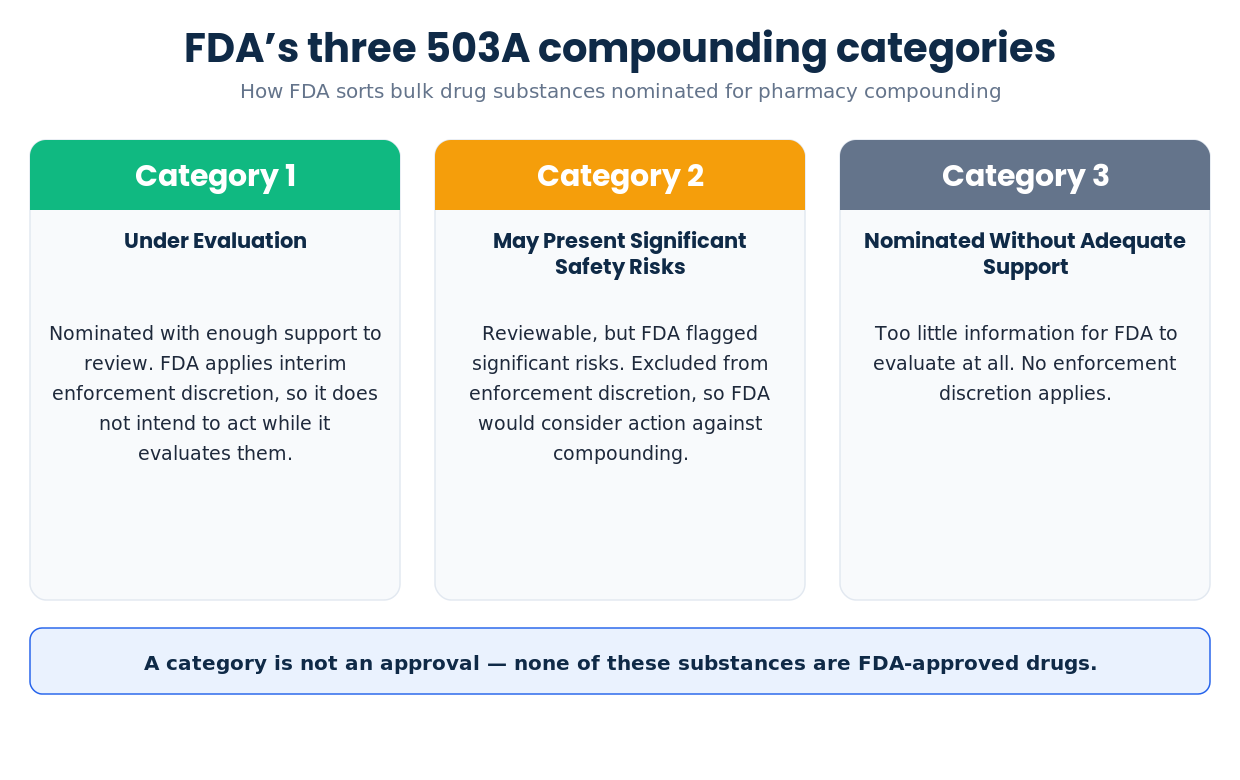
- Category 1 — Under Evaluation: nominated with enough information to review and potentially eligible for the list. FDA generally applies interim enforcement discretion, meaning it does not intend to act against a pharmacy compounding with them while the review continues.
- Category 2 — May Present Significant Safety Risks: enough information to evaluate, but FDA identified significant concerns. These are excluded from the enforcement-discretion policy, so FDA has said it would consider action against compounders using them.
- Category 3 — Nominated Without Adequate Support: the nomination did not include enough information for FDA to evaluate at all. No enforcement discretion.
An important update: in a final interim guidance effective January 7, 2025, FDA said it would no longer place newly nominated substances into Categories 2 or 3 — so the three-bucket framework now mostly governs the older, pre-2025 nominations.
Why so many peptides landed in Category 2
Read FDA’s reasoning and a pattern emerges: the agency’s stated concerns cluster around peptide-class manufacturing and characterization issues plus missing human data — not documented reports of harm.
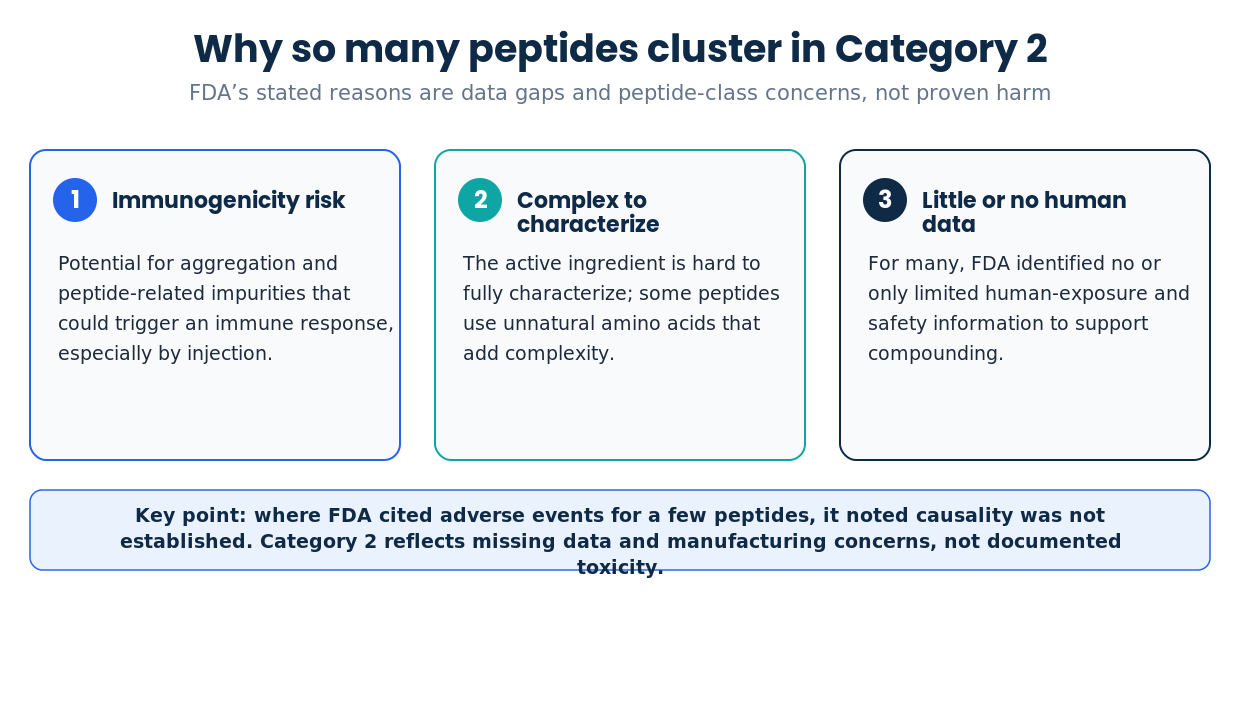
The recurring themes are: a risk of immunogenicity for certain routes of administration because of the potential for aggregation and peptide-related impurities; complexities in fully characterizing the active ingredient, sometimes compounded by unnatural amino acids; and little or no human exposure or safety data. Peptides placed in Category 2 include names familiar in research circles — BPC-157, TB-500 (a thymosin beta-4 fragment), MOTS-C, KPV, ipamorelin, CJC-1295, GHRP-2 and GHRP-6, among others. For a few, FDA also referenced serious adverse events reported in specific studies, but it explicitly noted that causality was not established.
What changed in 2026 — and what happens next
2026 brought real movement.
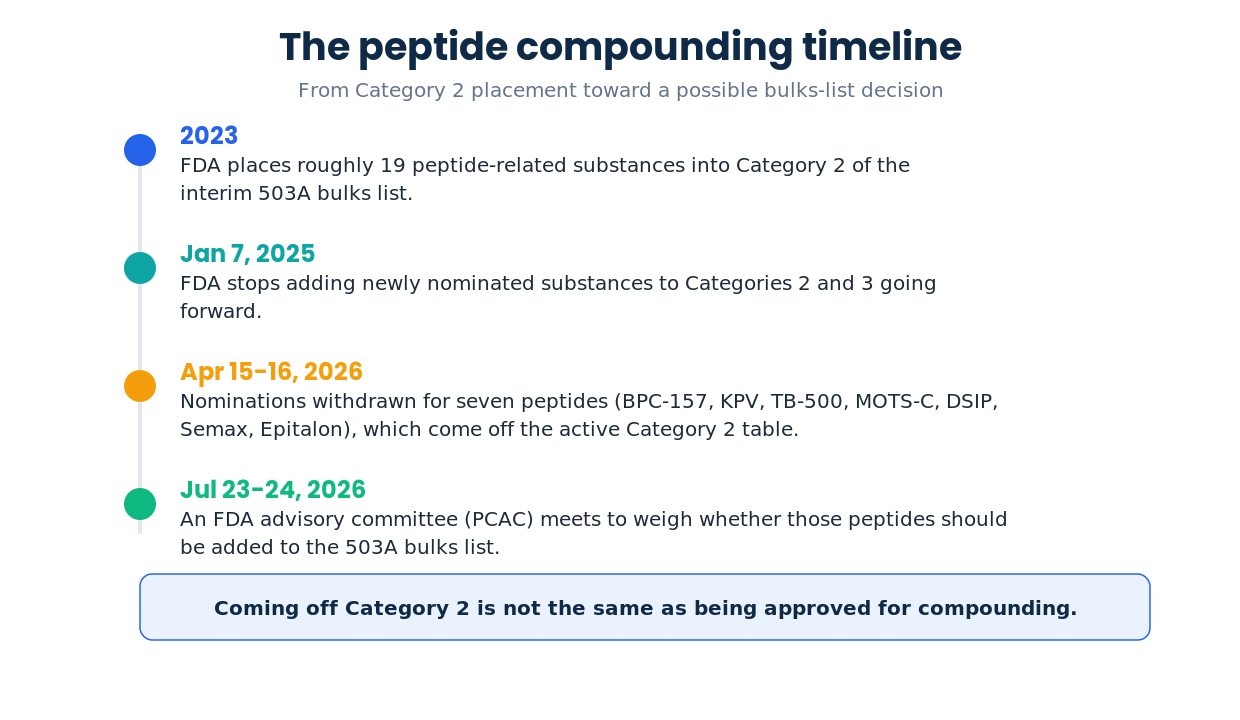
On April 15, 2026, FDA announced that a set of these peptides would come off Category 2 because the underlying nominations had been withdrawn by the parties that submitted them. The next day, FDA published a Federal Register notice scheduling a meeting of its Pharmacy Compounding Advisory Committee (PCAC) for July 23–24, 2026 to consider whether seven peptides — BPC-157, KPV, TB-500, MOTS-C, emideltide (DSIP), semax and epitalon — should be added to the 503A bulks list, with five more slated for a later meeting.
Here is the subtle part: coming off Category 2 is not a green light. Those peptides were not moved to Category 1, were not added to the bulks list, and FDA did not say it would exercise enforcement discretion. They sit in a grey area pending the advisory committee and any eventual rulemaking.
What a Category 2 placement does — and doesn’t — mean
A category is a regulatory status, not a verdict on a molecule. It is tempting to read “Category 2” as “banned,” but the accurate reading is narrower: the substance is excluded from FDA’s interim enforcement-discretion policy, so FDA states it would consider enforcement action against a pharmacy that compounds with it. The reverse matters just as much — removal from Category 2 does not, by itself, authorize compounding.
Frequently asked questions
Is a Category 2 peptide illegal to possess?
That is a different legal question from FDA’s compounding categories, and it varies by substance and jurisdiction. The category itself is about whether pharmacies may compound with the bulk substance — not about personal possession. This page is informational, not legal advice.
Does Category 2 mean the peptide is dangerous?
Not necessarily. FDA’s Category 2 reasoning for peptides is dominated by immunogenicity and characterization concerns plus missing human data. Where adverse events were cited, FDA noted causality was not established.
What is the difference between 503A and 503B?
503A covers traditional, typically patient-specific pharmacy compounding with exemptions from certain manufacturer requirements. 503B outsourcing facilities are registered, cGMP-compliant, can compound without patient-specific prescriptions, and use a separate bulks list.
If the July 2026 committee recommends adding a peptide, is it then approved?
No. A PCAC recommendation feeds FDA’s rulemaking for the bulks list; it is not the same as FDA approval of a drug, and the process can take time.
References
- FDA — Certain Bulk Drug Substances for Use in Compounding That May Present Significant Safety Risks (the Category 2 list).
- FDA — Interim Policy on Compounding Using Bulk Drug Substances Under Section 503A of the FD&C Act (guidance).
- Federal Register — Interim Policy on Compounding Using Bulk Drug Substances… (Jan. 7, 2025).
- FDA — Bulk Drug Substances Used in Compounding Under Section 503A of the FD&C Act.
- FDA — 503A Bulk Drug Substances Categories Update.
- Polsinelli / National Law Review — Tiny Chains, Big Changes? What FDA’s Latest Actions Mean for Peptide Compounding.
Informational only — not medical or legal advice · 21+. VialHelp is an educational resource and is not affiliated with the FDA. Regulatory status can change; verify against primary FDA sources before relying on it.